
India Cave Heritage Tour | Ajanta, Ellora, Elephanta & More | Prime Value Tours
Explore India’s greatest cave monuments-Ajanta, Ellora (UNESCO), Elephanta, Kanheri, Karla, Bagh, Sanchi & more. 9-day cave heritage tour from Bangkok. Expert guide, 4-star hotels. Book with Prime Value Tours.
India’s Caves: Where Stone Becomes Sacred
There is a moment that every visitor to India’s great cave monuments experiences and it is impossible to prepare for.
You walk through a narrow entrance cut into solid rock. The air changes immediately: cooler, quieter, older. Your eyes adjust to the dimness. And then, slowly, the walls begin to speak.
Faces emerge from the stone gods, bodhisattvas, dancers, kings, monks, elephants. Painted ceilings reveal scenes of court life and forest and miracle, executed in colours that have survived fifteen centuries of rain and heat. Pillars carved from the living mountain stand in perfect rows before halls that were already ancient when the first Crusaders set out from Europe.
This is what waits for you in the cave monuments of India.
For Thai travellers who have walked the Buddhist pilgrimage circuit -Bodh Gaya, Sarnath, Kushinagar the cave heritage tour of India offers a profoundly different experience. These are not sites of scripture and stupa alone. They are sites of extraordinary human achievement: the work of thousands of nameless artists, monks, and kings who carved their faith directly into the mountains of Maharashtra and Madhya Pradesh, leaving behind a legacy that has no equal anywhere in the world.
At Prime Value Tours, we have been bringing Thai groups to these sites since 1999. This guide is written from 25 years of experience walking these caves, explaining these paintings, and watching our guests fall silent before the Trimurti at Elephanta, or the painted Bodhisattva Padmapani at Ajanta that particular silence that means something has touched a person at a depth beyond words.
The Eight Cave Sites on Our Tour
Our India Cave Heritage Tour covers eight significant cave monuments across Maharashtra and Madhya Pradesh, including three UNESCO World Heritage Sites. Here is what each one offers:
1. Elephanta Caves -The Island of Lord Shiva
Location: Elephanta Island, Mumbai Harbour | Period: 5th–8th century CE | Faith: Hindu | UNESCO: Yes
You reach Elephanta by ferry from the Gateway of India ,a one-hour crossing of Mumbai Harbour. The moment you disembark and climb the stone steps through a corridor of vendors selling sandalwood and marigolds, you begin to sense that this island operates on a different kind of time.
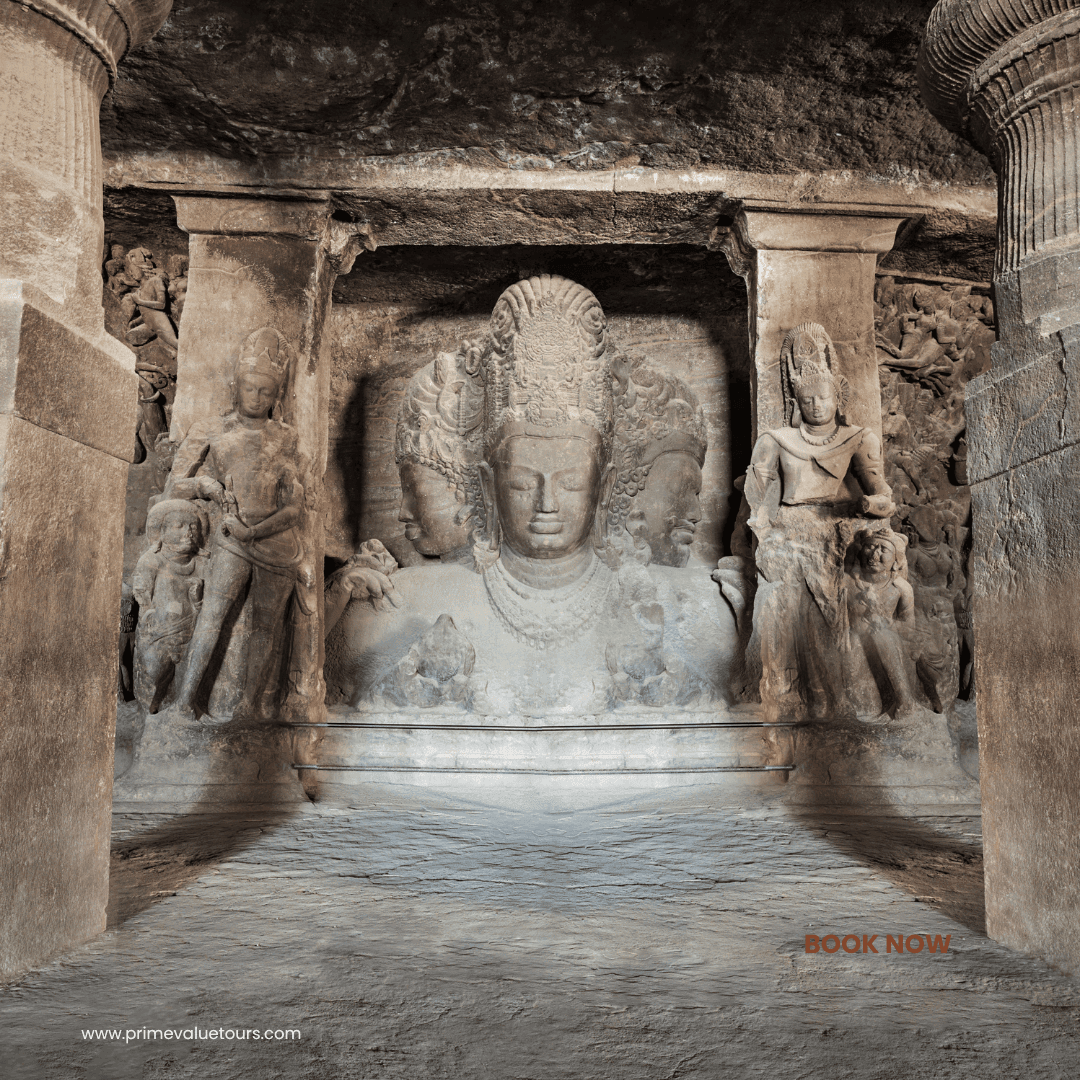
The main cave at Elephanta is a masterwork of Shaivite architecture and sculpture. At its heart stands the Trimurti a triple-headed bust of Lord Shiva, nearly six metres tall, carved from a single face of rock. The three faces represent Shiva as creator, preserver and destroyer. It is, by almost universal agreement, one of the finest sculptures produced in the ancient world.
For Thai visitors familiar with Hindu iconography through Southeast Asian temple traditions, the Elephanta sculptures offer a fascinating and moving encounter with these deities in their original Indian form powerful, serene and deeply instructive.
What to look for: The Trimurti (Sadashiva), Shiva-Parvati in Kalyanasundara panel, the Nataraja (Shiva as Cosmic Dancer), and the marriage of Shiva and Parvati relief.
Prime Value Tours note: We always visit Elephanta first, in the cool of the morning. The ferry ride across the harbour at sunrise, with Mumbai’s skyline fading behind and the island growing closer, is one of those travel moments that stays with a person for the rest of their life.
2. Kanheri Caves -The Buddhist Monastery Inside a Forest
Location: Sanjay Gandhi National Park, Borivali, Mumbai | Period: 1st century BCE – 9th century CE | Faith: Buddhist
Few visitors outside India know that one of the most extensive Buddhist cave complexes in the world sits inside a national park just forty minutes’ drive from central Mumbai.
Kanheri is a system of 109 caves carved from a single massive basalt outcrop in the Sahyadri hills. For nearly a thousand years from the 1st century BCE through to the 9th century CE this was a working Buddhist monastic university, continuously inhabited by monks, scholars, and artists.
The caves range from simple meditation cells cut into the rock face to large chaitya (prayer) halls with vaulted ceilings, carved pillars, and stupa shrines. Water channels, cisterns, and communal halls reveal how sophisticated the monastic community’s engineering was. Inscriptions in the Brahmi script, some of the oldest surviving written records in western India, record donations made by merchants, royalty, and Buddhist lay practitioners.
For Thai Buddhist visitors, walking through Kanheri is a deeply tangible experience of the early Sangha the community of monks and nuns that preserved the Dharma across centuries of history. You can sit in the same stone cells where bhikkhus (monks) sat in meditation two thousand years ago. That continuity of practice is something that touches Thai pilgrims in a particular way.
What to look for: Cave 3 (the large chaitya hall with impressive Buddha reliefs), the water management system, and the Brahmi inscriptions near the entrance.
3. Bhaja Caves -Where Buddhist Rock-Cutting Began
Location: Near Lonavala, Maharashtra | Period: 2nd century BCE | Faith: Buddhist
Bhaja is one of the oldest Buddhist rock-cut monuments in India, dating to approximately 200 BCE — contemporary with the reign of Emperor Ashoka’s successors. Carved into a basalt cliff overlooking a deep wooded valley near Lonavala, the caves feel exactly as ancient as they are: stark, powerful, and without any of the elaborate decorative carving that would come later.
The main chaitya hall at Bhaja is a long, narrow chamber with a simple ribbed wooden roof and a stupa at the far end. What makes Bhaja exceptional are the relief carvings in the adjacent vihara (monks’ hall), which include some of the earliest known representations of dancers and musicians in Indian religious art, and a famously joyful scene known simply as the “dancing couple” two figures in a moment of exuberant movement that has been delighting visitors for over two millennia.
For Thai Buddhist visitors, Bhaja’s great value is historical context. Seeing Bhaja first and Ajanta last, you witness the entire evolution of Buddhist cave art from austere 2nd century BCE chambers to the painted masterpieces of the 5th century CE — as a continuous, living artistic tradition.
4. Karla Caves -The Grandest Chaitya Hall in India
Location: Near Lonavala, Maharashtra | Period: 2nd–1st century BCE | Faith: Buddhist
Eight kilometres from Bhaja, up a hillside path past a large and lively modern Hindu temple, stands the single most impressive chaitya hall in India.
The Great Chaitya Cave at Karla was carved over an extended period beginning in the 2nd century BCE. Walking inside is an experience for which no photograph can prepare you. The hall stretches 38 metres deep into the rock. Its ceiling soars eight metres above your head, ribbed with dark wooden beams the original wood, installed more than two thousand years ago, still in place. Two rows of carved stone columns line the nave, topped with figures of kneeling elephants. At the far end, the great stupa rises in the dimness.
The decorative carving at Karla is extraordinarily refined particularly the large mithuna (loving couple) sculptures on the outer facade, among the most beautiful examples of ancient Indian figural carving anywhere. An ancient inscription records donations made by merchants of Dhenukakata, a wealthy trading community whose generosity made this monument possible.
Prime Value Tours note: We visit Bhaja and Karla in the same morning two hours at Bhaja, two hours at Karla before driving south to Aurangabad. The contrast between Bhaja’s austere simplicity and Karla’s elaborate grandeur, just eight kilometres apart, is one of the most instructive experiences in Indian art history.
5. Ellora Caves -Three Faiths, One Mountain
Location: 30 km from Aurangabad, Maharashtra | Period: 5th–11th century CE | Faith: Buddhist, Hindu, Jain | UNESCO: Yes
If the other cave sites on this tour are great individual monuments, Ellora is something different entirely -it is a civilisation.
Stretching for nearly two kilometres along a basalt escarpment, Ellora’s 34 caves were created by three different religious communities. Buddhist, Hindu, and Jain working at the same site across five centuries. The Buddhist caves (1st to 7th century CE) came first, followed by the great Hindu excavations of the Rashtrakuta period, followed by the Jain caves of the 9th and 10th centuries. That three faiths chose to create their most ambitious monuments side by side on the same hillside tells us something remarkable about the India of that era.
The centrepiece and one of the most astonishing human achievements anywhere in the world is Cave 16, the Kailasa Temple.
The Kailasa was not built. It was sculpted. Entire from a single mass of mountain rock, carved from the top downward, the Kailasa Temple replicates in stone the entire compound of Lord Shiva’s celestial mountain abode. Workers removed an estimated 200,000 tonnes of rock over several generations to create a structure that contains a main shrine tower, multiple subsidiary shrines, life-size stone elephants, massive carved panels depicting the Ramayana and Mahabharata, and a courtyard large enough to hold a pitch.
The scale defeats the eye. Standing in the Kailasa courtyard and looking up at the tower that soars above you knowing that not a single stone was imported, that everything you see was once solid mountain produces a feeling close to disbelief.
For Thai visitors: The Buddhist caves at Ellora (Caves 1–12) are deeply significant — particularly Cave 12’s three-storey monastery with its large seated Buddha images. But do not leave before spending a full hour in the Kailasa. It is, genuinely, one of the wonders of the ancient world.
Important: Ellora is closed on Tuesdays. Prime Value Tours always plans your visit to avoid this day.
6. Ajanta Caves -The Greatest Paintings in the Ancient World
Location: 100 km from Aurangabad, Maharashtra | Period: 2nd century BCE – 5th century CE | Faith: Buddhist | UNESCO: Yes
Ajanta is the climax of the cave heritage tour. Everything else has been preparation for this.
The 30 caves at Ajanta were carved over a period of nearly 700 years into a horseshoe-shaped gorge above the Waghora River. The earlier caves (1st century BCE) contain simple chaitya halls and viharas similar to Bhaja and Karla. But it is the later caves created during the Vakataka period in the 4th and 5th centuries CE that make Ajanta incomparable.
The paintings of Ajanta’s later caves are among the finest works of art produced in human history. Full stop.
The artists who painted these ceilings and walls worked on wet plaster mixed with rice husks, lime, and mineral pigments a technique that has preserved their work for 1,500 years. They painted the life of the Buddha and the stories of his previous lives (the Jataka Tales) in a visual language of extraordinary sophistication: graceful figures in natural poses, complex narrative scenes with multiple characters, detailed depictions of palace life, forest journeys, and miraculous events, all rendered with a sensitivity to gesture and expression that remained unmatched in world art for a thousand years.
Cave 1’s Bodhisattva Padmapani a standing figure holding a blue lotus, his face turned slightly downward in an expression of immeasurable compassion is perhaps the single most spiritually affecting image in all of Indian art. Cave 17’s painted ceiling is sometimes called the Sistine Chapel of the ancient world. The comparison undersells it.
For Thai Buddhist visitors, Ajanta is a homecoming of a particular kind. Many of the stories depicted the Jataka Tales, the Buddha’s previous lives are well known throughout Theravada Buddhist culture in Thailand. Seeing them rendered here, in their oldest surviving painted form, on the walls of the caves where Indian monks once sat in meditation, is an experience that connects Thai pilgrims directly to the deepest roots of the tradition they carry.
Prime Value Tours note: We always arrange an early start at Ajanta arriving before the large tour groups from Aurangabad to give our guests the fullest possible experience in the caves. The Waghora River gorge at first light, before the crowds arrive, is one of India’s truly beautiful moments.
Important: Ajanta is closed on Mondays. Private vehicles are not permitted near the caves all visitors take a short shuttle from the parking area. Our team handles this entirely.
7. Bagh Caves -The Forgotten Frescoes of Madhya Pradesh
Location: Bagh, Madhya Pradesh | Period: 4th–6th century CE | Faith: Buddhist
The Bagh Caves are one of India’s most overlooked heritage sites and for travellers who discover them, they become one of the most memorable.
Nine Buddhist rock-cut caves carved from sandstone on the banks of the Bagh River in Madhya Pradesh, the Bagh Caves were created during the Gupta period (4th–6th century CE) the same golden age that produced Ajanta’s greatest paintings. The frescoes at Bagh, originally comparable to Ajanta in quality and coverage, have suffered far more from water infiltration and time. The originals were removed for preservation and now exist in replica form, with some fragments surviving in museums in Delhi and Gwalior.
What remains at Bagh the quiet riverside setting, the carved pillars, the atmosphere of a site barely visited by international tourists gives a rare sense of discovery. Standing here, you understand that India’s cave heritage was not confined to a few famous sites. It was a vast civilisation of art and faith whose full extent we are still mapping.
8. Sanchi Stupa & Udayagiri Caves -The Emperor’s Legacy in Stone
Location: Sanchi and Vidisha, Madhya Pradesh | Period: 3rd century BCE – 5th century CE | Faith: Buddhist / Hindu | UNESCO: Yes (Sanchi)
Our final cave and heritage stop combines two extraordinary sites in Madhya Pradesh.
The Great Stupa of Sanchi, commissioned by Emperor Ashoka in the 3rd century BCE, is the oldest stone structure in India and one of the most complete early Buddhist monuments in the world. The four carved gateways (toranas) that surround it are covered with intricate narrative carvings depicting the Buddha’s life and previous lives all without showing the Buddha himself in human form, a convention of early Buddhist art in which he is represented only by symbols: a throne, an umbrella, a set of footprints.
Thirteen kilometres away at Udayagiri, on a rocky hillside overlooking the Beas River, is a group of rock-cut shrines carved during the Gupta period under King Chandragupta II in the early 5th century CE. The centrepiece is a giant relief carving of Varaha the boar avatar of Lord Vishnu rescuing the earth goddess from the cosmic ocean. Carved into the living rock at a scale of nearly five metres, this is one of the most powerful and technically refined sculptures in Indian history.
Together, Sanchi and Udayagiri offer a perfect closing meditation on the range and depth of India’s cave and rock-cut heritage: from the restrained symbolic language of early Buddhism to the exuberant figurative power of Gupta Hinduism, all within the same afternoon.
The Complete Itinerary at a Glance
| Day | Route | Cave Sites | Overnight |
| Day 1 | Bangkok → Mumbai (fly) | — | Mumbai |
| Day 2 | Mumbai | Elephanta Caves + Kanheri Caves | Lonavala |
| Day 3 | Lonavala → Aurangabad | Bhaja Caves + Karla Caves | Aurangabad |
| Day 4 | Aurangabad → near Ajanta | Ellora Caves (UNESCO) | Near Ajanta |
| Day 5 | Near Ajanta → Indore | Ajanta Caves (UNESCO) + Bagh Caves | Indore |
| Day 6 | Indore → Sanchi | Sanchi Stupa (UNESCO) + Udayagiri Caves | Sanchi |
| Day 7 | Sanchi → Bhopal → Delhi → Bangkok | — | Bangkok |
Duration: 9 Days / 7 Nights in India
Hotel Standard: 4-Star, Full Board (Breakfast + Lunch + Dinner)
Group Size: Minimum 10 Thai nationals
Transport: Air-conditioned coach throughout + 1 domestic flight (Bhopal–Delhi)
What Makes This Tour Different
There are many tour operators offering cave tours in India. Here is what Prime Value Tours does differently and why Thai travellers keep returning to us year after year:
We know these caves personally. Mr. Bhuvanendra Vikram Singh, our Managing Director and lead tour expert, has been visiting and guiding at every site on this circuit for over 25 years. He does not read from a script at Ajanta. He has stood before the Padmapani at Cave 1 hundreds of times, and he still finds new things to show each group.
We plan for the experience, not just the logistics. Early morning entry at Ajanta before the crowds. Elephanta by ferry at sunrise. Quiet time at Kailasa Temple in the afternoon when day-trippers have gone. These small decisions built from 25 years of experience transform a sightseeing tour into a genuine encounter with ancient India.
We understand Thai Buddhist culture. We know that the Jataka Tales painted at Ajanta are stories our Thai guests have grown up with. We know the significance of the Buddhist cave monasteries for practitioners of Theravada tradition. We explain these sites in a way that connects them to the living faith of our travellers, not just their historical interest.
We handle everything. Airport transfers, guide services, entry tickets, hotel check-in, meal arrangements, domestic flight, MTDC shuttles your group never needs to manage logistics. You focus entirely on the experience.
Practical Information for Thai Travellers
| Best Season | October to March (cool, dry ideal for cave visits) |
| Visa | Indian e-Visa available for Thai nationals apply online 4 days before travel. Prime Value Tours can advise. |
| Flight | Direct flights Bangkok–Mumbai available on Thai Airways, IndiGo, and Air Asia X |
| Language | English-speaking guides throughout. Thai-language support from Prime Value Tours team. |
| Meals | Full board vegetarian and non-vegetarian options. Thai dietary preferences accommodated. |
| Physical fitness | Moderate most cave sites involve some walking and steps. All key highlights accessible to standard fitness levels. |
| Photography | Permitted at most sites. Flash photography prohibited inside painted caves (Ajanta, Bagh). |
| Currency | Indian Rupee (INR). ATMs available in all cities. We advise exchanging Thai Baht before departure. |
| Dress code | Modest, comfortable clothing. Covered shoulders recommended at all religious sites. |
Frequently Asked Questions
Q1. Is this tour suitable for first-time visitors to India?
Yes and in many ways it is ideal for first-time visitors. The cave heritage circuit passes through major cities (Mumbai, Aurangabad, Indore, Bhopal) with excellent infrastructure and 4-star hotels, while the cave sites themselves are well-maintained with clear pathways. The relatively compact geography of Maharashtra and Madhya Pradesh means there are no extreme journey distances. Prime Value Tours manages all logistics, so first-time travellers are fully supported throughout.
Q2. How does this tour relate to the Buddhist Pilgrimage Tour?
The Cave Heritage Tour and the Buddhist Pilgrimage Tour are different journeys, though they overlap in one important respect: several sites on the cave tour Kanheri, Bhaja, Karla, the Buddhist caves at Ellora, Ajanta, and the Sanchi Stupa are Buddhist heritage sites of the highest significance. Thai Buddhist travellers who have already completed the main pilgrimage circuit (Bodh Gaya, Sarnath, Kushinagar, Lumbini) will find the Cave Heritage Tour a wonderful continuation: it reveals the artistic and monastic legacy of Indian Buddhism across the centuries after the Buddha’s time.
Q3. Can we combine the Cave Heritage Tour with other Prime Value Tours destinations?
Absolutely. Many of our Thai guests combine the cave circuit with the Golden Triangle (Delhi–Agra–Jaipur) before or after. We can also add Goa for a beach extension, or connect to our Ajanta–Ellora dedicated package. Contact us and we will design a custom combination itinerary.
Q4. How far in advance should we book?
We recommend booking at least 3 months in advance, particularly for travel in the peak October–March season. This allows time for visa applications, flight bookings at best prices, and confirmed hotel reservations at quality 4-star properties. Same-season bookings are possible but subject to availability.
Q5. Are the cave sites accessible for elderly travellers or those with reduced mobility?
Most of the key highlights are accessible with moderate effort. Elephanta involves a 300-metre walk from the jetty. Kanheri has some uphill paths. Ellora’s Kailasa Temple is accessible at ground level. Ajanta’s cave entrances require steps, but the most celebrated painted caves (1, 2, 16, 17) are not excessively steep. We always advise our guests on physical requirements and pace our tours to ensure no one is rushed or left behind. If you have specific mobility concerns, please discuss them with us at the time of booking.
Q6. What is the cost of the India Cave Heritage Tour for a group of 10 from Thailand?
Our 9-day cave heritage tour, based on 10 Thai national travellers, 4-star hotels on full board basis, is priced at approximately USD 1,174 per person (all-inclusive, covering flights, accommodation, meals, entry tickets, guides, and transfers). This pricing is valid for the October 2025 – March 2026 season. Please contact us directly for current pricing and availability.
A Note from Mr. Bhuvanendra Vikram Singh
“I have been bringing Thai groups to Ajanta since the early 2000s, when the roads to the caves were rougher and the guesthouses near Ajanta were very simple. Every time I stand in Cave 1 and watch a Thai Buddhist pilgrim encounter the Padmapani for the first time that expression of recognition, the sense that they have somehow always known this image I understand again why this work matters.
These caves are not ruins. They are not museum exhibits. They are places of living spiritual power, created by people of deep faith for people of deep faith. Thai Buddhist travellers understand this instinctively in a way that not every visitor to India does. That is why the India Cave Heritage Tour, for Thai groups, is always something more than sightseeing.
I invite you to come and see for yourself.”
– Bhuvanendra Vikram Singh, Managing Director, Prime Value Tours Pvt. Ltd., Varanasi
Begin Your Cave Heritage Journey Today
Eight cave monuments. Two thousand years of art, faith and extraordinary human achievement. One expert team with 25 years of experience bringing Thai travellers to these sacred and spectacular sites.
The caves of India are waiting for you. Contact Prime Value Tours today and let us plan your journey.
📿 PLAN YOUR INDIA CAVE HERITAGE TOUR
Ajanta · Ellora · Elephanta · Kanheri · Karla · Bhaja · Bagh · Sanchi
- Email: info@primevaluetours.com
- Line: me/ti/p/6QtZRvYpeP
- WhatsApp: +91-9721122849
- Website: www.primevaluetours.com
Prime Value Tours Pvt. Ltd. | Varanasi, India | Est. 1999
3rd Floor, E-8, Central Jail Rd, Shanti Vihar, Varanasi – 221003