
“Planning a Golden Triangle tour in India? Discover the best things to do in Delhi, Agra, and Jaipur — with itineraries, insider tips, and travel advice from Prime Value Tours, your trusted India tour operator since 1999.”
If you are visiting India for the very first time, there is one tour that every traveller — from Bangkok to Berlin — asks about: the Golden Triangle. This iconic route connects three of India’s most celebrated cities — Delhi, Agra, and Jaipur — forming a near-perfect triangle on the map of North India. In just five to seven days, you can stand inside a Mughal emperor’s palace, gaze at the Taj Mahal at sunrise, and explore a royal Rajasthani fort — all without rushing.
At Prime Value Tours, we have been running customised India tours since 1999. Over 25 years, we have guided thousands of travellers through the Golden Triangle, and we know exactly what makes each city special — and what most guidebooks miss. This guide gives you everything you need to plan your first Golden Triangle tour, including practical tips straight from our team.
What Is the Golden Triangle?
The Golden Triangle is a tourist circuit in North India that connects three cities: New Delhi (the national capital), Agra (home of the Taj Mahal), and Jaipur (the Pink City of Rajasthan). The total distance around the circuit is approximately 720 kilometres by road, with each leg taking roughly four to six hours to drive.
The route is shaped like a triangle on the map, which gives it the name. Travellers typically start in Delhi, drive south to Agra, then travel west to Jaipur, and finally return to Delhi. The Shatabdi Express, Vande Bharat Express, and Gatimaan Express trains also connect all three cities, making the route accessible and comfortable for all types of travellers.
Prime Value Tours Insider Tip: We always recommend arriving in Delhi at least one day before the tour begins. Jet lag is real, and the first morning in Delhi deserves your full energy.
Day 1–2: Delhi — Where Ancient History Meets Modern India
Delhi is not just India’s capital — it is a city built on top of seven different ancient cities. As you drive through its streets, you move between centuries in minutes. Allow at least two days here to do it justice.
Old Delhi: A Journey Back to the Mughal Era
Begin your Delhi experience in the old part of the city, where Mughal history is everywhere. The Red Fort (Lal Qila), a UNESCO World Heritage Site built from red sandstone, dominates the skyline of Old Delhi. Construction was completed in 1648 under Emperor Shah Jahan — the same emperor who built the Taj Mahal.
Nearby, the Jama Masjid is one of the largest mosques in India, and a five-minute cycle rickshaw ride through Chandni Chowk — Delhi’s centuries-old market street — is one of the most exciting urban experiences in Asia. The narrow lanes are packed with spice vendors, saree shops, street food stalls selling chaat and jalebi, and silversmiths who have been in business for generations.
New Delhi: The Grand British Legacy
New Delhi feels like a completely different city from Old Delhi. Wide, tree-lined avenues, grand colonial architecture, and large open parks characterise this part of the capital.
India Gate, the 42-metre war memorial at the heart of New Delhi, is a must-visit — especially in the evening, when it is beautifully lit. The Qutub Minar, the tallest brick minaret in the world at 73 metres, stands in the south of the city and dates back to the 12th century. Humayun’s Tomb, another UNESCO World Heritage Site, is widely regarded as the architectural inspiration for the Taj Mahal — making it an important stop for anyone heading to Agra next.
Prime Value Tours Insider Tip: Book your Qutub Minar and Humayun’s Tomb visits for early morning. By 10 AM, both sites become very crowded, especially with school groups and weekend visitors.
Day 3: Agra — The Taj Mahal and the City of Eternal Love
Agra is just one stop on the Golden Triangle, but for most travellers it is the most emotional day of the entire India trip. The city sits on the banks of the Yamuna River, 220 kilometres south of Delhi, and holds three UNESCO World Heritage Sites in one place — the Taj Mahal, Agra Fort, and Fatehpur Sikri.
The Taj Mahal: What to Expect
No photograph prepares you for the real thing. The Taj Mahal is best experienced at sunrise, when the white marble shifts from pale pink to golden to brilliant white as the light changes. This is not a marketing cliche — it is simply true.
The Taj Mahal is open from 30 minutes before sunrise to 30 minutes before sunset, every day except Friday. It is closed to the public on Fridays because the mosque inside the complex is used for prayer. If your Agra day falls on a Friday, we always rearrange the itinerary: visit Jaipur first and come to Agra on Saturday morning for sunrise.
Current ticket prices (2026) for foreign tourists are ₹1,100 for the main complex, with an optional additional ₹200 to enter the inner mausoleum chamber where the tombs of Shah Jahan and Mumtaz Mahal rest. Children under 15 years enter free. We strongly recommend booking tickets online in advance via the official Archaeological Survey of India website to avoid queues at the gate.
Prime Value Tours Insider Tip: Always visit the Taj Mahal with a licensed guide. The story behind the monument — the 22 years of construction, the 20,000 craftsmen, the optical illusion in the design — transforms what you are looking at. Without a guide, visitors often feel they have seen it in five minutes.
Agra Fort and Fatehpur Sikri
After the Taj Mahal, Agra Fort is the second great monument of the city. Emperor Akbar began construction in 1565, and it served as the main residence of the Mughal emperors until 1638. Inside its red sandstone walls are marble palaces, audience halls, and — most touchingly — the room where the imprisoned Emperor Shah Jahan reportedly spent his final years staring at the Taj Mahal from his window.
On the drive from Agra to Jaipur, we always stop at Fatehpur Sikri, the ghost city built by Emperor Akbar and then mysteriously abandoned after just 14 years. The entire complex — mosque, palace, and public halls — is in near-perfect condition and gives a vivid picture of Mughal court life.
Day 4–5: Jaipur — The Pink City of Royal Rajasthan
Jaipur is unlike Delhi or Agra. Where the first two cities carry Mughal history, Jaipur is Rajput — the warrior clans of Rajasthan who built fortresses on every hilltop and painted their city in terracotta pink to welcome the visiting Prince of Wales in 1876. The colour stuck, and today the entire old city is legally required to maintain its pink facade.
Amber Fort: Jaipur’s Crown Jewel
Amber Fort sits on a hilltop above Man Sagar Lake, 11 kilometres from Jaipur city. The fort is a masterpiece of Rajput architecture, combining red sandstone and white marble, with intricately carved halls, mirrored chambers, and a famous elephant gate. Visitors can reach the top either by elephant ride (a traditional experience) or by jeep. The views of the surrounding hills from the top are outstanding.
Hawa Mahal, City Palace, and Jantar Mantar
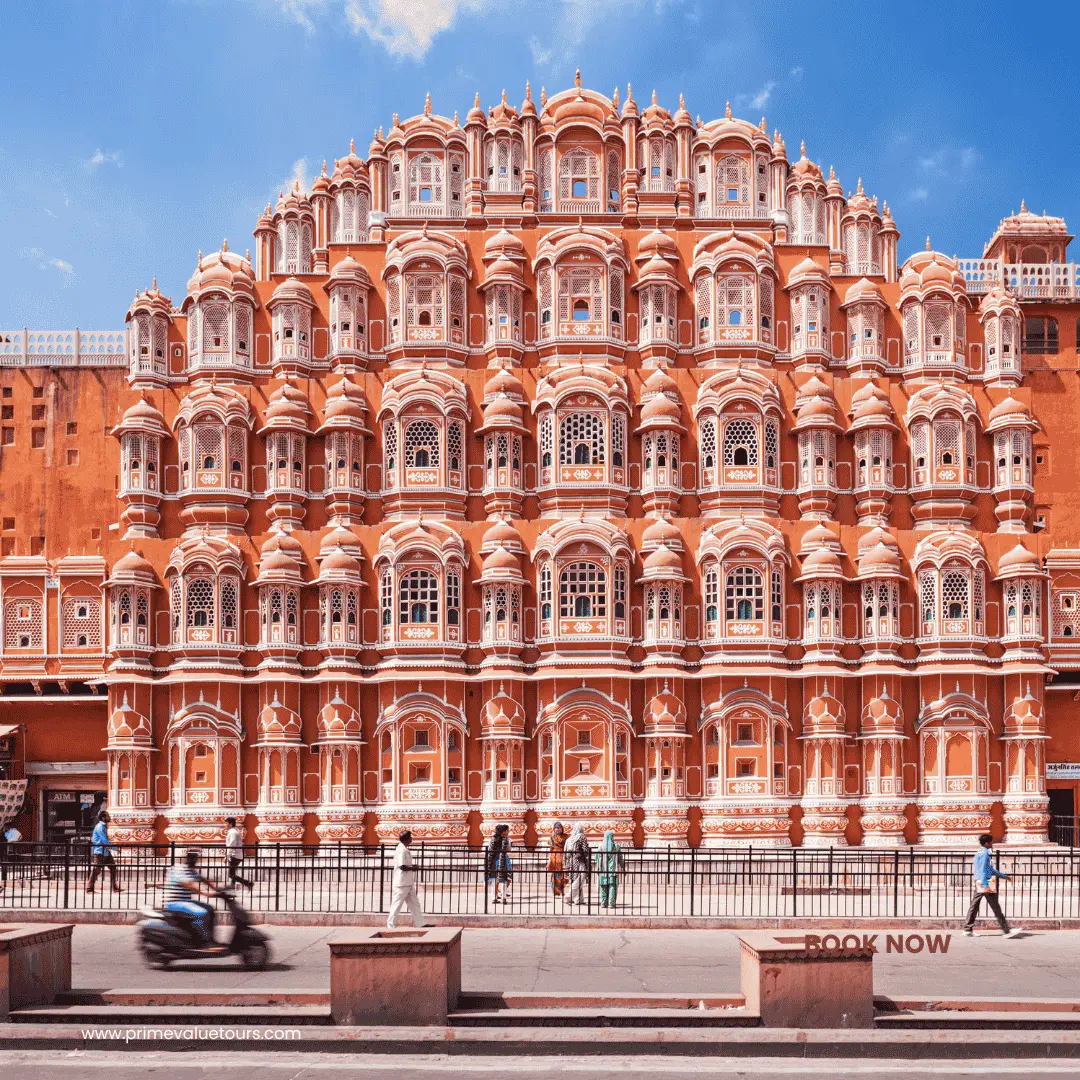
In the old city, three major sites stand close together, making them ideal for a single morning walk. The Hawa Mahal (Palace of Winds) is Jaipur’s most iconic facade — a five-storey screen of 953 small windows built so the ladies of the royal court could observe street life without being seen. It is most beautiful photographed from the street in the morning light.
The City Palace complex is still partially the home of the Jaipur royal family, and its museum holds royal costumes, weaponry, and paintings that bring Rajasthan’s history to life. Just beside it, Jantar Mantar is a collection of 19 giant stone astronomical instruments built in 1734 — they still accurately measure time, track stars, and predict eclipses. Another UNESCO World Heritage Site.
Prime Value Tours Insider Tip: Save at least one hour for Jaipur’s bazaars. Johari Bazaar is the place for gemstones and jewellery — Jaipur is the world’s gemstone cutting capital. Bapu Bazaar is perfect for block-print textiles, blue pottery, and camel leather goods.
Best Time to Visit the Golden Triangle
The Golden Triangle can be visited year-round, but the ideal season depends on your priorities:
- October to March: The best time. Weather is cool and pleasant, ranging from 10°C to 25°C. This is peak season for tourism, so hotels and monuments are busy — but the experience is excellent.
- November and December: Our most popular months for Golden Triangle tours. Clear skies, comfortable temperatures, and the Taj Mahal often wrapped in morning mist.
- April to June: Hot — temperatures in Agra and Jaipur can reach 45°C. Not recommended for elderly travellers or those unused to intense heat. Morning visits are essential.
- July to September: Monsoon season brings lush green landscapes and fewer tourists. The Taj Mahal reflected in rain puddles is extraordinarily beautiful. However, some roads can be affected by heavy rainfall.
How to Reach the Golden Triangle
By Air
Most international visitors fly into Indira Gandhi International Airport in New Delhi (airport code: DEL), which has direct flights from Bangkok, Singapore, Dubai, London, and many major cities worldwide. From Delhi airport, our team provides comfortable pickup and drop service directly to your hotel.
By Train
For travel between cities, India’s express trains are fast, comfortable, and an experience in themselves. The Gatimaan Express from Delhi to Agra takes just 90 minutes — making it one of the fastest train journeys in India. The Shatabdi Express and Vande Bharat Express also connect Delhi, Agra, and Jaipur reliably. Our team handles all train bookings as part of your tour package.
By Private Car
For groups, families, and those who prefer flexibility, private car transfer is the most comfortable option. Air-conditioned vehicles with experienced drivers allow you to stop at Fatehpur Sikri, roadside villages, and viewpoints that train travellers always miss. Prime Value Tours provides all vehicles with professional English-speaking drivers who know every road on this circuit.
Sample Golden Triangle Itineraries
3-Day Express Tour (Best for Short Trips)
- Day 1: Arrive Delhi. Check in. Old Delhi half-day tour — Red Fort, Chandni Chowk, Jama Masjid.
- Day 2: Drive to Agra. Taj Mahal at sunrise. Agra Fort. Afternoon drive to Jaipur.
- Day 3: Jaipur — Amber Fort, Hawa Mahal, City Palace, Jantar Mantar. Evening drive back to Delhi.
5-Day Comfortable Tour (Most Popular)
- Day 1: Arrive Delhi. Humayun’s Tomb. Qutub Minar.
- Day 2: Old and New Delhi. India Gate. Lotus Temple.
- Day 3: Drive Delhi to Agra. Fatehpur Sikri en route. Taj Mahal at sunset.
- Day 4: Taj Mahal at sunrise. Agra Fort. Drive to Jaipur.
- Day 5: Amber Fort. City Palace. Jantar Mantar. Bazaar shopping. Return Delhi.
7-Day Grand Tour (Perfect First Visit)
The 7-day tour includes everything above, plus Mathura and Vrindavan (the birthplace of Lord Krishna, 60 km from Agra), a full morning at Jaipur’s local bazaars, a day trip to the Ranthambore tiger reserve (wildlife add-on), and a leisurely final evening in Delhi for shopping at Dilli Haat.
Prime Value Tours Insider Tip: For Buddhist pilgrims who have already completed the Buddhist Circuit, we recommend combining the Golden Triangle with a Varanasi extension. After Jaipur, fly from Delhi to Varanasi for the evening Ganga Aarti — it makes for one of the most complete India experiences possible.
Extending Your Golden Triangle Tour
The Golden Triangle connects naturally to several other popular India destinations. Many of our guests extend their tour in the following ways:
- Varanasi: Fly from Delhi to Varanasi for India’s most spiritual city. Evening Ganga Aarti at Dashashwamedh Ghat is unforgettable.
- Buddhist Circuit: From Varanasi, continue to Sarnath (where the Buddha gave his first sermon), Bodhgaya, Kushinagar, and Lumbini in Nepal. This is Prime Value Tours’ speciality.
- Ranthambore National Park: India’s finest tiger reserve is just three hours from Jaipur by train — perfect for a wildlife day.
- Udaipur: The City of Lakes is four hours south of Jaipur and makes a beautiful Rajasthan extension.
Why Choose Prime Value Tours for Your Golden Triangle Trip
Prime Value Tours has been operating India inbound tours from our base in Varanasi since 1999 — over 25 years of experience. We are specialists in personalised group tours for international travellers, with a particular expertise in Buddhist pilgrimage tours for Thai groups.
Our Golden Triangle tours include comfortable AC vehicle transfers, licensed guides at every monument, carefully selected hotels, and flexible itineraries that adapt to your group’s pace and interests. We handle everything — from airport pickup to monument tickets — so that you can focus entirely on the experience.
Every tour we run is built on a foundation of authentic knowledge. Our guides do not recite scripts — they share stories. The details about how the Taj Mahal’s four minarets are built slightly tilted outward (so they fall away from the main tomb in case of an earthquake), or how the craftsmen of Fatehpur Sikri were never paid — these are the details that make India travel genuinely unforgettable.
Ready to Plan Your Golden Triangle Tour?
Whether you are a first-time visitor to India or a returning traveller looking for a fresh perspective, the Golden Triangle rewards everyone. It is India at its most accessible, its most historic, and its most visually stunning — all within a compact, manageable route.
Contact the Prime Value Tours team to start planning your Golden Triangle tour. Tell us your group size, travel dates, and any special interests, and we will design a private itinerary that fits you perfectly.
Email: info@primevaluetours.com | Phone: +91-9721122849
You can also visit our Plan Your Trip page on primevaluetours.com to tell us about your journey — and we will take care of the rest.