
Buddhist Pilgrimage India Checklist | Prime Value Tours
First time in India? Our Buddhist pilgrimage India checklist covers visa, money, temples, food and Route R1. Book with Prime Value Tours today.
Your group has saved for years. Your abbot has blessed the journey. And now, for the first time, you are boarding a flight that will touch down in the country where the Buddha walked, taught and found enlightenment. That feeling, equal parts excitement and quiet nervousness, is something we see in almost every Thai and Southeast Asian group we welcome at Prime Value Tours.
In our 25 years of guiding Buddhist pilgrimage groups from Thailand, Myanmar, Cambodia, Laos, Vietnam and Sri Lanka, we have learned that the first time in India is always easier when the group knows exactly what to expect. Misplaced passports, wrong SIM cards, unsuitable clothes at temples, spicy food surprises, these small things can steal focus from the real purpose of the journey.
So we put together this beginner’s checklist for first time India Buddhist pilgrimage groups. Think of it as a calm, honest guide from one pilgrim to another. Whether your group is 10 laypeople or 40 monks, these pointers will help you land smoothly, move peacefully from site to site, and return home with your heart full.
1. Before You Fly: Visa, Flights and Entry Documents
Here is the thing most first-time visitors forget: India’s e-Visa looks simple online, but Buddhist pilgrimage groups usually need the right category.
For most Thai, Cambodian, Lao and Vietnamese pilgrims, the e-Tourist Visa is the right choice. It allows 30, 90 or 180 days of stay depending on what you apply for. Apply through the official government portal (indianvisaonline.gov.in) at least 7 to 10 days before departure. Avoid third-party agents that charge double.
For Sri Lankan passport holders, visa-on-arrival is available for tourism at select airports. Still, we recommend applying for the e-Visa in advance for faster immigration clearance.
What every pilgrim must carry:
- Passport valid for at least 6 months beyond arrival date, with 2 blank pages
- Printed copy of the approved e-Visa (do not rely only on the phone copy)
- Return flight ticket printout
- Travel insurance certificate (strongly recommended, not mandatory)
- 4 passport-size photos per person (useful for unexpected formalities)
For monks travelling in robe, please carry a letter from your temple or monastic order on official letterhead. Indian immigration respects the Sangha, but the letter helps at busy counters.
Most groups from Bangkok, Yangon and Ho Chi Minh City fly into Delhi (DEL) or Kolkata (CCU). From there, our team arranges the transfer to Gaya (GAY) or Varanasi (VNS), the two main entry points for the Buddhist circuit.
2. The Buddhist Pilgrimage Route for First-Timers (Route R1)
For most first-time Buddhist pilgrimage groups from Southeast Asia, we recommend Route R1. It begins and ends at Bodh Gaya, which many of our monks find spiritually meaningful, the journey completing itself at the Bodhi Tree.
Here is the full route, in order:
Bodh Gaya → Rajgir → Patna → Vaishali → Kushinagar → Lumbini → Sravasti → Varanasi → Bodh Gaya
A typical R1 pilgrimage takes 11 to 13 nights. Each stop has its own quiet significance:
- Bodh Gaya: the place of enlightenment, home of the Mahabodhi Temple (UNESCO World Heritage)
- Rajgir: where the Buddha taught on Vulture Peak
- Patna and Vaishali: the second sermon of the Buddha, and the last Uposatha before Parinirvana
- Kushinagar: the sacred site of the Buddha’s Mahaparinirvana
- Lumbini (Nepal crossing): the birthplace of the Buddha
- Sravasti: where the Buddha spent 24 monsoon seasons
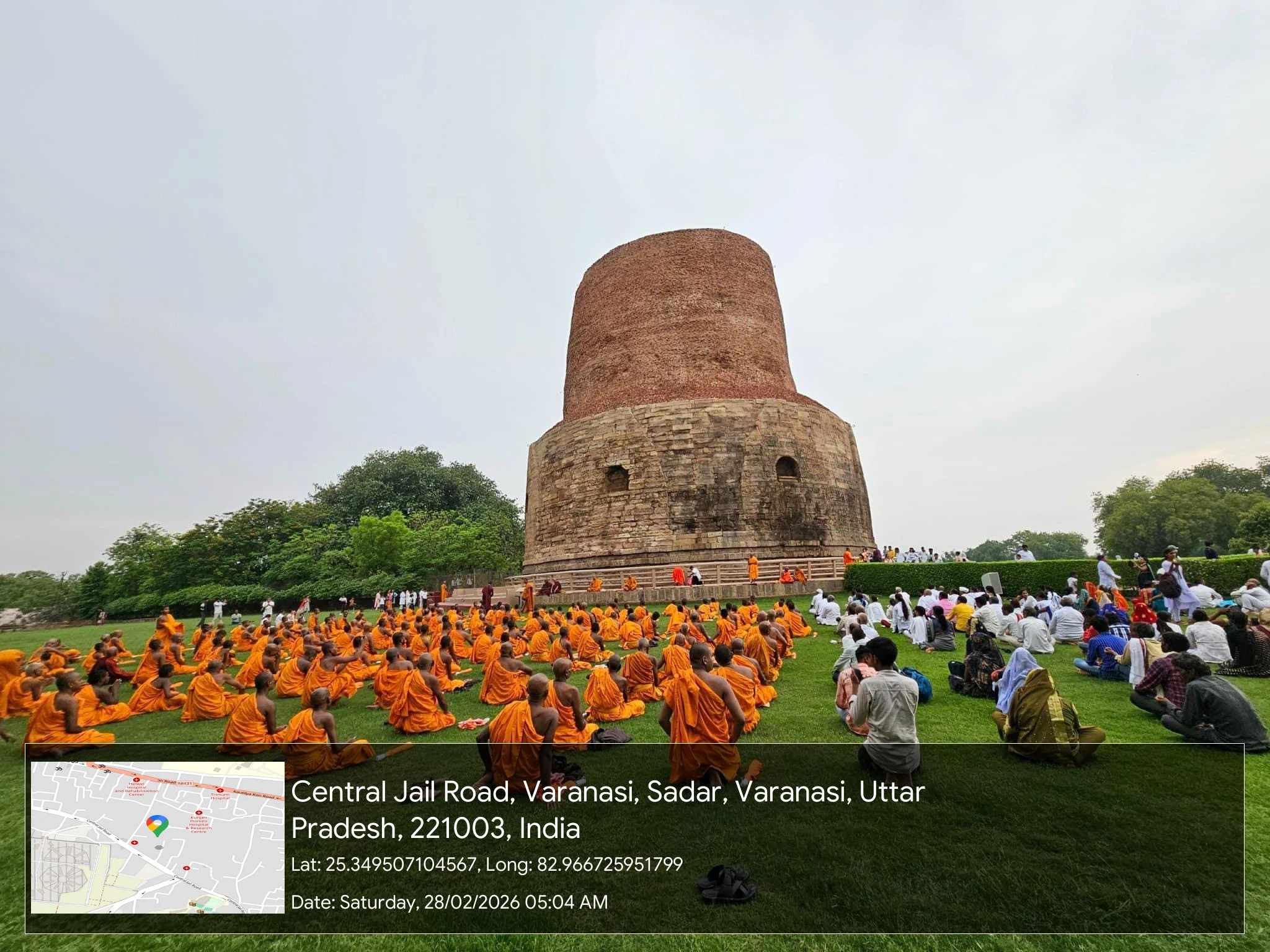
- Varanasi (Sarnath): the first sermon, the turning of the Dhamma Wheel
- Back to Bodh Gaya: for closing prayers at the Mahabodhi Tree
Because Lumbini lies inside Nepal, plan for the border crossing at Sonauli. Keep passports and visas handy, and expect an extra 1 to 2 hours at the checkpoint. We coordinate all border paperwork for our pilgrimage groups.
3. Money, Mobile and Daily Essentials in India
The Indian rupee (INR) is not freely tradable outside India. Most Thai and Southeast Asian groups exchange money on arrival at the airport or at trusted hotel counters.
Our honest tip: exchange about 60% of your currency on arrival, and keep 40% for later, when rates are often better in city centres. Credit cards work at most good hotels, but small temple town shops prefer cash.
For mobile connectivity, buy a local prepaid SIM at the airport. Airtel and Jio both offer 28-day tourist packs with 1.5 to 2 GB per day of data and free calls, priced around 400 to 600 INR. You will need your passport copy and one photo.
Daily cash guide per pilgrim (beyond the tour cost):
- Bottled water and snacks: 200 to 300 INR per day
- Tips for drivers and guides: 300 to 500 INR per day
- Temple offerings and flowers: 100 to 300 INR per site
- Small souvenirs (prayer beads, Dharma books): as you wish
Please avoid carrying large amounts of cash. Use your hotel safe whenever available. A small cross-body bag with a zip is far safer than a back pocket.
4. Temple Etiquette: Respecting Sacred Buddhist Sites
This section matters more than any packing list. In our experience, the deepest pilgrimage memories come from how gently a group enters a sacred space.
At the Mahabodhi Temple in Bodh Gaya, mobile phones, cameras, pens and lighters are not allowed inside the main shrine. A free locker facility is available at the entrance. Queue peacefully, even if your group is large. Morning hours (5:30 to 8:00 AM) are the quietest and most spiritually rewarding.
At Sarnath, Kushinagar and Sravasti, always circumambulate the stupa in a clockwise direction. This is an old and respected tradition across all Buddhist schools.
A few universal rules our guides gently remind groups about:
- Remove shoes before entering any shrine or temple courtyard
- Cover shoulders and knees, men and women alike
- Lower your voice inside the shrine, speak only when necessary
- Never turn your back directly toward the main Buddha image when leaving, step back a few paces first
- Photography is often allowed in outer courtyards but not inside inner sanctums, when in doubt, ask your guide
For monks in robe, Indian temples are very welcoming. Expect free entry at most Buddhist heritage sites and respectful priority seating at teachings and poojas.
5. Food, Water and Health for Southeast Asian Groups
Indian food is famous, but very different from Thai or Vietnamese cooking, especially in North India where the Buddhist circuit runs.
What to expect:
- Rice, lentil (dal) and vegetable curries are common and safe for vegetarian pilgrims
- Spice level is usually medium to high, ask for “no spicy” (in Hindi: “mirchi nahi”)
- Pure vegetarian meals are easily available near all Buddhist sites
- Halal options are limited on the Buddhist circuit, please inform us in advance
At Prime Value Tours, we arrange Thai-style cooks at selected hotels in Bodh Gaya and Varanasi for larger groups. If your group includes senior monks or pilgrims, we always keep boiled rice, soft dal and steamed vegetables available as a gentle daily option.
Water rules are simple and strict:
- Drink only sealed, branded bottled water (Bisleri, Aquafina, Kinley)
- Check the seal before opening, always
- Avoid ice cubes in drinks outside of good hotels
- Do not drink tap water, even in fine hotels
Please carry your personal medicines with prescriptions. Common pilgrim essentials include loose motion tablets, ORS sachets, antacids, basic painkillers, any regular blood pressure or diabetes medicine, and mosquito repellent cream.
6. The Complete First-Time Pilgrim Packing Checklist
Here is the list our senior coordinator shares with every new Thai or Cambodian group leader.
Documents:
- Passport and e-Visa printout
- Flight tickets
- Travel insurance
- 4 extra passport photos
- Temple or monastic order letter (for monk groups)
Clothing (for October to March, the main pilgrimage season):
- Light cotton clothes for daytime
- Warm layers or shawl for mornings and evenings (temperatures can drop to 5 to 8 C in December and January in Bodh Gaya and Sravasti)
- Comfortable walking shoes plus one pair of slip-on sandals (for temples)
- Traditional temple clothes (white is preferred by many groups)
- Umbrella or light raincoat during monsoon months (July to September)
Spiritual items:
- Prayer beads
- Personal chanting book
- Small offering items (incense, candles if permitted, flowers purchased locally)
- Kasaya or robe essentials, for monks
Daily use:
- Power adapter (India uses Type C, D and M plugs)
- Power bank (fully charged before each long drive)
- Reusable cloth bag (plastic bags are restricted at many heritage sites)
- Small torch or headlamp (helpful at early-morning poojas)
The good news is, you can buy most daily items cheaply in Bodh Gaya and Varanasi if you forget anything.
What to Know Before You Go
A few final tips we share with every first-time group:
- Be ready for long drives, some stretches between sites take 4 to 6 hours by road
- Book hotels close to temples, not city centres, your mornings will thank you
- Inform us 30 days in advance of any special dietary or medical needs
- Carry digital and printed copies of all documents, separately
- Respect local customs outside temples too, India is a deeply religious country
| Plan Your Trip with Prime Value Tours We have been organising Buddhist pilgrimage tours across India and Nepal since 1999, with a special focus on Thai, Cambodian, Lao, Vietnamese, Burmese and Sri Lankan groups. Our ground team, drivers and guides have walked this circuit hundreds of times, and we design every journey around your group’s pace, age and spiritual needs. Contact us today to design your perfect first pilgrimage: Phone: +91-542-2500113 WhatsApp: +91-9794122849 (https://wa.me/919794122849) Email: info@primevaluetours.com Website: www.primevaluetours.com LINE: https://line.me/ti/p/6QtZRvYpeP Office: 3rd Floor, E-8, Central Jail Rd, Opposite Main Gate, Shanti Vihar, Gilat Bazar, Chhota Chuppedpur, Varanasi, 221002, India We speak English fluently and assist Thai, Burmese and Sinhala-speaking groups with translator support on request. |
The first time you step off the plane in India as a Buddhist pilgrim, something shifts. The air feels older. The chants at Bodh Gaya feel familiar even though you have never been there before. If you follow a simple checklist and travel with a team that knows the Buddhist pilgrimage India circuit well, your first time will not feel overwhelming. It will feel like coming home. And that is exactly the feeling we hope every pilgrim carries back to Bangkok, Phnom Penh, Vientiane, Yangon or Colombo.
Frequently Asked Questions
1. How many days do I need for a complete Buddhist pilgrimage in India for the first time?
For Route R1, we recommend 11 to 13 nights. Shorter 7 to 9 night circuits (Route R3) are also available for groups with limited time.
2. What is the best time for a first-time Buddhist pilgrimage in India?
October to March is the best season. The weather is cool and comfortable, and all roads and temples are fully open. Avoid May and June (very hot) and July to September (monsoon).
3. Can monks in robe travel freely to all sites in the Buddhist circuit?
Yes. Monks are warmly welcomed at every site. We recommend carrying a letter from your temple or monastic order and informing us of any dietary needs in advance.
4. Do I need a separate visa for Lumbini since it is in Nepal?
Yes. If you are visiting Lumbini as part of the India Buddhist pilgrimage, you will need a Nepal tourist visa. This is available on arrival at the Sonauli border for most Southeast Asian nationalities.
5. Is it safe to travel in a large group for a first-time pilgrimage?
Yes, absolutely. Group pilgrimage is the safest and most economical way to visit India. Our coaches, guides and on-call support make it easier for seniors and children too.