
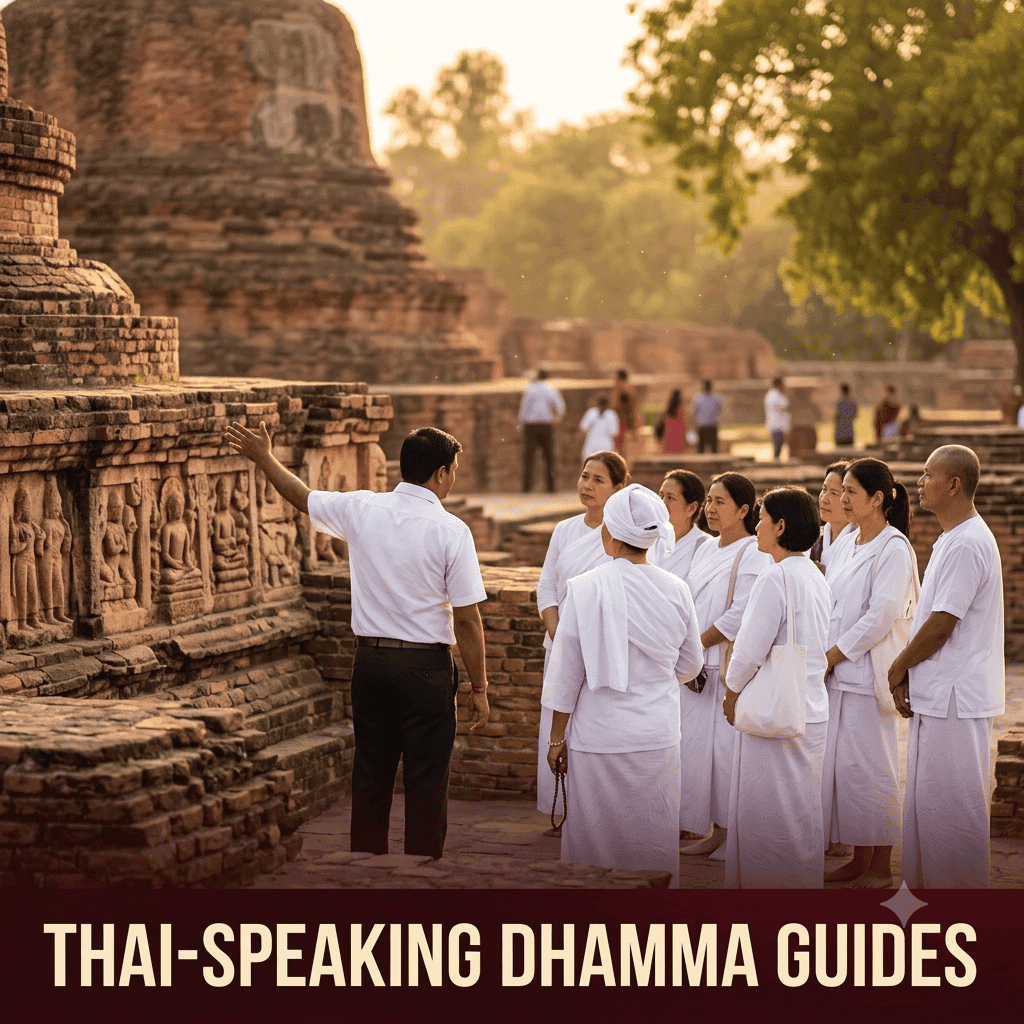
Buddhist Circuit Tour India: What It Covers, What It Costs, and How to Choose the Right Operator
A Buddhist circuit tour India is not an ordinary sightseeing holiday, and treating it like one is the single most common mistake pilgrims make when booking. This is a journey across roughly 1,500 kilometres of the Gangetic plains, connecting the places where Siddhartha Gautama was born, attained enlightenment, taught his first sermon and passed into Mahaparinirvana. It crosses two countries, four Indian states, and several roads where average speeds rarely exceed 40 kilometres an hour. Done well, it is the most moving journey a Buddhist can undertake. Done badly, it becomes eight days of tired coaches, rushed temple visits and a guide who cannot explain what happened at the site you are standing on. This guide sets out exactly what the circuit covers, how long it realistically takes, what drives the price, and the questions that separate a competent operator from a broker reselling your group to whoever answers the phone.
The Sites a Complete Buddhist Circuit Covers
Almost every enquiry begins with the four principal sites, and rightly so. These are the places the Buddha himself named as worthy of pilgrimage:
- Lumbini (Nepal) — the birthplace, marked by the Maya Devi Temple and the Ashoka Pillar. Requires a border crossing from Sunauli or Bhairahawa.
- Bodh Gaya (Bihar) — the Mahabodhi Temple and the Bodhi Tree, where enlightenment was attained. The emotional centre of the entire journey.
- Sarnath (Uttar Pradesh) — the deer park where the first sermon set the Wheel of Dhamma in motion, ten kilometres from Varanasi.
- Kushinagar (Uttar Pradesh) — the reclining Buddha and the Ramabhar Stupa, site of the Mahaparinirvana and cremation.
Beyond these four sit the secondary sites that turn a good pilgrimage into a complete one: Sravasti, where the Buddha spent twenty-four rainy seasons; Rajgir and the Griddhakuta hill; Nalanda, the great monastic university; Vaishali, where the final sermon was given; and Sankisa, where tradition places the descent from Tavatimsa heaven. We have written a full route breakdown of all eight in our guide to the eight great holy places of the Buddhist pilgrimage route, which is worth reading before you fix your itinerary length.
How Many Days Do You Actually Need?
Duration is where most budgets are won or lost, because every extra night is a hotel night, a meal plan and a coach day. Three configurations cover the vast majority of groups:
Seven to Eight Days — The Four Holy Places
This is the standard programme: Delhi or Gaya arrival, Bodh Gaya, Varanasi and Sarnath, Kushinagar, Lumbini, departure. It is tight but comfortable, with one full day at Bodh Gaya. For temple groups with limited leave from work, this is usually the right answer.
Ten to Eleven Days — The Complete Circuit
Adds Rajgir, Nalanda, Vaishali and Sravasti. Driving days become longer, but the pilgrimage gains coherence: you follow the Buddha’s own movement across the region rather than jumping between highlights. Groups travelling from Thailand, Sri Lanka or Malaysia who may only make this journey once in their lives generally find the extra three days worth every baht.
Fourteen Days and Above — Circuit Plus Extension
Usually the full circuit combined with Agra and the Taj Mahal, or a Kathmandu extension after Lumbini. Popular with groups where not everyone is a devout practitioner and a cultural component keeps the whole party engaged.
What Drives the Price of a Buddhist Circuit Tour
Two quotations for the same route can differ by forty percent, and the difference is almost never profit margin. It is these five variables:
- Group size. Coach and guide costs are fixed per vehicle, so per-person rates fall sharply between 15, 25 and 40 pilgrims. A group of 40 can often travel at close to half the per-head rate of a group of 12.
- Accommodation category. Thai temple guesthouses at Bodh Gaya, Kushinagar, Sravasti and Lumbini are the most economical and, for many groups, the most appropriate. Three-star and four-star hotels are available at every major stop for groups wanting private bathrooms and lift access.
- October to March is peak. December in Bodh Gaya, when Thai and Southeast Asian groups converge, sees the sharpest hotel rate increases of the year. Booking a December departure in June rather than October can save meaningfully.
- Meal arrangements. Thai-style catering, vegetarian-only requirements or early-morning almsgiving arrangements all change the cost structure and must be priced honestly upfront.
- Guide quality. A general licensed guide costs one thing; a Thai-speaking, dhamma-literate guide who can explain the Sutta associated with each site costs more and is worth the difference on a pilgrimage.
Questions That Separate a Real Operator From a Broker
The Buddhist circuit attracts a large number of intermediaries who take your booking and subcontract everything. Ask these five questions and the picture becomes clear very quickly:
- Are you a Government of India-approved and IATO-member operator? Approval and IATO membership are verifiable, and they matter when something goes wrong at a border or a hospital at 11 pm.
- Who owns the coaches, and how old are they? On Bihar and eastern Uttar Pradesh roads, vehicle condition is a safety question, not a comfort question.
- Will my guide speak my group’s language and know the dhamma? Ask for the guide’s name in advance, not a promise of “language guide available”.
- Do you have your own staff at Bodh Gaya and Varanasi, or agents? Local presence determines how fast a problem gets solved.
- What exactly is excluded? Monument entry fees, Nepal border charges, tips, and the Varanasi boat ride are the usual hidden extras.
Prime Value Tours has operated inbound Buddhist pilgrimage programmes from Varanasi since 1999, with branch offices at Bodh Gaya, Lucknow, Delhi, Agra and Dehradun, and Thai-speaking dhamma-literate guides on staff rather than on call. You can see our current circuit programmes and request a group quotation at Prime Value Tours.
Private Tour, Tourist Train, or Self-Planned?
Three ways exist to do this journey. A private coach tour gives you control over pace, chanting time and meal arrangements — the decisive factor for monk-led groups. The IRCTC Buddhist Circuit Tourist Train offers a fixed eight-day schedule with onboard accommodation, which suits individual travellers more than organised sanghas. Self-planning is possible but demanding, given the border formalities at Sunauli and the road distances involved. Our colleagues at Buddha Yatra have compared the train and private-tour options in detail, and Buddhist Circuit Tours maintains a working guide to distances, seasons and border logistics for anyone planning independently.
When to Travel
September to March is the operating season, and within it the character changes month by month. October and November are pleasant and less crowded. December and January are cold in the mornings — genuinely cold in Sravasti and Kushinagar — but this is when the great Thai and Southeast Asian pilgrimages take place and Bodh Gaya is at its most alive. February and March are warm and comfortable. Buddha Purnima in May brings an extraordinary atmosphere to Bodh Gaya and Sarnath, though daytime heat and crowds demand a carefully paced programme. April to August, outside the Vesak window, is generally not recommended for large groups.
Frequently Asked Questions
How much does a Buddhist circuit tour in India cost per person?
For a group of 25 travelling ten days in three-star hotels with full meals, transport and guides, most quotations land in a broad mid-range band per person. Temple-stay accommodation reduces it substantially; four-star hotels and smaller group sizes raise it. Request a written quotation against a fixed itinerary rather than comparing headline prices.
Do I need a separate visa for Lumbini in Nepal?
Yes. Lumbini is in Nepal, so a Nepal visa is required in addition to your Indian visa, and a double-entry Indian visa if you re-enter India afterwards. Most nationalities can obtain the Nepal visa at the Sunauli land border, but group paperwork should be prepared in advance.
Is the Buddhist circuit suitable for elderly pilgrims?
Yes, with planning. Road days are long, so the itinerary should be built with fewer stops per day, hotels with lift access, and wheelchair support arranged in advance. Many of the sites, including the Mahabodhi Temple complex, are largely level and walkable.
Can Thai groups stay in Thai temples along the route?
Yes. Thai monasteries at Bodh Gaya, Kushinagar, Sravasti and Lumbini accept organised groups, offering familiar food, Thai-speaking monks and a devotional atmosphere at low cost. Availability during December is limited and must be blocked months ahead.
Plan Your Buddhist Circuit With Prime Value Tours
A pilgrimage most people make once in a lifetime deserves an operator that runs this route every week of the season. Prime Value Tours Pvt. Ltd. is a Government of India-approved, IATO-member destination management company based in Varanasi, with more than twenty-five years of experience arranging Buddhist circuit tours for Thai temple groups, monastic sanghas and international pilgrims. Tell us your group size, your travel window and your preferred duration, and we will build a costed day-by-day programme around them. Start at primevaluetours.com or write to info@primevaluetours.com to begin planning.
Reference: UNESCO World Heritage listing for the Mahabodhi Temple Complex, Bodh Gaya and the Archaeological Survey of India.