
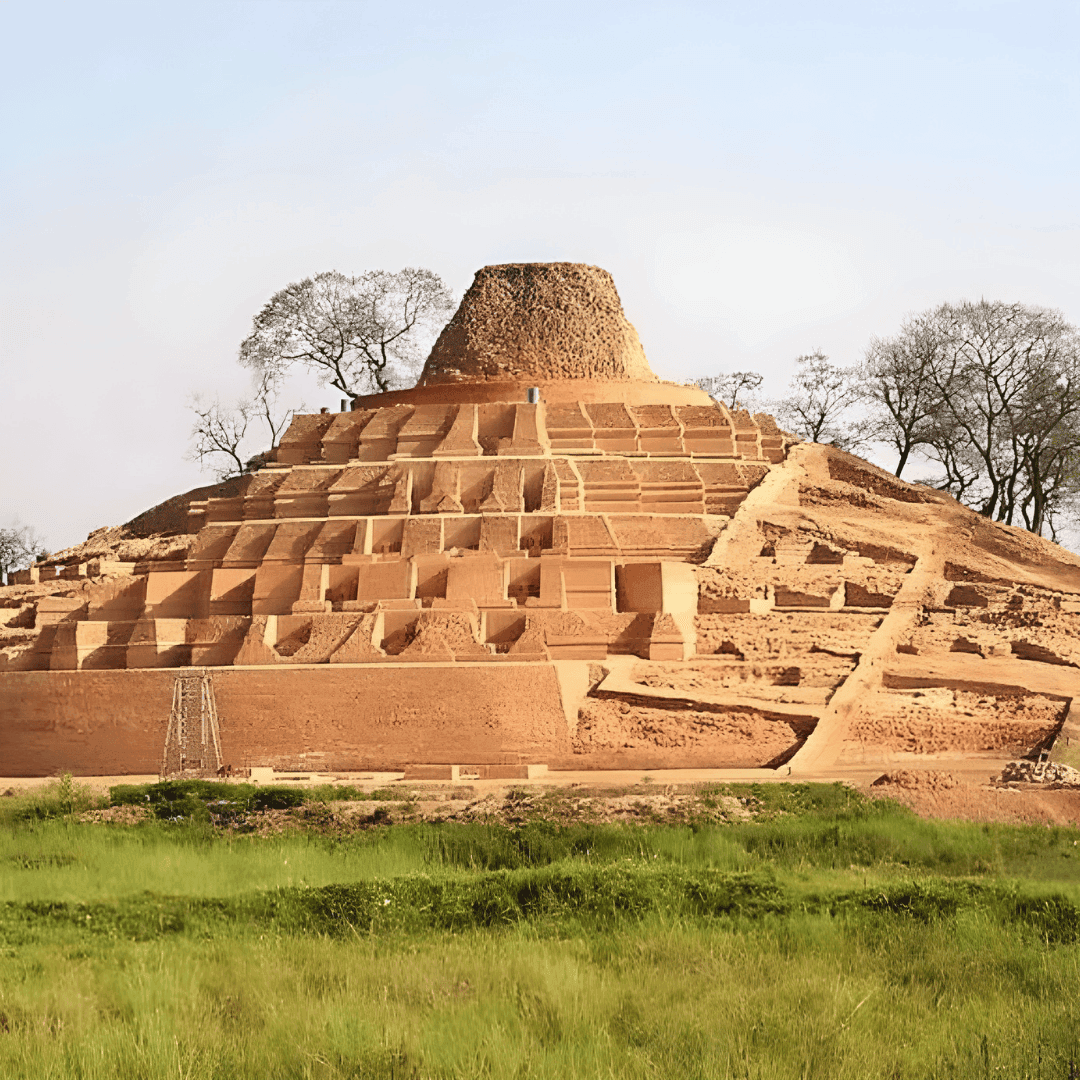
Discover Kesaria Stupa in Bihar -where the Buddha gave his final teachings before Mahaparinirvana. Join our expert Buddhist pilgrimage tour from Thailand to India. Book with Prime Value Tours today.
Kesaria Stupa:
Walk Where the Buddha Said Goodbye
The Forgotten Giant of the Buddhist Circuit-Bihar, India
A Sacred Farewell Frozen in Stone
Imagine standing before a structure that has silently watched over the plains of Bihar for more than 1,400 years a place where the Lord Buddha himself paused on His final journey, turned to His devoted discourses, and in an act of profound compassion, distributed His almsbowl. For Thai Buddhist pilgrims making the sacred journey to India, Kesaria Stupa is not simply another archaeological site. It is a living moment of the Buddha’s life, perfectly preserved in brick and devotion.
At approximately 34 metres in height and spanning a base circumference of nearly 400 metres, Kesaria Stupa in the East Champaran district of Bihar is believed by many scholars to be the world’s largest Buddhist stupa by volume. Yet it remains one of the least-visited sacred sites on the entire Buddhist pilgrimage circuit a quiet, unhurried space untouched by heavy tourist crowds.
At Prime Value Tours, we have walked this path with Thai pilgrimage groups since 1999. We bring you to Kesaria not just as a stop on a tour itinerary, but as a profound spiritual encounter that most pilgrims carry in their hearts long after they return home to Thailand.
Why Kesaria Stupa Matters to Every Buddhist Pilgrim
The Story Behind the Stupa
According to Buddhist historical accounts preserved in ancient Pali texts and confirmed by the Chinese pilgrim Xuanzang, who visited India in the 7th century CE, Kesaria is the very spot where the Buddha distributed His begging bowl to the Licchavis of Vaishali. This act took place just days before His Mahaparinirvana -His final passing into Nirvana at Kushinagar.
The Licchavis, deeply devoted followers who had accompanied the Buddha from Vaishali, were grief-stricken at the knowledge of His approaching Parinirvana. They wept and begged to accompany Him further. The Buddha, in His boundless compassion, created a magical moat to prevent them from following and, as a final blessing, gave them His almsbowl as a sacred remembrance.
The stupa was originally built over the bowl relic. Later, during the reign of Emperor Ashoka in the 3rd century BCE and again during the Gupta Period (4th–6th century CE), the stupa was greatly expanded layer upon layer of devotion added across a thousand years of Buddhist civilisation.
What the Archaeological Evidence Tells Us
Excavations by the Archaeological Survey of India (ASI) have revealed five distinct structural phases, confirming continuous veneration from the Mauryan period through the medieval era. More than 108 niches have been identified around the stupa’s circular terraces, each originally housing a seated Buddha image in the Dhyana Mudra (meditation posture). Many of these figurines remain visible today, giving pilgrims a rare and deeply moving meditation on the image of the Buddha repeated endlessly around this sacred mound.
Kesaria is currently on the UNESCO Tentative World Heritage List, a recognition of its extraordinary universal significance.
The Pilgrim’s Experience at Kesaria
For Thai Buddhist pilgrims, arriving at Kesaria feels unlike arriving at any other sacred site in India. There are no hawkers pushing at the gate. No large commercial temple complex surrounds the stupa. Instead, you step out of your comfortable coach onto a wide open sacred plain where the stupa rises from the earth like an ancient sleeping mountain worn smooth by rain and time, yet radiating a stillness that silences even the most restless mind.
What You Will See and Feel
- The vast circular mound, restored in sections and still partially excavated, towering above the Bihar plains
- Rows of seated Buddha figures in stone and terracotta set into the stupa’s outer niches some intact, some weathered, all deeply moving
- The ASI museum on site, displaying artefacts, Buddha images, and inscriptions discovered during excavation
- A deeply peaceful atmosphere ideal for chanting, meditation, and private prayer particularly powerful at dawn or in the late afternoon golden light
- A connection to the living landscape that the Buddha walked: flat, fertile plains, large old trees, and the sound of birds unchanged in two millennia
Our tour leader, Mr. Bhuvanendra Vikram Singh, who has personally guided Thai Buddhist groups along this circuit for over 25 years, always takes time to share the full story of the Buddha’s last journey at Kesaria. He speaks slowly, clearly, and with the reverence this sacred place deserves, so that every pilgrim in your group can absorb the spiritual significance fully.
How Kesaria Fits Into Your Complete Buddhist Pilgrimage
Kesaria Stupa is ideally positioned on the route between Vaishali ,where the Buddha delivered His final sermon to the Sangha and Kushinagar, the site of His Mahaparinirvana. By including Kesaria in your pilgrimage, you are literally retracing the Buddha’s final footsteps in their correct geographical and spiritual sequence.
Prime Value Tours includes Kesaria as part of our carefully designed Buddhist Circuit, which covers all Eight Principal Buddhist Sites and several important secondary sites in India and Nepal. Our tours depart from major Thai cities and are conducted with full Thai-language support at every step.
Related pilgrimage pages on our site: Bodh Gaya Tour | Kushinagar Pilgrimage | Vaishali Buddhist Tour | 8-Day Complete Buddhist Circuit Itinerary
Practical Information for Thai Pilgrims
| Location | Kesaria, East Champaran District, Bihar, India |
| Best Time to Visit | October to March (cool and dry season, ideal for pilgrimage) |
| Nearest Airport | Patna Airport (approx. 100 km) or Gorakhpur Airport (approx. 120 km) |
| Entry Fee | Nominal ASI fee (managed by Archaeological Survey of India) |
| Transport | Prime Value Tours provides comfortable, air-conditioned coaches with Thai-speaking tour guide support |
| Dress Code | Modest, respectful clothing recommended; white robes welcome and appropriate |
Frequently Asked Questions (FAQ)
These are the questions most asked by Thai Buddhist pilgrims planning to include Kesaria Stupa in their India tour:
| Q1. Is Kesaria Stupa on the official UNESCO World Heritage list? |
| Kesaria Stupa is currently on the UNESCO Tentative World Heritage List. While it has not yet received full World Heritage status, it is fully protected and managed by the Archaeological Survey of India (ASI), which is India’s highest authority for heritage conservation. The site has tremendous scholarly and spiritual significance globally. Prime Value Tours monitors this closely and will update pilgrims on any new UNESCO designations. |
| Q2. Is Kesaria Stupa suitable for elderly pilgrims or those with limited mobility? |
| Yes. The open ground around the stupa is mostly flat and accessible. Thai pilgrims in their 50s, 60s, and 70s regularly visit with our group tours without difficulty. The primary spiritual experience circumambulating the great stupa, chanting prayers, and seated meditation can all be done at ground level without climbing. Our tour vehicles park directly at the site entry, minimising walking distances. |
| Q3. How much time should we allocate for Kesaria Stupa? |
| We recommend a minimum of 1.5 to 2 hours at Kesaria. This allows enough time for a complete circumambulation (pradakshina), group chanting at the stupa base, quiet personal meditation, a visit to the on-site ASI museum, and photography. Our experienced guides pace the visit to ensure spiritual depth rather than a rushed overview. |
| Q4. Can we perform Buddhist rituals and prayers at Kesaria Stupa? |
| Absolutely. Kesaria Stupa is a living pilgrimage site. Thai Buddhist pilgrims regularly perform chanting (suad mon), offer lotus flowers and incense, light candles, and conduct merit-making activities at the base of the stupa. Prime Value Tours coordinates with the site authorities in advance to ensure your group has the space and time needed for undisturbed prayers. We also assist with arrangement of yellow robes, offerings, and ceremonial items if requested. |
| Q5. Is Kesaria Stupa included in Prime Value Tours’ standard Buddhist circuit package? |
| Yes. Kesaria Stupa is a signature inclusion in our Buddhist pilgrimage tours designed specifically for Thai groups. Unlike many tour operators who skip this site, we at Prime Value Tours believe the spiritual journey of retracing the Buddha’s final footsteps is incomplete without Kesaria. It is always included in our full Buddhist Circuit between the Vaishali and Kushinagar day stages. |
| Q6. How is Kesaria Stupa different from Bodh Gaya or Sarnath? |
| Bodh Gaya is the site of the Buddha’s Enlightenment, joyful, busy, and magnificent. Sarnath is the place of the First Sermon also well-visited and beautifully maintained. Kesaria is deeply different: it is the site of farewell, of the Buddha’s final compassionate act before Parinirvana. Its atmosphere is quiet, unhurried, and profoundly introspective. Many Thai pilgrims tell us that their most moving meditation experience in all of India happened at Kesaria precisely because of its silence. |
| Q7. What is the best way to book a Buddhist pilgrimage tour that includes Kesaria Stupa from Thailand? |
| The simplest and most reliable way is to contact Prime Value Tours directly. We are a specialised Buddhist circuit tour operator based in Varanasi since 1999, and we work exclusively with Thai-speaking group pilgrims. We handle all logistics: flights from Thailand, visa guidance, comfortable group transport, ASI-licensed guides, vegetarian meals, and appropriate accommodation at each site. Contact us by email at info@floralwhite-eel-181618.hostingersite.com or by phone at +91-9721122849. |
Why Trust Prime Value Tours for Your Sacred Journey?
There are many tour companies offering Buddhist pilgrimage packages. Here is why Thai Buddhist pilgrims from across Thailand have trusted Prime Value Tours for over 25 years:
- Founded in 1999 over 25 years of dedicated Buddhist pilgrimage expertise
- Specialist in Thai Buddhist group tours we understand your culture, your language needs, and your devotional requirements
- Expert team led by Mr. Bhuvanendra Vikram Singh, who has personally guided hundreds of Thai pilgrimage groups across every major Buddhist site in India and Nepal
- Full coverage of all 8 principal Buddhist sacred sites plus important secondary sites such as Kesaria, Vaishali, Rajgir, Nalanda, and Sravasti
- ASI-licensed expert guides who explain each site’s historical and spiritual significance in depth
- Comfortable, fully air-conditioned coaches our own vehicles, not subcontracted
- Vegetarian meals respecting Thai Buddhist dietary needs
- Strong relationships with Buddhist monasteries and site authorities across Bihar and Uttar Pradesh
- Transparent, all-inclusive pricing with no hidden costs
Begin Your Sacred Journey Today
The Buddha walked these very plains of Bihar more than 2,500 years ago. His footsteps are still here preserved in stone, in silence, and in the faith of the millions who have come to bow in this holy land since.
Kesaria Stupa waits for you. Come and stand where the Buddha gave His final blessing. Come and feel the still, unchanging quality of a place untouched by commercialisation. Come and bring home a merit so deep it will carry through every remaining day of this lifetime.
| 📿 PLAN YOUR BUDDHIST PILGRIMAGE TO INDIA Including Kesaria Stupa — The World’s Tallest Stupa ——————————————————————
—————————————————————— Prime Value Tours Pvt. Ltd. | Varanasi, India | Est. 1999 |