
Lumbini Travel Guide for Thai Buddhist Pilgrims | Birthplace of Buddha 2026. Complete Lumbini travel guide for Thai Buddhist pilgrims. Visit the birthplace of Lord Buddha in Nepal—Maya Devi Temple, Thai Monastery, border crossing tips, how to reach it from Kushinagar, and practical advice from 25+ years of experience.
There are very few places on earth where you can stand on the exact spot where a world-changing life began. Lumbini, in the southern plains of Nepal, is one of them.
Over 2,500 years ago, in a garden grove between the ancient kingdoms of Kapilavastu and Devadaha, Queen Mayadevi gave birth to a prince named Siddhartha Gautama. That child would grow up to become the Buddha — the Awakened One — whose teachings have guided hundreds of millions of people across Asia and the world for over two millennia.
Today, Lumbini is a UNESCO World Heritage Site and one of the four most sacred places in Buddhism. For Thai Buddhists, standing at the exact spot where the Buddha was born — confirmed by an inscription on a pillar placed by Emperor Ashoka himself in 249 BCE — is a deeply moving experience that connects you to the very beginning of the Dhamma that shapes your life, your temples, your monks, and your practice in Thailand.
We have been bringing Thai pilgrimage groups to Lumbini for over 25 years, crossing the India-Nepal border from Kushinagar as part of the Buddhist Circuit. This guide shares everything you need to know — the sacred sites, the border crossing process, practical tips, and the insights that come from walking this path with hundreds of Thai pilgrims over the decades.
Why Lumbini is Sacred: The Birth of the Buddha
The story of the Buddha’s birth is one of the most beautiful narratives in Buddhist tradition, and knowing it deepens the experience of visiting Lumbini immensely.
Queen Mayadevi, wife of King Suddhodana of the Shakya clan, was travelling from Kapilavastu to her parents’ home in Devadaha for the birth of her first child. Along the way, she stopped to rest in a beautiful garden grove called Lumbini. Surrounded by Sal trees in full bloom, she reached up to hold a branch, and at that moment, her son was born.
According to tradition, the newborn prince immediately took seven steps, and at each step a lotus flower bloomed beneath his feet. He pointed one hand to the sky and one to the earth and declared that this would be his final birth. The earth trembled, flowers rained from the sky, and celestial beings celebrated.
Queen Mayadevi bathed in a nearby pond (now the Sacred Pond at Lumbini), and the newborn prince was also bathed there. The child was named Siddhartha, meaning “one who has accomplished his goal.”
This story — whether taken literally or as sacred symbolism — marks the beginning of everything. Without this birth in this garden, there would be no enlightenment at Bodh Gaya, no first sermon at Sarnath, no 45 years of teaching. Lumbini is where the journey that transformed the world began.
Emperor Ashoka visited Lumbini in 249 BCE and erected a stone pillar with an inscription that reads: “Here the Buddha was born.” This pillar still stands today — one of the most important pieces of archaeological evidence in all of Buddhist history.
Sacred Sites in Lumbini: A Complete Guide
1. Maya Devi Temple — The Exact Birthplace
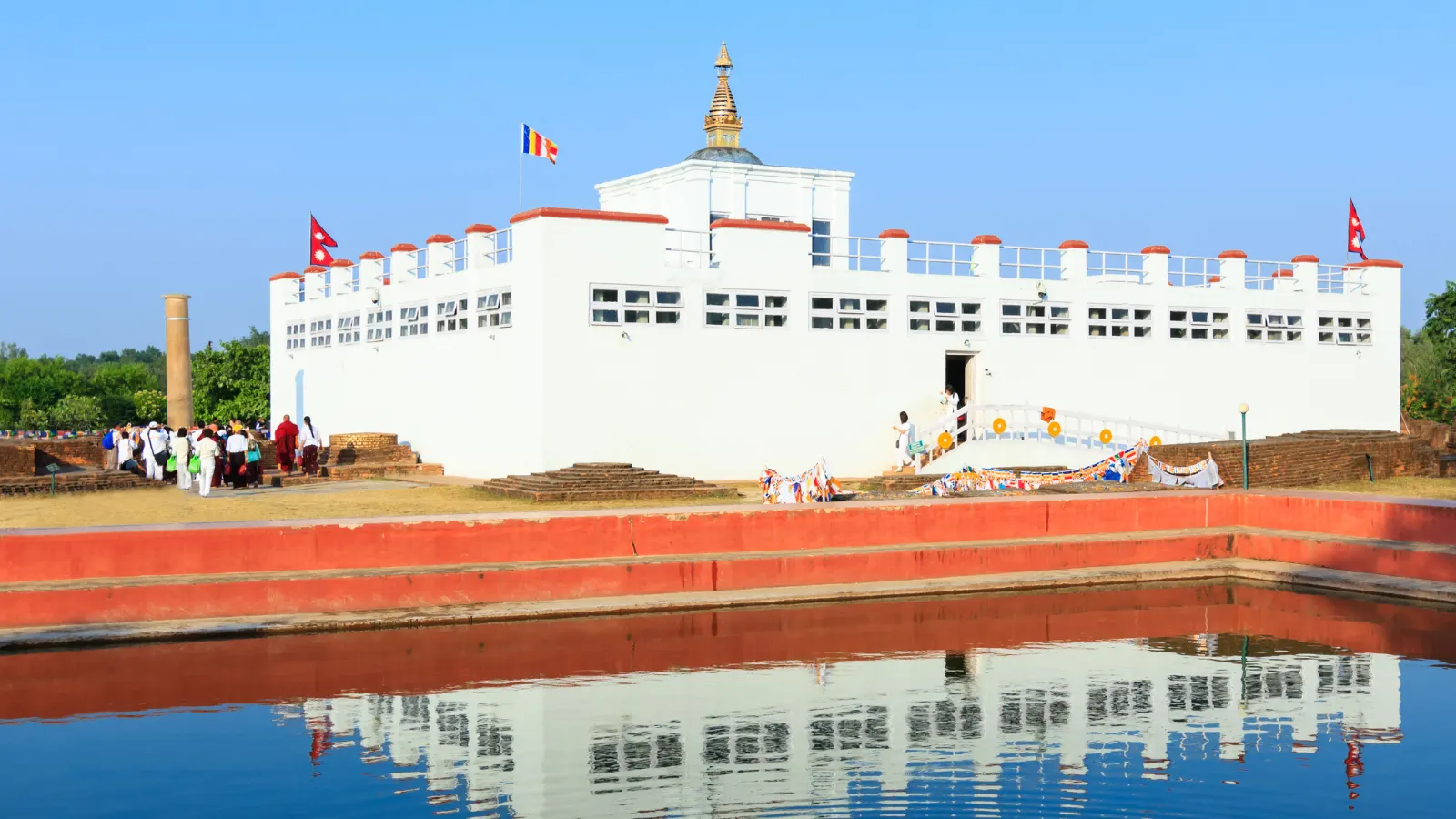
The Maya Devi Temple is the heart of Lumbini and the most sacred spot in the entire complex. The modern temple building, completed in 2003, is built directly over the ancient ruins and archaeological remains that mark the precise location of the Buddha’s birth.
Inside the temple:
- The Marker Stone — A sandstone slab identified as the exact spot where Queen Mayadevi stood when she gave birth to Prince Siddhartha. This is the single most sacred point at Lumbini. Standing before this stone, you are standing at the geographical origin of Buddhism itself
- Ancient temple foundations — The ruins of earlier temples and structures built over the birthplace across different centuries are visible through a glass floor. The layers of construction, going back to the 3rd century BCE, tell the story of how pilgrims and kings have honoured this spot for over 2,300 years
- The Nativity Sculpture — A carved stone panel depicting the birth scene — Queen Mayadevi holding the tree branch, with the infant prince below
The experience for Thai pilgrims:
Thai pilgrimage groups conduct a chanting ceremony inside the Maya Devi Temple, offering prayers and flowers at the birthplace marker. The atmosphere is reverent and deeply emotional. After visiting the sites of the Buddha’s enlightenment (Bodh Gaya), his teaching (Sarnath), and his passing (Kushinagar), arriving at the place where his life began brings the entire pilgrimage full circle. Many pilgrims describe it as a moment of completeness — the feeling that you have now walked the Buddha’s entire journey from birth to liberation.
Practical tips:
- Remove shoes before entering the temple
- Photography may be restricted inside — follow the posted rules
- The temple can be crowded during peak pilgrimage season. Early morning visits are quieter
- Dress modestly — covered shoulders and knees
- Walk clockwise around the temple as part of your circumambulation
2. Ashoka Pillar — 2,300 Years of Proof
Immediately outside the Maya Devi Temple stands the Ashoka Pillar — one of the most important historical monuments in the Buddhist world.
Emperor Ashoka, the great Mauryan ruler who converted to Buddhism and spread the Dhamma across Asia, visited Lumbini in 249 BCE. He erected this stone pillar and had it inscribed with the words confirming that this was indeed the birthplace of the Buddha. The inscription also records that Ashoka reduced taxes for the people of Lumbini in honour of the sacred site.
This pillar is not just a religious monument — it is one of the earliest and most reliable pieces of archaeological evidence establishing the historical reality of the Buddha’s birth and the location of Lumbini. For pilgrims who want to understand Buddhism as both a spiritual path and a historical reality, standing before this 2,300-year-old inscription is a powerful moment.
3. Sacred Pond (Pushkarini)
Adjacent to the Maya Devi Temple is the Sacred Pond — a beautiful, well-maintained pool where, according to tradition, Queen Mayadevi bathed before giving birth, and where the newborn Prince Siddhartha was given his first bath.
The pond is surrounded by trees and a walkway, creating a peaceful spot for reflection. In the afternoon light, the reflections on the still water add to the serene atmosphere. Many pilgrims pause here to sit quietly and contemplate the significance of this place.
4. Eternal Peace Flame
The Eternal Peace Flame was lit in 1986 and has been burning continuously ever since, symbolising the aspiration for world peace through the Buddha’s teachings of compassion and non-violence. It is located in the Sacred Garden area near the Maya Devi Temple.
5. Lumbini Monastic Zone — Monasteries from Around the World
One of the most remarkable features of Lumbini is its extensive Monastic Zone — a large planned area where Buddhist nations from around the world have built monasteries, temples, and meditation centres, each reflecting the architectural tradition and spiritual practice of their home country.
The Monastic Zone is divided into two sections:
- Eastern Monastic Zone — Theravada monasteries (the tradition followed in Thailand, Sri Lanka, Myanmar)
- Western Monastic Zone — Mahayana and Vajrayana monasteries (China, Japan, Korea, Tibet, Vietnam)
The Royal Thai Monastery is located in the Eastern Monastic Zone and is a highlight for Thai pilgrims. Built in traditional Thai architectural style with golden roof decorations and familiar Thai Buddha images, this monastery is a spiritual home for Thai visitors in Nepal. Walking through its halls after the intensity of the pilgrimage gives Thai groups a sense of comfort, familiarity, and pride — the Dhamma that was born here has flourished beautifully in Thailand.
Other notable monasteries in the zone:
- Myanmar (Burmese) Golden Temple — A striking golden pagoda
- Sri Lankan Monastery — Representing the Theravada tradition’s oldest continuous lineage
- Chinese Monastery — Impressive Mahayana architecture
- Japanese Temple — Elegant simplicity
- German Monastery — Representing the growth of Buddhism in Europe
- Korean Monastery — Beautiful traditional design
- Cambodian Monastery — Reflecting Khmer Buddhist heritage
Thai pilgrimage groups sometimes visit additional monasteries in the zone beyond the Thai Monastery, depending on time and interest. The full Monastic Zone is large — covering several square kilometres — so visiting all monasteries in one day is not practical. Focus on the Thai Monastery and 2-3 others that interest your group.
Practical tips for the Monastic Zone:
- The zone is spread out. Cycling or hiring a local vehicle is more practical than walking the entire area
- Some monasteries may have limited opening hours — check locally
- The area is quiet and pleasant for walking, with tree-lined paths and gardens
- Carry water and sun protection, as shade is limited in some areas
6. Lumbini Museum
The Lumbini Museum houses a collection of artifacts, photographs, and information about the archaeological history of Lumbini and the life of the Buddha. It provides useful context for understanding the significance of the sites you have visited.
Getting to Lumbini from Kushinagar: The Border Crossing
For Thai pilgrimage groups on the Buddhist Circuit, Lumbini is typically reached by road from Kushinagar, crossing the India-Nepal border at Sunauli (Indian side) / Belahiya (Nepal side).
Most groups make this journey on the same day they depart Kushinagar — leaving in the morning, crossing the border during the day, and arriving in Lumbini by afternoon or evening.
The Route
| Segment | Distance | Estimated Time |
|---|---|---|
| Kushinagar to Sunauli border | ~160 km | 3-4 hours |
| Border crossing process | — | 1-5 hours |
| Belahiya (Nepal side) to Lumbini | ~100 km | 2-2.5 hours |
| Total Kushinagar to Lumbini | ~260 km | 6-11 hours (including border) |
What to Expect at the Border
The Sunauli-Belahiya border crossing is a land border used regularly by pilgrimage groups. Here is what the process looks like:
Step 1: Indian side (Sunauli)
- Your bus stops at the Indian immigration checkpoint
- All passengers exit the bus with their passports
- Indian immigration stamps your passport for departure
- This usually takes 30-60 minutes for a group
Step 2: Cross into Nepal (Belahiya)
- The border is a short walk or drive between the two checkpoints
- Your same bus continues into Nepal — Indian vehicles are permitted to enter Nepal, so there is no need to change vehicles. This makes the crossing much more convenient for groups
Step 3: Nepal immigration (Belahiya)
- Thai citizens can obtain a Nepal visa on arrival at the border
- Visa fee: Approximately $30 USD for a 15-day visa
- Documents needed: Valid passport (minimum 6 months validity), one passport-size photograph, and the visa fee in USD cash
- Nepal immigration stamps your passport and issues the visa
- This is typically the longest part of the process, especially during peak pilgrimage season when many groups are crossing
How long does the border crossing take? In our experience over 25 years, the total border crossing can take anywhere from 1 to 5 hours. The wide range depends on:
- The day of the week (weekdays are generally faster)
- The number of other groups crossing at the same time
- How quickly the immigration officers are processing
- Whether there are any system or power issues at the checkpoints
On a good day, you can be through in about an hour. On a busy day during peak season, it can take several hours. We always plan the day with this variability in mind, and our team assists with all paperwork and coordination at both checkpoints.
Border Crossing Tips for Thai Pilgrims
- Keep your passport in your carry bag, not in luggage stored in the bus compartment. You will need it in your hand at both checkpoints
- Carry USD cash for the Nepal visa fee. Exact amount ($30) is helpful. Nepalese Rupees or Indian Rupees may also be accepted but USD is most reliable
- Bring one passport-size photograph. Have it ready before you arrive at the border
- Use the restroom at your hotel before departing. Border facilities are very basic
- Be patient. The border process can feel slow, but it always gets done. Use the waiting time for conversation, prayer, or rest
- Carry water and snacks. Depending on the wait time, you may spend several hours at the border area
- Your tour operator should handle the logistics. A good operator will have experience with this crossing and will guide your entire group through each step. We have been doing this crossing with Thai groups for over two decades
Where to Stay in Lumbini
Lumbini has a growing range of accommodation options. Hotels here are generally simpler than in Bodh Gaya or Varanasi, but the pilgrimage-focused properties offer clean rooms, vegetarian meals, and basic comfort.
Accommodation options:
- Pilgrimage hotels near the Sacred Garden: The most convenient location — within walking distance or a short ride to the Maya Devi Temple. These cater specifically to Buddhist pilgrimage groups
- Lumbini Buddha Garden Resort and similar mid-range options: Comfortable properties with gardens, restaurants, and good service
- Monastery guesthouses: Some monasteries in the Monastic Zone offer simple accommodation at very affordable rates
Booking advice:
- Book in advance during peak season (November to February)
- Confirm that your hotel provides hot water and vegetarian meals
- Most Thai groups spend 1 night in Lumbini, arriving from Kushinagar in the afternoon/evening and departing the next morning after visiting the sacred sites
Best Time to Visit Lumbini
Lumbini’s climate is similar to the northern Indian plains, though it can feel slightly cooler due to its proximity to the foothills.
| Season | Months | Temperature | Recommendation |
|---|---|---|---|
| Winter (Best) | November – February | 8°C – 23°C | Ideal — cool, clear, dry |
| Spring | March – April | 20°C – 35°C | Pleasant in March, warming in April |
| Summer | May – June | 30°C – 40°C | Hot and humid — not ideal |
| Monsoon | July – September | 25°C – 35°C | Very heavy rain — avoid |
Note: Lumbini can be slightly cooler than the Indian plains in winter, especially in the mornings. Carry an extra warm layer when crossing from India.
For a detailed seasonal guide covering the entire Buddhist Circuit, read our Best Time to Visit Bodh Gaya and the Buddhist Circuit from Thailand.
Practical Tips for Thai Pilhttps://floralwhite-eel-181618.hostingersite.com/best-time-to-visit-bodh-gaya-buddhist-circuit-2026/grims in Lumbini
Currency
Nepal uses the Nepalese Rupee (NPR), not the Indian Rupee. While Indian currency is sometimes accepted informally in the border area, you should have some Nepalese Rupees for purchases in Lumbini. Money exchange is available at the border and in Lumbini town. Your tour operator can advise on the best approach for your group.
Language
Nepali is the main language, but English is understood at hotels and tourist sites. In the border area and smaller shops, communication may require gestures or help from your guide.
Food
Hotels in Lumbini serve vegetarian meals suitable for Buddhist pilgrimage groups. The food is similar to North Indian vegetarian cuisine — rice, dal, vegetables, roti. Some hotels may also offer Nepali specialities. As always, drink only bottled water.
Temple Etiquette
The same respectful practices apply at Lumbini as at all Buddhist sacred sites:
- Remove shoes before entering the Maya Devi Temple
- Dress modestly with covered shoulders and knees
- Walk clockwise during circumambulation
- Maintain silence or speak softly inside sacred areas
- Ask permission before photographing
Getting Around Lumbini
The Sacred Garden (Maya Devi Temple, Ashoka Pillar, Sacred Pond) is compact and walkable. However, the Monastic Zone is spread over a large area. Options for getting around include:
- Bicycle rental — A popular and pleasant way to explore the Monastic Zone. Available near the main entrance
- Electric rickshaws — Available for hire for short trips
- Your tour bus — Can drive to specific monasteries if your group prefers not to cycle or walk
How Long to Spend
1 night and half a day is sufficient for most Thai pilgrimage groups to visit the Maya Devi Temple (with chanting), the Ashoka Pillar, the Sacred Pond, the Eternal Peace Flame, and the Royal Thai Monastery. If your group wants to explore the full Monastic Zone or spend more time in meditation at the birthplace, 2 nights allows a more relaxed pace.
Lumbini’s Place in the Buddhist Circuit
Lumbini is one of the four most sacred Buddhist pilgrimage sites — marking the beginning of the Buddha’s life, just as Kushinagar marks its end.
On a typical 8-day Buddhist Circuit from Thailand, Lumbini fits into the journey like this:
…Kushinagar (Mahaparinirvana) → Border crossing → Lumbini (Birth) → Sravasti (24 rainy seasons of teaching) → Varanasi/Sarnath (First sermon)…
This sequence creates a beautiful narrative: after witnessing the place where the Buddha’s earthly life ended in Kushinagar, you cross into Nepal and arrive at the place where that life began. It is a journey from ending to beginning, from Mahaparinirvana back to birth — a reflection on the cycle of existence that the Buddha’s own life and teachings illuminate.
Related guides for your pilgrimage planning:
- Complete Buddhist Pilgrimage Tour from Thailand to India (2026 Guide)
- Kushinagar Travel Guide 2026
- Bodh Gaya Travel Guide for Buddhist Pilgrims
- Sravasti: Walk in the Footsteps of Buddha
- Varanasi and Sarnath Travel Guide
- Nalanda Buddhist Pilgrimage Guide
Frequently Asked Questions
What is the significance of Lumbini in Buddhism? Lumbini is the birthplace of Lord Buddha — the place where Queen Mayadevi gave birth to Prince Siddhartha Gautama over 2,500 years ago. It is one of the four most sacred Buddhist pilgrimage sites in the world and a UNESCO World Heritage Site. Emperor Ashoka’s pillar inscription from 249 BCE confirms this as the Buddha’s birthplace.
Do Thai citizens need a visa for Nepal? Yes. Thai citizens can obtain a Nepal visa on arrival at the Sunauli-Belahiya border crossing. The fee is approximately $30 USD for a 15-day visa. You will need your passport and one passport-size photograph. Carry the fee in USD cash.
How long does the India-Nepal border crossing take? The total border crossing can take anywhere from 1 to 5 hours, depending on the day and how busy the immigration checkpoints are. Peak pilgrimage season tends to be busier. Your tour operator should assist with all paperwork and coordination.
Can the Indian tour bus enter Nepal? Yes. Indian vehicles are permitted to enter Nepal, so your group can continue in the same AC bus throughout the border crossing and into Lumbini. There is no need to change vehicles at the border, which makes the journey much more convenient.
How many days should I spend in Lumbini? Most Thai pilgrimage groups on the Buddhist Circuit spend 1 night in Lumbini. This allows enough time to visit the Maya Devi Temple, Ashoka Pillar, Sacred Pond, and the Royal Thai Monastery. Groups wanting a deeper experience with the full Monastic Zone can stay 2 nights.
Is there a Thai Monastery in Lumbini? Yes. The Royal Thai Monastery in the Eastern Monastic Zone is built in traditional Thai architectural style and is a highlight for Thai pilgrims. It offers a familiar spiritual space and a reminder that the Dhamma born at this very spot thrives in Thailand today.
Can my group hold a chanting ceremony at the Maya Devi Temple? Yes. Thai pilgrimage groups regularly conduct chanting ceremonies inside the temple at the birthplace marker. Your tour operator can help coordinate timing for a peaceful experience.
What currency is used in Lumbini? The Nepalese Rupee (NPR). Indian Rupees may be accepted informally in the border area, but you should have Nepalese Rupees for purchases in Lumbini. Money exchange is available at the border and in town.
Is Lumbini well-developed for tourists? Lumbini has been developed significantly as a pilgrimage destination, with the Sacred Garden, Monastic Zone, museum, and hotels all catering to international visitors. However, it remains a relatively quiet, peaceful place compared to major Indian cities. Facilities are adequate but simpler than what you might find in Bangkok or even Varanasi.
Plan Your Lumbini Pilgrimage
Prime Value Tours has been guiding Thai Buddhist pilgrims to Lumbini and across the entire Buddhist Circuit since 1999. We handle the India-Nepal border crossing, vehicle coordination, hotels, meals, guided visits, and chanting ceremony arrangements — so your group can focus on the profound spiritual experience of standing at the Buddha’s birthplace.
Contact us to start planning:
- Email: info@primevaluetours.com
- Line: line.me/ti/p/6QtZRvYpeP
- WhatsApp: +91-9794122849
- Website: primevaluetours.com