
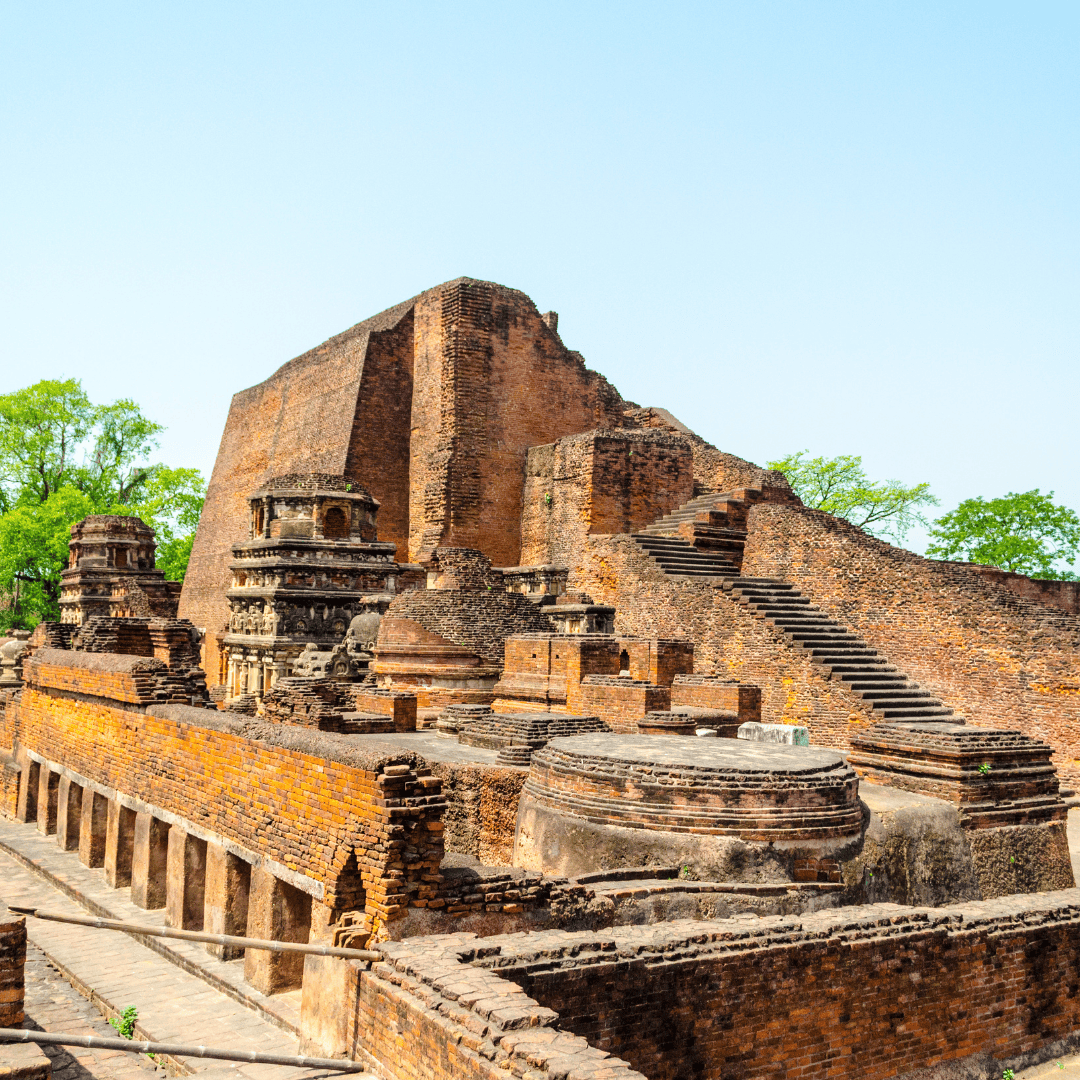
Nalanda & Rajgir Travel Guide for Thai Buddhist Pilgrims | 2026 Guide: A complete travel guide to Nalanda and Rajgir for Thai Buddhist pilgrims. Ancient Buddhist university ruins, Vulture Peak chanting, how to reach them from Bodh Gaya, practical tips, and insider advice from 25+ years of guiding Thai groups.
If Bodh Gaya is where the Buddha found enlightenment and Sarnath is where he began teaching, then Rajgir and Nalanda are where the Dhamma took root and flourished into a tradition that would transform all of Asia.
Rajgir — ancient Rajagriha — was one of the Buddha’s most beloved cities. He spent years here, teaching on the summit of Vulture Peak, receiving the first gift of land for the Sangha at the Bamboo Grove, and building a close relationship with King Bimbisara, one of his earliest royal supporters. Some of the most important suttas in the Pali Canon were delivered from the rocky hilltop of Griddhakuta, where the Buddha sat overlooking the valley and spoke to monks gathered at his feet.
Nalanda, just 15 kilometres from Rajgir, became the greatest Buddhist university the world has ever known. For over 700 years, it attracted thousands of monks and scholars from across Asia — including from the lands that are now Thailand — to study the Dhamma, philosophy, logic, medicine, and astronomy. At its peak, Nalanda housed over 10,000 students and 2,000 teachers. Walking through its vast ruins today, you can still feel the scale of what Buddhist learning once was.
Thai pilgrimage groups on the Buddhist Circuit almost always visit Rajgir and Nalanda together on the same day, typically on the journey between Bodh Gaya and Patna. We have been guiding Thai groups through both sites for over 25 years, and these two destinations — one a sacred mountain where the Buddha’s voice echoed across the valley, the other a university where his teachings were preserved and studied for centuries — together create one of the most intellectually and spiritually rich days on the entire pilgrimage.
Rajgir: Where the Buddha Taught on Vulture Peak
Rajgir (ancient Rajagriha, meaning “House of the King”) was the capital of the powerful Magadha kingdom and one of the most important cities in the Buddha’s life. He spent many rainy seasons here, attracted powerful discuses, and delivered teachings that form the foundation of both Theravada and Mahayana Buddhism.
The city sits in a natural bowl surrounded by five hills, giving it a dramatic and beautiful setting. In the Buddha’s time, it was one of the largest and most prosperous cities in India.
Griddhakuta (Vulture Peak) — The Buddha’s Mountain Pulpit
Vulture Peak is the highlight of any visit to Rajgir and one of the most spiritually powerful places on the Buddhist Circuit. This rocky hilltop is where the Buddha delivered many of his most important teachings, including discourses that form the basis of several key suttas.
The name “Vulture Peak” (Griddhakuta in Sanskrit, Gijjhakuta in Pali) comes from the shape of the rock at the summit, which is said to resemble a vulture’s beak. The Buddha chose this elevated, peaceful spot for teaching because of its natural beauty, its distance from the noise of the city below, and the expansive view across the Rajgir valley.
Getting to the top:
There are two ways to reach Vulture Peak:
- Ropeway/Chair lift: For elderly pilgrims or those who prefer not to climb, a chair lift operates from the base of the hill to a point near the Japanese Peace Pagoda at the top of the adjacent hill. From there, you can walk along the ridge to Vulture Peak. This is a comfortable option, though it still involves some walking at the top
At the summit:
The summit of Vulture Peak is a small, rocky platform — surprisingly intimate for a place of such immense spiritual significance. A small brick structure marks the spot where the Buddha is believed to have sat while teaching. The view from here — across the green valley with the surrounding hills — is stunning.
Thai pilgrimage groups conduct chanting ceremonies at the summit of Vulture Peak. The sound of Pali verses ringing out from the same hilltop where the Buddha’s voice once carried across the valley is one of the most moving experiences on the Buddhist Circuit. Groups gather on the small platform, monks lead the chanting, and for a few minutes the ancient and the present merge completely.
Practical tips for Vulture Peak:
- Wear comfortable shoes with good grip — the stone steps can be slippery, especially if there has been any moisture
- Carry water — there are no facilities on the hill
- Start early in the morning if possible, before the heat of the day makes the climb uncomfortable
- The climb is manageable for most people, but if your group includes elderly pilgrims with mobility concerns, the ropeway is a good alternative
- Allow about 1 to 1.5 hours total for the Vulture Peak visit including the climb, time at the top for chanting, and the descent
Venuvana (Bamboo Grove) — The First Monastery
At the foot of the hills, the Venuvana Vihara (Bamboo Grove) holds a special place in Buddhist history. This peaceful garden was donated to the Buddha and the Sangha by King Bimbisara of Magadha — making it the first piece of land ever given to the Buddhist monastic community.
Before Venuvana, the Buddha and his monks had no permanent place to stay. They wandered from place to place, sleeping under trees and in caves. King Bimbisara’s gift changed everything — it gave the Sangha a home base, a place for extended teaching and meditation during the rainy season, and a model for all the monasteries that would follow across Asia.
Today, Venuvana is a quiet garden with tall bamboo groves, a small pond, and neatly maintained grounds. A modern Burmese-style temple and a Japanese temple are nearby. The atmosphere is peaceful and contemplative.
Practical tips:
- Allow about 30 minutes for a relaxed visit
- The garden is flat and easy to walk through — suitable for all pilgrims
- A good place for group photographs with the bamboo groves as a backdrop
Other Sites in Rajgir
Ajatashatru’s Fort: The ruins of the ancient fortress built by King Ajatashatru, Bimbisara’s son, who initially opposed the Buddha but later became a supporter. The massive stone walls give you a sense of Rajgir’s importance as a political and military centre in the Buddha’s time.
Japanese Peace Pagoda (Vishwa Shanti Stupa): A gleaming white stupa built on a hilltop by the Japanese Buddhist Nipponzan Myohoji order. The stupa contains four golden statues of the Buddha representing key events in his life. The views from the hilltop are excellent, and the ropeway from the base of Vulture Peak stops near here.
Bimbisara’s Jail: The ruins of the palace where King Bimbisara was imprisoned by his own son Ajatashatru. According to Buddhist tradition, Bimbisara chose this location for his prison because it offered a view of Vulture Peak, where the Buddha often taught.
Hot Springs (Brahmakund): Natural hot springs considered sacred by both Hindus and Buddhists. The warm mineral water is believed to have healing properties. The main spring area can be crowded and is more of a cultural experience than a pilgrimage site.
Nalanda: The Greatest Buddhist University in History
Just 15 kilometres from Rajgir, the ruins of Nalanda Mahavihara stand as a monument to what may be the most ambitious educational institution the ancient world ever produced.
The Legacy of Nalanda
Nalanda was founded in the 5th century CE during the Gupta dynasty, though Buddhist monastic activity at the site goes back much further — the Buddha himself is believed to have visited and taught in the Nalanda area during his lifetime.
For over 700 years, Nalanda operated as the world’s largest and most prestigious Buddhist university. To understand its scale, consider these facts:
- At its peak, Nalanda housed over 10,000 students and 2,000 teachers
- The campus included massive monasteries (viharas), temple complexes, meditation halls, and lecture rooms
- Its libraries — collectively known as Dharmaganja (“Treasury of Truth”) — were said to contain hundreds of thousands of manuscripts. One library building, the Ratnasagara (“Ocean of Jewels”), was reportedly nine stories tall
- Students came from across Asia — China, Korea, Japan, Tibet, Central Asia, Southeast Asia, and the regions that are now Thailand, Myanmar, and Indonesia
- The curriculum covered not just Buddhist philosophy and meditation, but also logic, grammar, astronomy, medicine, and mathematics
The Chinese monk Xuanzang, who travelled from China to India in the 7th century CE, spent several years studying at Nalanda. His detailed written accounts of the university are among the most important historical documents about Buddhist India. He described a place of extraordinary intellectual energy, rigorous debate, and deep spiritual practice.
Nalanda was destroyed in the late 12th century CE, likely by invading forces. The libraries were burned — a loss of knowledge that historians consider one of the greatest tragedies in human intellectual history. The site was gradually abandoned and the ruins were buried under earth until British-era archaeologists began excavations in the 19th century.
Why Nalanda Matters for Thai Buddhists
The connection between Nalanda and Thailand runs deep, even if it is not always visible on the surface. The Buddhist teachings that eventually reached Southeast Asia — the suttas, the commentaries, the meditation practices, the monastic rules — were studied, debated, refined, and preserved at centres like Nalanda before spreading across the continent.
When you walk through Nalanda’s ruins, you are walking through the place where the intellectual foundations of the Buddhism you practise in Thailand were built. The monks who studied here carried the Dhamma outward, generation after generation, until it reached the lands of Suvarnabhumi — the ancient name for mainland Southeast Asia, which includes Thailand.
Standing in Nalanda is standing at the roots of your own tradition.
What to See at Nalanda
The Ruins of Nalanda Mahavihara (UNESCO World Heritage Site)
The excavated ruins cover a vast area — approximately 14 hectares of monasteries and temples have been uncovered, and archaeologists believe much more remains unexcavated beneath the surrounding fields.
The site is laid out in an orderly pattern:
- Monasteries (Viharas) line the eastern side — rows of small cells arranged around central courtyards, where monks lived, slept, and meditated. Walking through these quiet corridors, you can imagine the daily life of thousands of monks who studied here centuries ago
- Temple complexes line the western side — larger structures where teachings, debates, and ceremonies took place
Temple No. 3 (The Great Temple): The largest and most impressive structure at Nalanda. Multiple layers of construction are visible — earlier temples built on top of even earlier ones, showing how the site grew and was renovated over centuries. Climb to the upper level for a panoramic view across the entire ruins complex. From here, the sheer scale of ancient Nalanda becomes real — monastery after monastery, stretching into the distance.
Thai pilgrimage groups spend approximately 2 hours at Nalanda, walking through the ruins with a guide who explains the history and significance of each structure. Groups typically hold a chanting ceremony among the ruins — offering prayers in the very place where Buddhist monks studied and practised for seven centuries. Chanting Pali verses surrounded by the ancient walls of a Buddhist university is a uniquely powerful experience.
Nalanda Archaeological Museum
Located near the ruins entrance, this museum houses artifacts discovered during excavations:
- Ancient Buddha statues in various styles and materials (stone, bronze, terracotta)
- Carved stone panels depicting scenes from the Buddha’s life and from daily life at the university
- Bronze sculptures of Buddhist deities
- Seals and inscriptions providing clues about the university’s administration
- Architectural fragments from the original buildings
Some Thai groups visit the museum; others prefer to spend their time at the ruins themselves. If your group is interested in the historical artifacts, allow an additional 30-45 minutes for the museum. The museum is closed on Fridays.
Xuanzang Memorial Hall
A modern memorial dedicated to the famous Chinese monk Xuanzang, whose detailed accounts of Nalanda provide some of our best information about the ancient university. The memorial includes exhibits about his remarkable journey from China to India and back. A few Thai groups visit this site, but it is optional depending on your schedule and interest.
Visiting Rajgir and Nalanda Together: Practical Planning
Thai pilgrimage groups almost always visit Rajgir and Nalanda on the same day, as part of the journey from Bodh Gaya towards Patna. The two sites are only 15 kilometres apart, making them natural companions.
Route and Timing
| Segment | Distance | Driving Time |
|---|---|---|
| Bodh Gaya to Rajgir | ~80 km | 2 hours |
| Rajgir to Nalanda | ~15 km | 20-30 minutes |
| Nalanda to Patna | ~90 km | 2 hours |
Typical day plan (order may vary depending on timing):
Option A — Rajgir first (recommended for early start):
- Depart Bodh Gaya early morning → arrive Rajgir
- Vulture Peak (1-1.5 hours including climb and chanting)
- Venuvana Bamboo Grove (30 minutes)
- Drive to Nalanda (20 minutes)
- Nalanda ruins and optional museum (2 hours)
- Drive to Patna for overnight stay
Option B — Nalanda first (if departing Bodh Gaya later):
- Depart Bodh Gaya → drive to Nalanda
- Nalanda ruins and optional museum (2 hours)
- Drive to Rajgir (20 minutes)
- Vulture Peak and Venuvana
- Drive to Patna for overnight stay
Your tour operator will recommend the best order based on your group’s departure time, the weather, and the crowd levels at each site. Both options work well.
Total Time Needed
Plan for approximately 4 to 5 hours to visit both Rajgir (Vulture Peak and Venuvana) and Nalanda (ruins and optional museum) comfortably, not including driving time between Bodh Gaya, the sites, and Patna.
How to Reach Rajgir and Nalanda
For Thai pilgrimage groups on the Buddhist Circuit, Rajgir and Nalanda are reached by road from Bodh Gaya, typically on the day your group departs Bodh Gaya heading towards Patna.
| From | To Rajgir | To Nalanda |
|---|---|---|
| Bodh Gaya | ~80 km (2 hours) | ~95 km (2.5 hours) |
| Patna | ~100 km (2.5 hours) | ~90 km (2 hours) |
| Varanasi | ~330 km (7 hours) | ~340 km (7 hours) |
Nearest airport: Gaya International Airport (for Bodh Gaya) or Patna Airport. There is no airport at Rajgir or Nalanda.
Nearest railway station: Rajgir has a small railway station, but most pilgrimage groups travel by road from Bodh Gaya.
For the complete day-by-day route of the Buddhist Circuit, read our Complete Buddhist Pilgrimage Tour from Thailand to India (2026 Guide).
Practical Tips for Thai Pilgrims
At Vulture Peak
- Footwear: Wear comfortable shoes with good grip for the climb. Sandals and flip-flops are not recommended on the stone steps
- Water: Carry at least one bottle per person — there are no water vendors on the hill
- Sun protection: The hilltop is exposed. Wear a hat and sunscreen, especially from March onwards
- Ropeway option: The chair lift operates seasonally. Check with your guide on the day whether it is running. Even with the ropeway, some walking is involved at the top
- Pace yourself: The climb is moderate but steady. Go slowly, especially if your group includes elderly pilgrims. There are resting spots along the path
- Chanting: Coordinate with your group’s monks for a chanting session at the summit. The small platform fills up quickly, so arriving early helps
At Nalanda
- Walking shoes: The ruins cover a large area on uneven ground. Comfortable walking shoes are essential
- Sun protection: There is very little shade across the ruins complex. Carry water, wear a hat, and apply sunscreen
- Guided visit: A knowledgeable guide makes an enormous difference at Nalanda. Without context, the ruins look like walls and foundations. With a guide, they come alive as dormitories, classrooms, libraries, and temples. Make sure your tour includes an experienced guide for this site
- Photography: Allowed throughout the ruins and museum
- Time management: 2 hours is a good amount of time for the ruins. If adding the museum, allow 2.5-3 hours total
General Tips
- Carry snacks and water for the day — facilities between Bodh Gaya, Rajgir, and Nalanda are limited
- ATMs are available in Rajgir town but may not always be reliable. Carry enough cash for the day
- The drive between sites passes through beautiful rural Bihar countryside — rice paddies, small villages, and ox carts. It is a pleasant journey that gives you a real picture of everyday Indian rural life
- Toilet facilities are available at the main sites but are basic. Use your hotel restroom before departing Bodh Gaya in the morning
Best Time to Visit
Rajgir and Nalanda share the same climate as Bodh Gaya and the broader Bihar plains.
| Season | Months | Temperature | Recommendation |
|---|---|---|---|
| Winter (Best) | November – February | 8°C – 25°C | Ideal for climbing Vulture Peak and walking the ruins |
| Spring | March – April | 22°C – 38°C | Acceptable but warm — climb early morning |
| Summer | May – June | 35°C – 45°C | Not recommended — extreme heat makes outdoor sites unbearable |
| Monsoon | July – September | 28°C – 35°C | Slippery paths at Vulture Peak, muddy ruins — avoid |
For a detailed seasonal guide, read our Best Time to Visit Bodh Gaya and the Buddhist Circuit from Thailand.
Frequently Asked Questions
Can Rajgir and Nalanda be visited in one day? Yes. They are only 15 kilometres apart and are almost always visited together on the same day. Allow 4-5 hours total for both sites (not including driving time from Bodh Gaya to Rajgir and from Nalanda to Patna).
Is the Vulture Peak climb difficult? The climb is moderate — a paved path with stone steps taking about 15-20 minutes. It is manageable for most people at a steady pace. For elderly pilgrims or those with mobility concerns, a ropeway/chair lift is available (check seasonal availability). Even with the ropeway, some walking is required at the top.
Can my group hold chanting ceremonies at these sites? Yes. Thai groups regularly chant at both the summit of Vulture Peak and among the ruins of Nalanda. These are two of the most spiritually meaningful chanting experiences on the Buddhist Circuit — one on the hilltop where the Buddha taught, the other in the university where his teachings were preserved for centuries.
How long should we spend at Nalanda? Approximately 2 hours is ideal for the main ruins. Add 30-45 minutes if your group wants to visit the Archaeological Museum.
What is the connection between Nalanda and Thailand? The Buddhist teachings that eventually reached Southeast Asia — including the suttas, meditation practices, and monastic rules followed in Thailand — were studied, debated, and preserved at centres like Nalanda for centuries before spreading across the continent. Visiting Nalanda is visiting the intellectual roots of Thai Buddhism.
Is there an entry fee? Yes, nominal entry fees apply at both the Nalanda ruins and the Rajgir sites. Your tour operator typically includes these in the tour cost.
What should I wear? Comfortable walking shoes are essential for both sites. At Vulture Peak, avoid sandals or flip-flops on the stone steps. Dress modestly as these are sacred Buddhist sites. In winter, carry a light jacket for the morning — it can be cool, especially at the hilltop.
Is Nalanda fully excavated? No. Only about 14 hectares have been excavated so far. Archaeologists believe the original university campus was much larger, with significant portions still buried beneath the surrounding agricultural land. What you see today — while impressive — represents only a fraction of what Nalanda once was.
Rajgir and Nalanda’s Place in the Buddhist Circuit
On a typical 8-day Buddhist Circuit from Thailand, Rajgir and Nalanda are visited on Day 3 — the day your group departs Bodh Gaya and heads towards Patna:
…Bodh Gaya (Enlightenment, 2 nights) → Rajgir & Nalanda (Day visit) → Patna (overnight) → Vaishali → Kushinagar…
This placement works beautifully in the pilgrimage narrative. After spending two days at the site of the Buddha’s enlightenment, you travel to the places where he taught and where his teachings were studied and preserved — a natural progression from the moment of awakening to the spread of the Dhamma.
Related guides for your pilgrimage planning:
- Complete Buddhist Pilgrimage Tour from Thailand to India (2026 Guide)
- Bodh Gaya Travel Guide for Buddhist Pilgrims
- Kushinagar Travel Guide 2026
- Lumbini Travel Guide 2026
- Sravasti: Walk in the Footsteps of Buddha
- Varanasi and Sarnath Travel Guide
Plan Your Rajgir and Nalanda Visit
Prime Value Tours includes Rajgir and Nalanda as a key day on all our Buddhist Circuit tours from Thailand. We provide experienced guides who bring the ruins and hilltops to life with historical context and spiritual insight, comfortable AC transport between all sites, and coordination of chanting ceremonies at Vulture Peak and Nalanda.
Contact us to start planning:
- Email: info@primevaluetours.com
- Line: line.me/ti/p/6QtZRvYpeP
- WhatsApp: +91-9794122849
- Website: primevaluetours.com