
Vaishali Travel Guide for Thai Buddhist Pilgrims | Ashokan Pillar & Relic Stupa 2026 — Complete Vaishali travel guide for Thai Buddhist pilgrims. Visit the site of the Buddha’s last sermon, the Ashokan Lion Pillar, the Relic Stupa enshrining the Buddha’s ashes, practical tips, and 25+ years of guiding Thai pilgrimage groups.
Of all the moments in the Buddha’s life, perhaps the most tender is this: standing in the city of Vaishali, surrounded by his devoted followers, he quietly announced that in three months he would leave the world.
He did not flee or disappear. He gave the people of Vaishali a farewell. He turned, looked back at the city one last time, and then walked slowly northward towards Kushinagar. That final glance a gesture so human, so filled with compassion is recorded in the Pali texts and is still recalled by pilgrims who visit Vaishali today.
This is what makes Vaishali different from every other site on the Buddhist Circuit. Bodh Gaya is where the Buddha found enlightenment. Sarnath is where the teaching began. Kushinagar is where he passed from the world. But Vaishali is where he said goodbye quietly, gently, with the same boundless compassion that had defined his entire ministry.
For Thai Buddhists, Vaishali carries additional significance. It was here, in this ancient republic, that the Buddha made a decision that transformed Buddhism forever: he agreed to admit women into the Sangha for the first time, creating the order of bhikkhunis — fully ordained nuns. The inclusion of women as equal participants in the spiritual path, something that was revolutionary in the ancient world, was ratified here, in Vaishali.
We have been bringing Thai pilgrimage groups to Vaishali for over 25 years. It is one of the quieter stops on the Buddhist Circuit smaller than Bodh Gaya, less visited than Sarnath but every Thai group we have brought here has been deeply moved. There is a stillness in Vaishali, an intimacy, that the larger pilgrimage cities sometimes cannot offer. When you stand beside the Ashokan Pillar at Kolhua and understand what happened at this very spot, it is impossible not to feel it.
Why Vaishali is Sacred: The Buddha’s Last Farewell
To understand Vaishali, you need to understand the Licchavi people who lived here.
Ancient Vaishali known as Vesali in the Pali texts was the capital of the Vajjian Confederacy, a powerful alliance of clans governed not by a single king but by an elected council of representatives. This system, remarkable for its time, made Vaishali what historians today describe as one of the world’s first republics a city of open debate, democratic governance, and civic pride that stood apart from the monarchies that surrounded it.
The Buddha’s connection to Vaishali was deep and longstanding. He visited the city three times across his ministry, and the Licchavis were among his most devoted lay supporters. Vaishali was a prosperous, cosmopolitan city a place of merchants, courtesans, musicians, scholars, and kings and the Buddha taught here across all strata of society.
During these visits, several events of profound importance took place:
The Ratana Sutta According to Buddhist tradition, a plague and famine afflicted Vaishali during one of the Buddha’s visits. The city’s prince came to him for help. The Buddha walked through the city for seven days chanting the Ratana Sutta the Discourse on the Three Jewels a powerful text still chanted in Thai temples today at moments of crisis and protection. By the end of seven days, the calamity had passed. The Ratana Sutta’s association with protection and healing is deeply embedded in Thai Buddhist practice, and Vaishali is the ground where those words were first spoken for exactly this purpose.
The Ordination of Women At Vaishali, the Buddha’s aunt and foster mother, Mahapajapati Gotami, arrived at the city gates with 500 Sakyan women, all requesting ordination as nuns. After careful deliberation, the Buddha agreed establishing the Bhikkhuni Sangha, the order of fully ordained nuns, for the first time. This moment, which happened in Vaishali, changed the course of Buddhism permanently. For Thai Buddhists, who are part of a tradition where nuns and lay women practise alongside monks, the significance of this event cannot be overstated.
The Last Announcement During his final rainy season retreat, the Buddha spent the last monsoon of his life in Vaishali. Here he announced to his attendant Ananda that in three months he would attain Mahaparinirvana. After delivering his final sermon at Kolhua a short distance from the city he accepted the gift of a golden alms bowl from the Licchavis, then gently turned and took one long, compassionate look back at Vaishali. It was his final gaze at the city he had loved. He then walked northward toward Kushinagar, and did not return.
The Second Buddhist Council Approximately one hundred years after the Buddha’s passing, the Second Buddhist Council was convened at the Valukarama Monastery in Vaishali. This gathering of monks addressed disagreements about monastic rules that had begun to emerge across the growing Sangha an event that shaped the development of Theravada Buddhism, the tradition that Thai Buddhism follows today.
Sacred Sites in Vaishali: A Complete Guide
The sacred sites of Vaishali are spread across a rural landscape in Bihar, clustered around three main archaeological areas. A half-day visit which is what most Thai pilgrimage groups spend at Vaishali covers the most important sites comfortably.
1. Kolhua Complex — The Ashokan Pillar and Site of the Last Sermon
Kolhua is the first place most pilgrims visit in Vaishali, and it is the spiritual heart of the entire site.
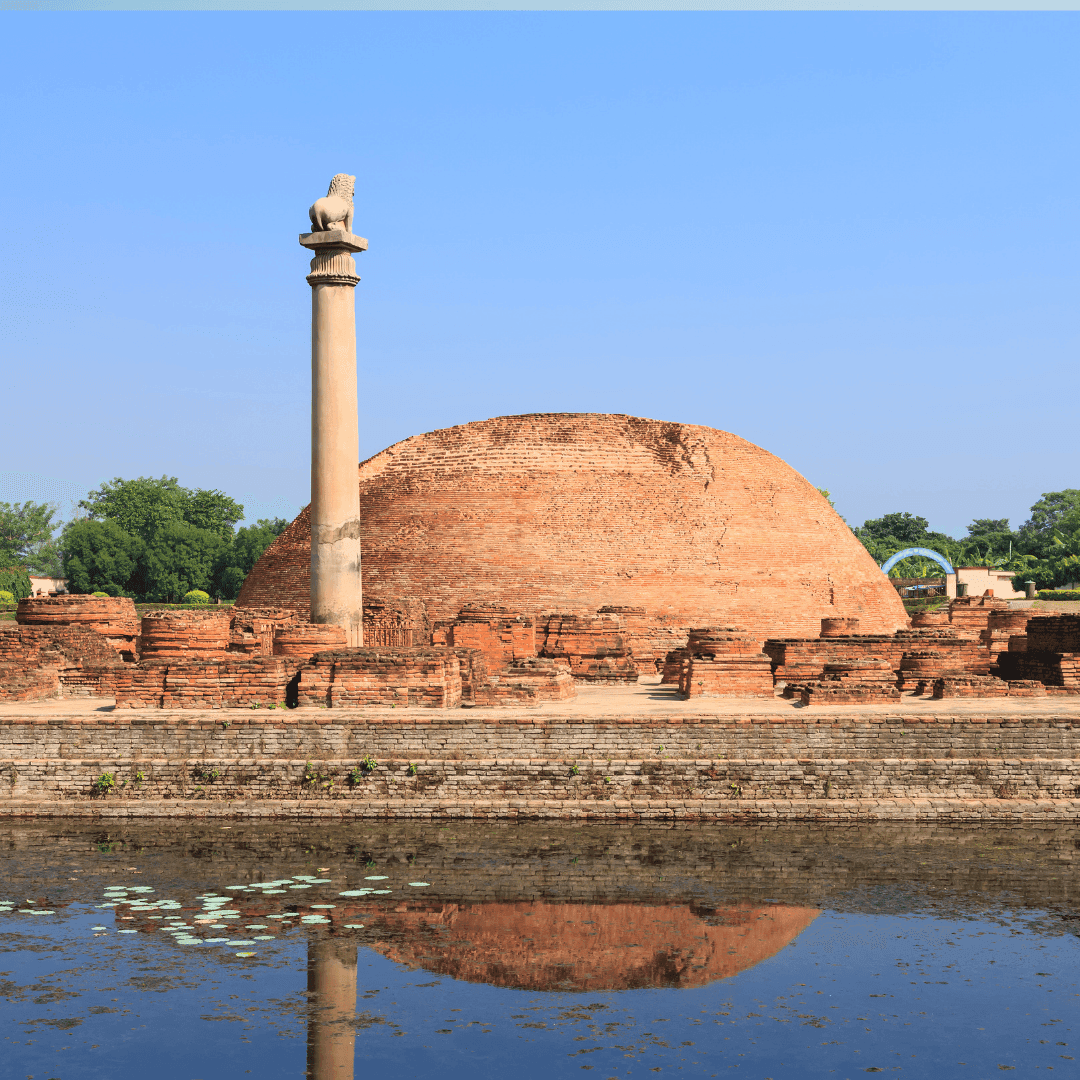
At the entrance of the Kolhua complex stands the Ashokan Pillar an 18.3-metre red sandstone column erected by Emperor Ashoka in the 3rd century BCE to commemorate the Buddha’s final visit to Vaishali. Crowned by a beautifully carved single Asiatic lion, the pillar is one of the best-preserved of all the Ashokan pillars in India. Unlike several other Ashokan pillars that bear inscriptions, this one carries no text only the lion, standing alone, gazing toward Kushinagar, as if marking the direction the Buddha walked on his final journey.
Beside the pillar stands a hemispherical brick stupa, believed to mark the exact spot where the Buddha delivered his last sermon before departing for Kushinagar. Standing between the pillar and the stupa with the lion’s gaze above you and the knowledge of what happened here beneath your feet is one of the most quietly powerful moments on the entire Buddhist Circuit.
Most Thai pilgrimage groups conduct their chanting ceremony at Kolhua beside this stupa reciting suttas and offering flowers and incense at the site of the Buddha’s final teaching. Groups that have chanted the Ratana Sutta in Thai temples back home often choose to chant it here, at the very place where those words were first spoken for protection and healing.
Adjacent to the stupa is a small Monkey Tank (Markatahrada in Sanskrit) a bathing pool associated with the story of the monkey who offered honey to the Buddha at Vaishali. According to tradition, a monkey, observing an elephant bring fruit and water to the Buddha, was inspired to offer a gift as well. He climbed a tree, harvested a honeycomb, carefully removed the larvae so no harm would be done, and presented the pure honey to the Buddha. The Buddha accepted the gift with the same grace he gave to all offerings, great and small. This story beloved in Thai Buddhism speaks directly to the spirit of dana (generosity) that the Buddha encouraged in all beings, human and animal alike. The remains of the monastic buildings used as the Buddha’s residence during his stays at Vaishali are also visible within the Kolhua complex.
2. Relic Stupa of Vaishali -Where the Buddha’s Ashes Rest
A short distance from Kolhua stands the Relic Stupa of Vaishali one of the holiest sites in all of Buddhism.
After the Buddha’s Mahaparinirvana at Kushinagar, his ashes were divided into eight portions and distributed among the republics and kingdoms that had supported him in life. The Licchavi people of Vaishali received one portion. They built a mud-brick stupa to enshrine it a structure that pre-dates the Mauryan Empire, making it potentially one of the earliest stupas in the Buddhist world.
The stupa was excavated between 1958 and 1962, during which a relic casket containing the Buddha’s ashes was discovered. A small portion of these relics has since been enshrined in the Vishwa Shanti Stupa nearby. The main stupa itself now restored and clearly visible stands as a tangible connection to the historical Buddha, to his physical presence in the world, and to the Licchavi people’s grief and devotion at his passing.
For Thai Buddhist pilgrims, this is among the most moving stops on the circuit. To stand before a stupa that contains a portion of the Buddha’s actual ashes ashes from the cremation at Kushinagar and to chant the suttas, to place flowers, to bow in respect this is what the pilgrimage is ultimately about.
3. Abhishek Pushkarini -The Coronation Tank
Adjacent to the Relic Stupa is the Abhishek Pushkarini — the ancient coronation tank of the Licchavis. In the great republic of Vaishali, newly elected leaders were ceremonially bathed in the waters of this tank before taking office, making it a symbol of the democratic tradition that made Vaishali unique in the ancient world.
The tank still holds water today. Beside it stands the Japanese-built Vishwa Shanti Stupa (World Peace Pagoda) a gleaming white structure erected jointly by the governments of India and Japan, enshrining a portion of the Buddha’s relics discovered at Vaishali. The pagoda, reflecting the enduring international significance of Vaishali as a Buddhist site, is a peaceful spot for reflection and photography.
4. Raja Vishal Ka Garh -The World’s First Parliament
About one kilometre from the Relic Stupa, a large earthen mound rises from the flat Bihar plain. This is Raja Vishal Ka Garh the remains of the ancient citadel or parliament hall where the elected representatives of the Licchavi republic met to govern the city.
Excavations have confirmed that this structure dates to the Northern Black Polished Ware period, approximately 500 to 200 BCE placing it firmly in the era of the Buddha himself. Historians consider this the physical remains of one of the world’s earliest experiments in republican governance.
For most Thai pilgrimage groups, a brief stop here provides important historical context: the Buddha did not teach in a vacuum. He taught in a sophisticated, politically advanced society that prized debate, democratic participation, and civic responsibility. The values of the Licchavi republic respect for counsel, the protection of community, the importance of collective decision-making resonated deeply with the Dhamma he was teaching.
5. Vaishali Archaeological Museum
Located near the Relic Stupa, the Vaishali Museum was established by the Archaeological Survey of India in 1971 to preserve and display artefacts from the excavations around ancient Vaishali. The collection includes over two thousand pieces from the Mauryan, Kushana, and Gupta periods Buddhist statues, terracotta figures, coins, pottery, and objects of daily life from the era of the Buddha.
The museum is a recommended stop for groups with an interest in the historical and material culture of the Buddhist world. A visit of 30 to 45 minutes provides excellent context for the archaeological sites.
How to Reach Vaishali
Vaishali is located in the Vaishali District of Bihar, approximately 55 km north of Patna.
By Road from the Buddhist Circuit
For Thai pilgrimage groups, Vaishali is most commonly reached by road from Patna, Nalanda, or Rajgir, as part of the Bihar leg of the Buddhist Circuit.
| From | Distance | Driving Time |
|---|---|---|
| Patna (Jay Prakash Narayan Airport) | 55 km | 1.5 – 2 hours |
| Nalanda | ~140 km | 3 – 3.5 hours |
| Rajgir | ~145 km | 3.5 hours |
| Bodh Gaya | ~163 km | 4 hours |
| Varanasi | ~272 km | 6 hours |
| Kushinagar | ~280 km | 6 – 7 hours |
Most Thai groups visiting Vaishali combine it with Nalanda and Rajgir visiting all three Bihar Buddhist sites in a single day or over two days, using Patna as the hotel base. This is the most efficient routing.
By Air
Nearest airport: Jay Prakash Narayan International Airport, Patna approximately 55 km from Vaishali.
Patna is connected to Delhi, Mumbai, Kolkata, Varanasi, and Kathmandu by regular flights. For Thai groups, the typical routing is to fly into Varanasi or Patna as part of a larger Buddhist Circuit itinerary. Patna is the most convenient gateway specifically for Vaishali, Nalanda, and Rajgir.
By Train
Nearest railway stations: Hajipur Junction (approx. 35 km) and Patna Junction (approx. 55 km). In 2020, Vaishali also gained its own railway station connecting to Hajipur and Patna. In practice, virtually all pilgrimage groups reach Vaishali by AC road transport as part of the circuit.
For the complete day-by-day route of the Buddhist Circuit, read our Complete Buddhist Pilgrimage Tour from Thailand to India (2026 Guide).
Where to Stay Near Vaishali
Vaishali is a small town with limited accommodation options. Most pilgrimage groups use Patna (55 km away) as the overnight base for visits to Vaishali, Nalanda, and Rajgir which is also the most practical arrangement given Patna’s better hotels, restaurants, and connectivity.
Staying in Patna:
- Business-class and 3-4 star hotels are available in Patna, offering comfortable rooms, vegetarian meal options, and reliable amenities
- Patna also offers better facilities for groups who need medical access, ATMs, SIM cards, or shopping for daily necessities
- The drive from Patna to Vaishali takes approximately 1.5 to 2 hours manageable for an early morning departure
Staying in Vaishali (if required):
- A limited number of guesthouses and simple hotels are available in the town area
- Accommodation is basic clean rooms with attached bathrooms, vegetarian meals, and minimal amenities
- This option suits groups on an extremely tight itinerary or those who prefer to be in the pilgrimage town itself
- Confirm hot water availability and vegetarian meal service when booking
Our recommendation: For most Thai pilgrimage groups, staying in Patna and making a day visit to Vaishali (combined with Nalanda and Rajgir) offers the best balance of comfort and accessibility.
Best Time to Visit Vaishali
Vaishali follows the same seasonal pattern as all of Bihar and the Buddhist Circuit in northern India.
| Season | Months | Temperature | Recommendation |
|---|---|---|---|
| Winter (Best) | November – February | 8°C – 25°C | Ideal cool mornings, clear skies, comfortable site visits |
| Spring | March – April | 22°C – 38°C | Acceptable in March; increasingly warm by April |
| Summer | May – June | 38°C – 45°C | Extreme heat not recommended |
| Monsoon | July – September | 28°C – 36°C | Heavy rain, flooding risk avoid |
October is an excellent month to visit the monsoon has just ended, the landscape is green and fresh, temperatures are pleasant, and the pilgrimage season is just opening. This is also one of the less crowded periods at the sites.
For a complete month-by-month seasonal guide covering the entire Buddhist Circuit, read our Best Time to Visit Bodh Gaya and the Buddhist Circuit from Thailand.
Practical Tips for Thai Pilgrims in Vaishali
At the Sacred Sites
- Hire a knowledgeable guide — the sites at Vaishali are archaeological ruins that, without explanation, can appear as mounds of brick and earth. With an expert guide, each structure comes alive as a place of specific, profound events from the Buddha’s life. This is not optional — it is the difference between a meaningful pilgrimage and a confusing walk. Ensure your tour includes a guide for Vaishali
- Wear comfortable walking shoes — the Kolhua complex and Relic Stupa area involve uneven ground, gravel paths, and open terrain
- Carry water and sun protection — the Kolhua complex is largely open, with limited shade. In October and beyond, temperatures can still reach 32–35°C in the afternoon. Schedule your site visit in the morning when it is cooler
- Clothing — dress modestly at all sacred sites. Covered shoulders and knees. At some structures you will need to remove footwear; at open archaeological sites, shoes may be kept on
- Photography is generally permitted throughout the ruins and at the Ashokan Pillar. The Monkey Tank and the Relic Stupa make especially memorable photographs
- Chanting coordination — Thai groups regularly conduct chanting ceremonies at the stupa beside the Ashokan Pillar in Kolhua and at the Relic Stupa. We can coordinate the timing and location of your ceremony with your group leader in advance
Practical Logistics
- ATMs — Vaishali town has limited banking facilities. Carry sufficient cash from Patna for offerings, tips, and any personal purchases
- Time required — Allow 3 to 4 hours in Vaishali to comfortably visit the Kolhua complex, the Relic Stupa, the Abhishek Pushkarini, and the Museum. Raja Vishal Ka Garh can be added if your group has interest in ancient history. A hurried visit covering just Kolhua and the Relic Stupa can be done in 2 hours, but this is not recommended
- Combining with Nalanda and Rajgir — If you are visiting all three sites on the same day (a common arrangement), visit Vaishali first in the morning it is closer to Patna then drive to Nalanda and Rajgir in the afternoon. Allow the full day and do not try to rush
- Mobile signal is generally adequate in Vaishali, unlike some more remote Buddhist sites
- Restrooms at the sites are basic. Use hotel facilities before departing
How Vaishali Fits into the Buddhist Circuit
On a standard 8-day Buddhist Circuit from Thailand, Vaishali is typically visited as part of the Bihar days the stretch of the circuit that covers Bodh Gaya, Nalanda, Rajgir, and Vaishali, before heading toward Kushinagar, Lumbini, and Sravasti.
…Bodh Gaya (Enlightenment) → Nalanda/Rajgir (Learning & Teaching) → Vaishali (Last Sermon & Farewell) → Kushinagar (Parinirvana)…
This sequence carries a profound narrative logic for the pilgrimage. By the time your group reaches Vaishali, you have already visited the place where the Buddha became enlightened (Bodh Gaya) and the ancient university where his teachings were preserved and transmitted (Nalanda). At Vaishali, you encounter something different not a milestone event, but a farewell. A last look. A quiet acknowledgment that the journey, for the Buddha himself, was nearly complete.
And then, from Vaishali, you drive toward Kushinagar following the very road the Buddha walked after his final gaze at this city. The pilgrimage becomes not merely a tour of historical sites, but a gentle re-walking of the Buddha’s own last journey. For Thai Theravada Buddhists, who are accustomed to thinking of the Buddha’s life as a continuous living story rather than a chapter of history, this is deeply meaningful.
For our detailed guide to the Bihar sites that come before Vaishali, read our Nalanda and Rajgir Travel Guide for Buddhist Pilgrims from Thailand.
Frequently Asked Questions
Why is Vaishali important in Buddhism? Vaishali holds a unique place in the Buddha’s life for several reasons: it was the city where he delivered his last sermon before announcing his Mahaparinirvana; it was here that he took his final look back before walking to Kushinagar; and it was at Vaishali that women were admitted to the Sangha for the first time, establishing the Bhikkhuni (nun) order. The famous Ratana Sutta chanted in Thai temples for protection was also first delivered here. The Second Buddhist Council, which shaped the development of Theravada Buddhism, was held in Vaishali approximately 100 years after the Buddha’s passing.
What is the Ashokan Pillar at Vaishali? The Ashokan Pillar at Kolhua is an 18.3-metre red sandstone column erected by Emperor Ashoka in the 3rd century BCE to mark the site of the Buddha’s last sermon. Topped by a single carved Asiatic lion, it is one of the best-preserved of all the Ashokan pillars in India. Unlike other Ashokan pillars that bear inscriptions, this one carries only the lion standing in dignified silence at the place where the Buddha said farewell to the world.
Does Vaishali have actual relics of the Buddha? Yes. The Relic Stupa of Vaishali enshrines a portion of the Buddha’s ashes one of the eight portions distributed after his Mahaparinirvana at Kushinagar. The stupa was excavated between 1958 and 1962, during which the relic casket was discovered. A part of these relics has also been enshrined in the Vishwa Shanti Stupa (World Peace Pagoda) nearby. For Thai pilgrims, this makes Vaishali one of the genuinely relic-bearing sites on the entire circuit.
What happened to women in Buddhism at Vaishali? At Vaishali, the Buddha’s aunt and foster mother Mahapajapati Gotami arrived with 500 Sakyan women, requesting ordination as nuns. After deliberation, the Buddha agreed establishing the Bhikkhuni Sangha, the order of fully ordained nuns, for the first time. This decision, made in Vaishali, meant that women could pursue the same path of full renunciation and liberation as men. For the ancient world, this was extraordinary. For Thai Buddhism, which honours nuns and lay women practitioners as part of the fourfold community, Vaishali is where that story begins.
What is the Ratana Sutta and why is it connected to Vaishali? The Ratana Sutta is a powerful protective chant from the Pali Canon, widely used in Thai Buddhist ceremonies especially for healing, protection, and at times of crisis. According to tradition, the Buddha chanted the Ratana Sutta in Vaishali for seven days during a period of plague and famine, walking through the city streets as he chanted. The calamity subsided. The connection between the Ratana Sutta and Vaishali gives the site a special resonance for Thai Buddhists who may have heard this chant countless times in temples at home without knowing where it originated.
How long should we spend in Vaishali? Allow 3 to 4 hours to visit comfortably: the Kolhua complex (Ashokan Pillar, stupa, Monkey Tank, monastic ruins), the Relic Stupa and Abhishek Pushkarini, and the Vaishali Museum. If your group has specific interest in ancient history, add Raja Vishal Ka Garh. A visit of less than 2 hours will feel rushed and will not allow adequate time for chanting ceremonies and quiet reflection at the key sites.
Is Vaishali a UNESCO World Heritage Site? Vaishali has been on the UNESCO World Heritage Tentative List since 2010, under the category of Silk Road Sites in India. It has not yet received full World Heritage status, but the site is under archaeological protection by the Archaeological Survey of India (ASI) and is widely recognised as one of the most historically significant Buddhist sites in the world.
Can we include Vaishali on an 8-day Buddhist Circuit itinerary from Thailand? Yes, and we strongly recommend it. Vaishali is most efficiently included as part of a Bihar day combined with Nalanda and Rajgir and works well as a transition point between the Bodh Gaya days and the Kushinagar and Lumbini days. It adds meaningful spiritual depth to the circuit without requiring a significant detour. Speak to us about how to include Vaishali in your group’s customised itinerary.
Who was Ambapali, and why is she connected to Vaishali? Ambapali was a celebrated courtesan of Vaishali renowned for her beauty, her skill as a dancer and musician, and her extraordinary wealth. When the Buddha visited Vaishali, Ambapali invited him and his monks to take a meal at her home. She then donated her entire mango grove the Ambavana to the Sangha. Later in life, Ambapali renounced the world entirely and became a fully ordained nun, attaining a high level of realisation. Her story of generosity, transformation, and liberation across all social boundaries is celebrated in Buddhist literature and is a living reminder that the Dhamma was never reserved for the privileged.
Is Vaishali included in all your Buddhist Circuit tours from Thailand? Vaishali can be included in our customised Buddhist Circuit tours depending on the duration and routing of the group’s programme. Standard 8-day circuits typically include Vaishali as part of the Bihar day alongside Nalanda and Rajgir. We are happy to advise on the best itinerary structure for your group. Contact us to discuss.
Plan Your Vaishali Pilgrimage
Prime Value Tours includes Vaishali as part of our Buddhist Circuit tours from Thailand. We provide expert guides who bring the Ashokan Pillar, the Relic Stupa, and the story of the Buddha’s farewell to life for your group, comfortable AC transport, Patna hotel arrangements, vegetarian meals, and coordination of chanting ceremonies at the sacred sites.
With over 25 years of experience guiding Thai Buddhist pilgrimage groups through Bihar and Uttar Pradesh, we understand what these sites mean to Thai pilgrims — not just as historical landmarks, but as living chapters in the story of the Dhamma.
Contact us to start planning:
- Email: info@primevaluetours.com
- Line: line.me/ti/p/6QtZRvYpeP
- WhatsApp: +91-9721122849
- Website: primevaluetours.com