
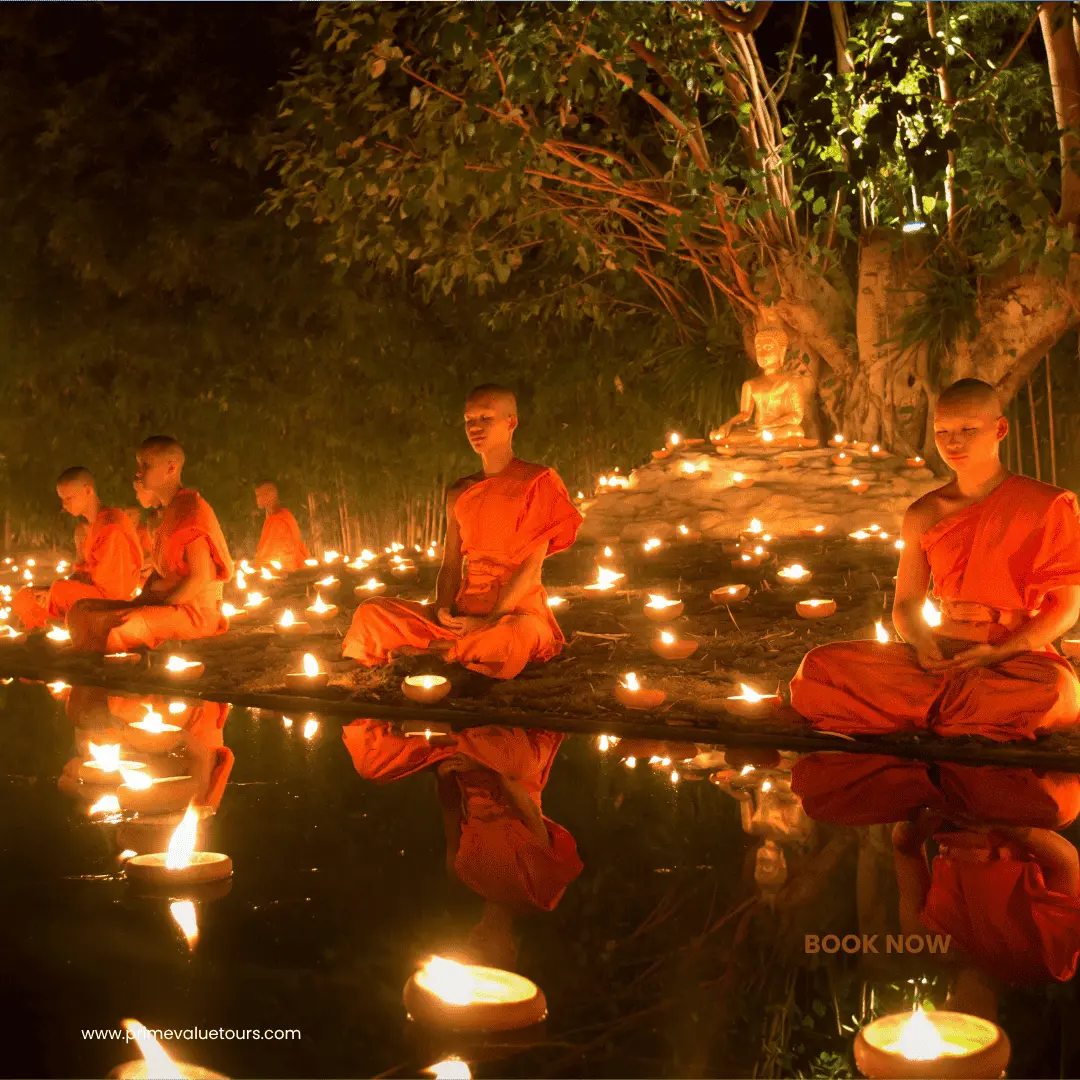
The Complete Buddhist Pilgrimage Circuit India Guide 2026
Bodh Gaya • Sarnath • Kushinagar • Lumbini • Varanasi
More than 2,500 years ago, a prince sat beneath a fig tree on the banks of the Niranjana River in Bihar, India, and the world changed forever. That tree is now known as the Bodhi Tree. The city around it is Bodh Gaya. And for millions of Buddhists around the world, traveling to stand beneath its sheltering branches is a dream that transcends travel—it is a return to the source.
The Buddhist pilgrimage circuit in India traces the four sacred footsteps of the Buddha: the place of his birth, the place of his enlightenment, the place of his first teaching, and the place of his final passing. This complete guide will walk you through every site on the circuit, how to reach each one, what to experience, and how to plan a journey that is spiritually meaningful and practically seamless.
Whether you are planning your first pilgrimage or your tenth, Prime Value Tours has been walking alongside Buddhist pilgrims for over 25 years—and we would be honored to walk with you.
The Four Sacred Sites: Heart of the Buddhist Pilgrimage Circuit India
The Buddha himself is said to have identified four places as worthy of pilgrimage. These four sites form the core of every Buddhist circuit tour in India—and each one carries a unique spiritual energy that pilgrims often describe as unlike anywhere else on earth.
1. Bodh Gaya — Where the Buddha Attained Enlightenment
Bodh Gaya, in the state of Bihar, is the most sacred destination on the Buddhist pilgrimage circuit in India. It is here, under the Bodhi Tree, that Prince Siddhartha Gautama attained supreme enlightenment and became the Buddha—the Awakened One.
The Mahabodhi Temple, a UNESCO World Heritage Site, rises 55 meters above the ground beside the Bodhi Tree. Pilgrims from Thailand, Sri Lanka, Japan, Myanmar, Tibet, and across the world come here to meditate, make offerings, and experience the profound stillness of this most sacred ground. The atmosphere at dawn, when monks chant and butter lamps flicker in the early light, is something that stays with a pilgrim for life.
Practical tip: The best time to visit Bodh Gaya is October to March, when the weather is cool. Dress modestly—shoulders and knees covered. Photography is permitted outside the temple but restricted inside the inner sanctum.
2. Sarnath — Where the Buddha Gave His First Teaching
Just 13 kilometers from Varanasi lies Sarnath—the Deer Park where the newly enlightened Buddha turned the Wheel of Dhamma for the first time and delivered his first sermon to his five disciples. This moment, known as Dhammacakkappavattana, is considered one of the most significant events in the entire history of Buddhism.
Today, Sarnath is home to the Dhamek Stupa—a great cylindrical tower that marks the exact spot where the Buddha taught. The Archaeological Museum at Sarnath houses the famous Sarnath Lion Capital, which became the national emblem of India. The Mulagandhakuti Vihara, built by the Maha Bodhi Society, is beautifully adorned with frescoes depicting the life of the Buddha.
Practical tip: Visit Sarnath in the early morning for a quiet, peaceful experience before the crowds arrive. Many Thai Buddhist groups hold brief puja ceremonies at the Dhamek Stupa—your guide can arrange this in advance.
3. Kushinagar — Where the Buddha Attained Parinirvana
Kushinagar, in eastern Uttar Pradesh, is one of the most emotionally moving stops on the Buddhist pilgrimage circuit in India. It is here that the Buddha passed into Mahaparinirvana—his final passing—at the age of 80, surrounded by his disciples in a grove of Sala trees.
The Mahaparinirvana Temple houses a 6-meter reclining Buddha statue, crafted from a single block of red sandstone, showing the Buddha in his final moment of peace. The Ramabhar Stupa, a short distance away, marks the site of his cremation. Walking between these two sites, especially at dusk, is a profound and deeply moving experience for every Buddhist pilgrim.
Practical tip: Kushinagar is approximately 53 km from Gorakhpur. Allow at least half a day. Arrive with a quiet heart—many pilgrims find this the most emotionally resonant site on the entire circuit.
4. Lumbini — The Birthplace of the Buddha (Nepal)
Just across the border in Nepal, Lumbini is the birthplace of Prince Siddhartha Gautama, the man who would become the Buddha. It is one of the four most sacred sites in all of Buddhism and a UNESCO World Heritage Site since 1997.
The Maya Devi Temple marks the exact birthplace. The Sacred Garden is surrounded by a monastic zone where temples from Thailand, Myanmar, Sri Lanka, China, Japan, and many other Buddhist nations stand side by side — a living testament to the universal reach of the Dhamma. The Ashoka Pillar, erected by Emperor Ashoka in 249 BCE, bears an inscription that confirms this as the birthplace of the Buddha.
Practical tip: Indian and Thai passport holders can obtain a Nepal visa on arrival at the border crossing at Sunauli. Most Buddhist circuit tours include Lumbini as a day trip or overnight extension from Kushinagar.
Varanasi and the Extended Circuit: Beyond the Four Sacred Sites
While the four sacred sites form the core of every Buddhist pilgrimage circuit in India, the extended circuit includes additional places of deep significance to Buddhist pilgrims. Varanasi, the ancient city on the Ganges, is both a gateway to Sarnath and a sacred destination in its own right. Rajgir, Nalanda, and Shravasti complete the picture for pilgrims who wish to walk even more deeply in the footsteps of the Buddha.
Varanasi — The Eternal City
Varanasi is one of the oldest continuously inhabited cities in the world, and it serves as the natural base for any Buddhist circuit tour. Sarnath is just 20 minutes away. The Ganges ghats come alive at dawn and dusk with ancient rituals that have continued unbroken for thousands of years.
For Buddhist pilgrims, Varanasi is also where Prime Value Tours is based—meaning all logistics, local ground support, and coordination begin and end here. Our team knows every road, every season, and every sacred corner of the circuit.
Rajgir & Nalanda—Where the Buddha Taught and His Teachings Were Preserved
Rajgir, in Bihar, is where the Buddha spent many rainy seasons and delivered some of his most important teachings, including the Prajnaparamita Sutras. The Vulture Peak (Gridhrakuta) is where the Buddha is said to have given the Heart Sutra. Nalanda, nearby, was one of the great universities of the ancient world—a center of Buddhist learning visited by scholars from across Asia for over 700 years.
How to Plan Your Buddhist Pilgrimage Circuit India: Practical Guide
Best Time to Visit
The ideal time for the Buddhist pilgrimage circuit in India is October to March. Temperatures are pleasant (15–28°C), skies are clear, and all sites are fully accessible. The circuit can be done year-round, but April to June is very hot, and July to September sees monsoon rains.
Special dates to consider: Buddha Purnima (the full moon day of the Buddha’s birth, enlightenment, and Parinirvana—usually in May) is extraordinarily sacred and draws pilgrims from across the world to Bodh Gaya and Sarnath.
How Long Does the Circuit Take?
The core 4-site circuit (Varanasi / Sarnath → Bodh Gaya → Kushinagar → Lumbini) typically takes 7 to 10 days. The extended circuit including Rajgir, Nalanda, and Shravasti takes 12 to 15 days. Prime Value Tours offers flexible itineraries for individuals, small groups, and large group pilgrimages.
How to Reach India
The most convenient entry points for international Buddhist pilgrims are Delhi (IGI Airport), Varanasi (Lal Bahadur Shastri Airport), and Patna (Jay Prakash Narayan Airport). Thai travelers flying from Bangkok typically connect via Delhi, Mumbai, or Kolkata.
Visa: Most nationalities require a tourist or e-Visa to enter India. e-Visa is available online and typically processed within 3–5 business days. Prime Value Tours can provide a support letter for your visa application if needed.
What to Pack
Comfortable walking shoes, loose and modest clothing (covering shoulders and knees for all temple visits), a light shawl or scarf, sunscreen, and a small personal first-aid kit. At the sacred sites, footwear must be removed—slip-on shoes are very practical.
Why Choose a Guided Buddhist Pilgrimage Tour
The Buddhist pilgrimage circuit spans multiple Indian states and crosses an international border into Nepal. Distances are long, roads are varied, and local knowledge makes an immense difference to the quality and depth of your experience.
At Prime Value Tours, our guides are not simply drivers and translators—they are knowledgeable, respectful companions who understand the spiritual significance of every site and can support your group’s religious practices at each stop. We offer Thai-speaking guides for Thai Buddhist groups, vegetarian and Buddhist-friendly meal arrangements, and monastery stay options where available.
We have been Government of India-approved since our founding and are a member of
IATO (Indian Association of Tour Operators). Our 25+ years of experience on this circuit means we have seen every season, every road condition, and every variation — so your group does not have to.
Frequently Asked Questions
Q: Do I need a special visa for the Buddhist pilgrimage circuit in India?
A: Most international visitors, including Thai nationals, can obtain an Indian e-Visa online before travel. The e-Visa covers tourism and pilgrimage purposes and is typically approved within 3–5 business days. For the Nepal leg (Lumbini), Thai passport holders can obtain a visa on arrival at the Nepal border. Prime Value Tours can provide a support letter to assist your visa application if required.
Q: Is vegetarian food available throughout the circuit?
A: Yes. Vegetarian and Buddhist-friendly meals are readily available at all major pilgrimage sites. Prime Value Tours specifically arranges vegetarian meal packages for all our Buddhist pilgrimage groups. See our Frequently Asked Questions page for more details on food and accommodation.
Q: Do you provide Thai-speaking guides?
A: Yes. Prime Value Tours provides experienced Thai-speaking guides for Thai Buddhist pilgrim groups. Our guides are knowledgeable about Buddhist traditions and site-specific religious practices, and they can support puja ceremonies, meditation sessions, and group activities at each sacred site.
Q: How large can a pilgrim group be?
A: We welcome groups of all sizes — from individual travelers to large monastery groups of 50 or more. Every group receives a custom itinerary tailored to their schedule, spiritual needs, and budget. Visit our Plan Your Trip page to begin planning.
Q: What is the best tour package for a first-time Buddhist pilgrimage to India?
A: For first-time pilgrims, we recommend our 8-day or 10-day Buddhist circuit covering the four sacred sites—Bodh Gaya, Sarnath, Kushinagar, and Lumbini—with Varanasi as a base. See our full range of Buddhist tour packages in India for options and pricing.
Begin Your Sacred Journey
If this guide has stirred something in your heart, perhaps the time is right. At Prime Value Tours, we have been walking alongside Buddhist pilgrims for over 25 years — from the Bodhi Tree in Bodh Gaya to the peaceful shores of Lumbini. We would be honored to plan your pilgrimage.
Reach out to us here — there is no obligation, only a conversation about what your journey could look like.
Contact Prime Value Tours Pvt. Ltd.
Prime Value Tours Pvt. Ltd.
Government of India Approved Tour Operator
E8-Shanti Vihar, Jail Road, Shivpur, Varanasi, UP – 221003, India
Mobile / WhatsApp: +91-9794122849
Email: info@primevaluetours.com
Website: www.primevaluetours.com
Plan your trip: primevaluetours.com/plan-your-trip