
India Buddhist pilgrimage Thai groups
“Plan your India Buddhist pilgrimage with Prime Value Tours. Complete route, sacred sites and expert tips for Thai groups. ” Imagine standing beneath the ancient Bodhi Tree in Bodh Gaya at dawn, the air still cool, incense drifting gently across centuries-old stone. Around you, a group of Thai monks in bright saffron robes chants softly. This is not just a trip. This is a journey to the very birthplace of Buddhism. For Thai Buddhist groups, an India Buddhist pilgrimage is one of the most sacred and spiritually meaningful experiences a traveler can undertake.
India is where the Buddha was born, attained enlightenment, gave his first sermon, and passed into Nirvana. Every site is alive with history, with faith, and with the presence of millions of pilgrims who have walked the same sacred path across centuries. And yet, for many Thai groups, planning this pilgrimage can feel overwhelming. Which sites to include? What route makes sense? How many days are enough? What about travel, accommodation, and food?
In our experience organizing Buddhist pilgrimage tours for Thai and Southeast Asian groups since 1999, we have helped thousands of pilgrims navigate this journey with comfort, reverence, and deep satisfaction. This complete guide answers every question your group might have.
Why India Buddhist Pilgrimage Is Special for Thai Groups
For Thai Buddhists, India is not simply a foreign country. It is the sacred land where the Dhamma itself was born. Thailand follows Theravada Buddhism, the oldest surviving school of Buddhist thought, which traces its roots directly to the teachings the Buddha gave on Indian soil. Every temple, every stupa, every bodhi tree you visit here is a direct connection to the source.
What makes India Buddhist pilgrimage sites unique is that they are not reconstructions or replicas. These are the actual places: the actual spot where Prince Siddhartha sat under the Bodhi Tree, the actual deer park where the first sermon was delivered, the actual site where the Buddha took his final breath. For devout Thai pilgrims, standing at these places carries an emotional and spiritual weight that is difficult to describe but impossible to forget.
Plus, visiting these holy Buddhist places in India gives Thai groups the rare opportunity to connect with Buddhist communities from Sri Lanka, Myanmar, China, Japan, and across the world, all converging on the same sacred ground.
The 8 Sacred Buddhist Pilgrimage Sites in India (and Nepal)
The classical India Buddhist pilgrimage route covers 8 main holy places. These are the sites that every Thai group should visit. Here is what makes each one special:
1. Lumbini, Nepal: The Birthplace of the Buddha
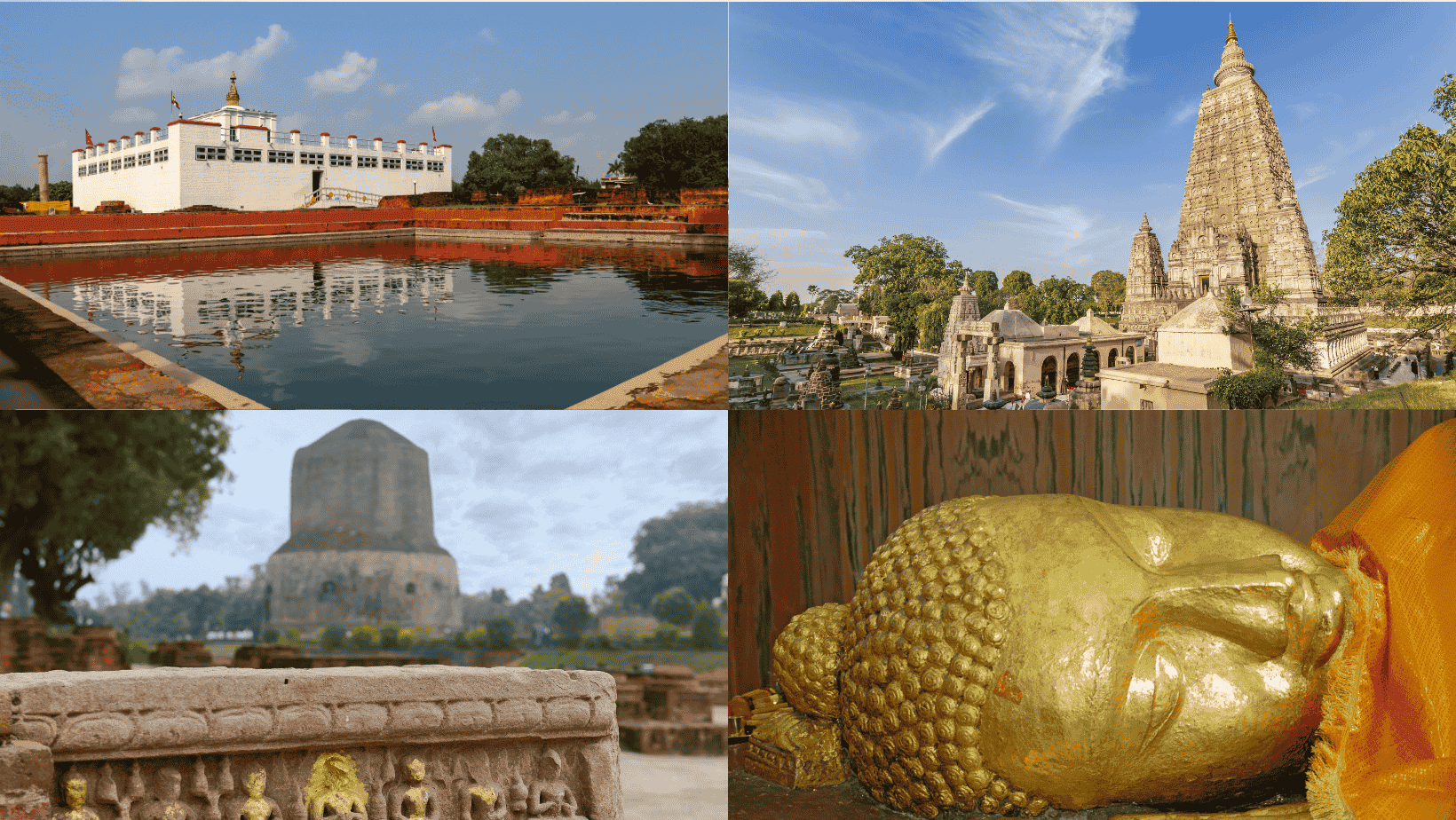
Lumbini is where Queen Maya Devi gave birth to Prince Siddhartha Gautama around 563 BCE. The sacred garden holds the Maya Devi Temple, the exact spot of birth marked by a stone, and the famous Ashoka Pillar erected by Emperor Ashoka in 249 BCE. The Thai government has built a beautiful Thai Buddhist temple here. Lumbini is just across the border in Nepal, and most India pilgrimage tours include it as a day trip or overnight stop from Gorakhpur or Kushinagar.
2. Bodh Gaya, Bihar: The Place of Enlightenment
Bodh Gaya is the most sacred place in Buddhism. It is here, under the original Bodhi Tree (or its direct descendant), that Prince Siddhartha achieved enlightenment and became the Buddha. The Mahabodhi Temple Complex is a UNESCO World Heritage Site. The Temple is one of the oldest brick temples in India, standing more than 50 metres tall. Thai Buddhist groups almost always include special puja and meditation sessions here. Several Thai temples in Bodh Gaya offer accommodation and meals for Thai pilgrims.
3. Sarnath, Uttar Pradesh: The First Sermon
Just 13 kilometres from Varanasi, Sarnath is where the Buddha delivered his first sermon, the Dhammacakkappavattana Sutta, to his first 5 disciples. The Dhamek Stupa, one of the most impressive stupas in India, stands at the spot where the sermon was given. The Mulagandha Kuti Vihara temple and the Sarnath Museum (which houses the famous Lion Capital of Ashoka, India’s national emblem) are essential visits. For Thai groups staying in Varanasi, Sarnath is a half-day trip.
4. Kushinagar, Uttar Pradesh: The Place of Parinirvana
Kushinagar is where the Buddha passed into Mahaparinirvana at the age of 80. The Mahaparinirvana Temple contains a magnificent 6-metre reclining Buddha statue, showing the Buddha in his final moments. The Ramabhar Stupa marks the cremation site. Kushinagar has a quiet, deeply contemplative atmosphere that moves every Buddhist pilgrim who visits. Several Thai-funded temples and rest houses are located here.
5. Vaishali, Bihar: Where the Buddha Preached and Announced Parinirvana
Vaishali holds a special place in Buddhist history. It was here that the Buddha delivered important teachings and announced his approaching Parinirvana. The Ashoka Pillar at Vaishali, topped by a single lion, is one of the best-preserved Ashokan pillars in India. The Relic Stupa, which contains actual relics of the Buddha, is deeply revered by Thai pilgrims.
6. Rajgir, Bihar: The City of the Buddha’s Teaching Years
Rajgir was one of the Buddha’s favourite places to spend the rainy season retreats. The Griddhakuta Hill (Vulture’s Peak) is where the Buddha delivered many important discourses. The Venuvana Bamboo Grove, gifted to the Buddha by King Bimbisara, is a serene garden sanctuary. The Japanese Peace Pagoda offers panoramic views and is a popular stop for Thai groups.
7. Nalanda, Bihar: The World’s First University
Nalanda was the greatest center of Buddhist learning in the ancient world, attracting scholars from China, Korea, Japan, Tibet, and Southeast Asia, including Thailand’s ancestors. The Nalanda Archaeological Site is a UNESCO World Heritage Site, and the Nalanda Museum houses thousands of Buddhist artefacts. The new Nalanda University, revived in 2014, is nearby.
8. Sravasti, Uttar Pradesh: Where the Buddha Performed Miracles
Sravasti was the Buddha’s favourite residence during his teaching years. He spent 25 rainy season retreats here. The Jetavana Monastery, one of the most important monasteries in early Buddhism, is located here. Several Thai Buddhist organizations have built temples and dharmasalas (rest houses) at Sravasti, making it a welcoming stop for Thai pilgrims.
The Best Buddhist Pilgrimage Route for Thai Groups: Step by Step
Most Thai groups join India as a complete pilgrimage circuit, visiting all 8 sites in 10 to 14 days. Here is the route that works best in terms of travel efficiency, spiritual flow, and comfort:
- Arrive Delhi or Varanasi (Day 1)
- Varanasi and Sarnath (Day 2)
- Sravasti (Day 3)
- Lumbini, Nepal (Days 4 and 5)
- Kushinagar (Day 6)
- Vaishali (Day 7)
- Rajgir and Nalanda (Day 8)
- Bodh Gaya (Days 9 and 10)
- Departure from Gaya or Patna Airport (Day 11 or 12)
This circular route minimizes backtracking and keeps the travel experience smooth for groups. Depending on the size of your group and your specific spiritual priorities, we can extend this to a 14-day or 16-day program adding extended meditation retreats at Bodh Gaya or Sarnath.
Practical Tips: What to Know Before Your Group Travels
Best Time to Visit
The ideal season for India Buddhist pilgrimage is October to March. The weather is cool and comfortable, the roads are in good condition, and all the major sites are accessible. What most travelers do not know is that November to February is the peak pilgrimage season at Bodh Gaya, with large Thai delegations visiting for important Buddhist calendar dates. Book early if your group plans to travel during this period.
Visa for Thai Nationals
Thai citizens can apply for an India e-Visa online, which is quick and convenient. The tourist e-Visa allows a stay of up to 90 days. Always apply at least 7 to 10 days before travel. For Buddhist monks traveling in robes, the e-Visa process is the same. We can provide a detailed visa assistance guide for your group on request.
Accommodation for Thai Groups
The good news is that all major Buddhist pilgrimage sites in India have Thai Buddhist temples and rest houses (dharmasalas) that cater specifically to Thai groups. At Bodh Gaya, Kushinagar, Sravasti, and Lumbini, your group can stay in Thai-funded facilities, eat familiar food, and feel completely at home. We also work with quality 3-star and 4-star hotels at key stops for groups requiring higher comfort levels.
Food and Dietary Needs
Vegetarian food is widely available along the Buddhist circuit, and Thai groups will find that many rest houses and dharmasalas offer simple Thai-style vegetarian meals. For groups with monks, we arrange appropriate full-board meal arrangements throughout the journey. We also ensure timing of meals follows monastic schedules where required.
Group Size and Transport
We handle groups from 15 to 150 pilgrims. Transport options include comfortable air-conditioned buses for large groups, tempo travellers for smaller groups, and private cars for VIP or senior pilgrims who require additional comfort. All our vehicles are well-maintained and insured, with experienced drivers familiar with the pilgrimage route.
Hidden Buddhist Sacred Sites Worth Adding to Your Itinerary
Beyond the 8 main sites, India has several lesser-known sacred Buddhist places that deeply enrich a pilgrimage. In our years of organizing Buddhist tours, we have found that groups who include even one or two of these hidden gems always speak of them as unforgettable highlights:
- Sankisa (Uttar Pradesh): Where the Buddha descended from Heaven after preaching to his mother in the Tusita realm. One of the eight most sacred sites in Buddhism.
- Kesaria (Bihar): Home to the tallest Buddhist stupa in the world, largely unrestored and deeply atmospheric.
- Sarnath Museum: Houses the original Lion Capital of Ashoka and some of the finest Buddhist sculptures in the world.
- Ajanta Caves (Maharashtra): For groups with extra time, the UNESCO-listed rock-cut Buddhist cave temples at Ajanta are extraordinary. The wall paintings inside the caves are 2,000 years old and still vivid.
- Amaravati (Andhra Pradesh): One of the most important ancient Buddhist stupas in South India, with a long connection to Theravada Buddhism.
Plan Your India Buddhist Pilgrimage with Prime Value Tours
We have been organizing Buddhist circuit tours across India and Nepal since 1999, with a special focus on serving Thai and Southeast Asian pilgrimage groups. Our team understands the specific spiritual, dietary, and logistical needs of Thai Buddhist groups, from arranging early morning puja visits at Bodh Gaya to coordinating with Thai temples along the route.
Every group is different. A group of 40 devotees from Bangkok has different needs from a party of 8 Thai monks on a private retreat circuit. We design every itinerary from scratch around your group’s size, duration, budget, and spiritual priorities. We handle everything: airport pickups, inter-city transport, accommodation, meals, entrance permits, guides, and Nepal border crossings.
| CONTACT US TO PLAN YOUR PILGRIMAGE Prime Value Tours Pvt. Ltd. Phone: +91-542-2500113 WhatsApp: +91-9721122849 LINE: https://line.me/ti/p/6QtZRvYpeP Email: info@primevaluetours.com Website: www.primevaluetours.com We speak English and thai are happy to assist Thai-speaking groups. |
The Buddha walked this land more than 2,500 years ago. He walked through the forests of Bihar and Uttar Pradesh, sat under trees, taught beside rivers, and left behind a trail of sacred places that still vibrate with the energy of his presence. For Thai Buddhist groups, following this path is not just a tour. It is a pilgrimage of the heart. Let us help you walk it with dignity, comfort, and deep spiritual meaning.
Frequently Asked Questions
How many days do Thai groups need for a complete India Buddhist pilgrimage?
A standard Buddhist circuit tour covering all 8 sacred sites takes 10 to 14 days. Groups who want to add meditation retreats at Bodh Gaya or visit hidden sacred Buddhist sites like Sankisa and Kesaria may prefer 14 to 16 days. We can customize the length based on your group’s priorities.
Which is the most important Buddhist pilgrimage site in India for Thai groups?
Bodh Gaya is considered the most important site, as it is the place of the Buddha’s enlightenment. The Mahabodhi Temple is a UNESCO World Heritage Site and the spiritual heart of the entire pilgrimage circuit. Sarnath, Kushinagar, and Lumbini are equally significant for a complete pilgrimage.
Is India Buddhist pilgrimage suitable for elderly Thai pilgrims?
Yes, with proper planning. We arrange air-conditioned vehicles, accessible accommodation, and pacing that respects the physical needs of elderly pilgrims. Several sites have wheelchair-accessible paths, and our guides always support senior travelers throughout the journey. We recommend the October to December period for elderly groups as the weather is most comfortable.
Can Thai monks travel on this pilgrimage without a tour operator?
Technically yes, but it is not recommended. The Buddhist circuit covers multiple states, requires Nepal border crossings for Lumbini, involves complex logistics between sites, and requires advance bookings at Thai dharmasalas during peak season. Having an experienced operator like Prime Value Tours ensures everything runs smoothly so monks can focus entirely on the spiritual experience.
What is the best way to reach India for a Thai pilgrimage group from Bangkok?
The most convenient entry points for Buddhist circuit tours are Varanasi (Lal Bahadur Shastri International Airport) for groups starting at Sarnath, or Bodh Gaya (Gaya Airport) for groups starting the circuit from the south. Direct and one-stop flights from Bangkok Suvarnabhumi are available via Delhi, Kolkata, or Mumbai. We can advise on the best flight routing based on your group’s itinerary.