
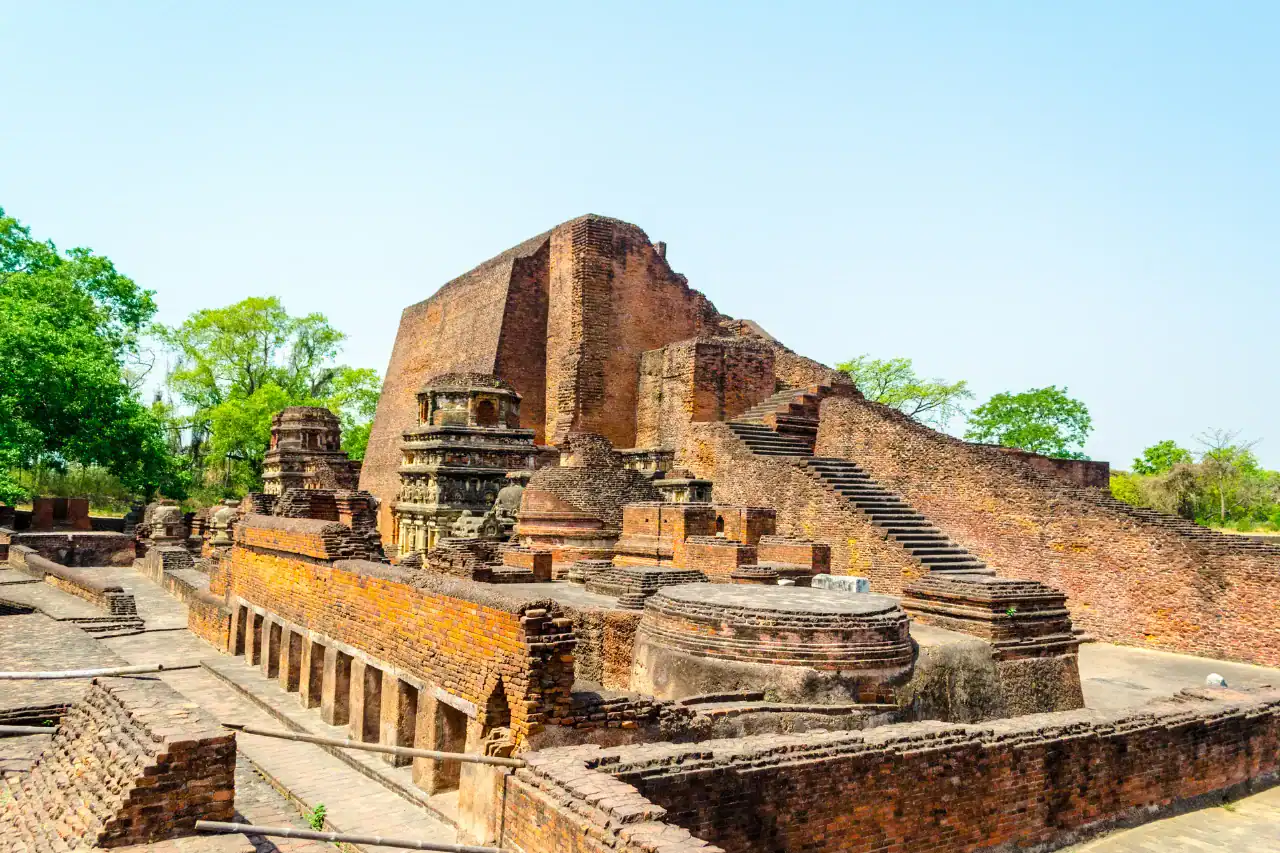
World’s First Great Buddhist University
Long before Oxford rose in England or Bologna in Italy, a great seat of learning glowed quietly in the plains of ancient India. Its name was Nalanda University—a place where monks, scholars, and seekers from across Asia gathered to study the Dhamma, philosophy, medicine, and the stars.
For Buddhist pilgrims, Nalanda is more than ruins. It is sacred ground where the Buddha himself once walked, where his great disciple Sariputta was born and attained Parinirvana, and where the wisdom of the Buddha’s teachings was preserved and shared with the world for over 700 years.
In this guide, we share 7 amazing facts about Nalanda University — facts that will deepen your reverence for this blessed site and make your pilgrimage truly meaningful.
1. Nalanda Was the World’s First Residential University
Founded in the 5th century CE under the patronage of Emperor Kumaragupta I of the Gupta dynasty, Nalanda Mahavihara was the world’s first true residential university. Unlike the small forest hermitages of earlier times, Nalanda offered classrooms, dormitories, dining halls, and meditation cells—all within one vast monastic complex.
At its peak, Nalanda housed over 10,000 students and 2,000 teachers living, studying, and meditating together. Students from China, Korea, Tibet, Sri Lanka, Persia, and Southeast Asia—including ancient Suvarnabhumi, the land that today includes Thailand—travelled across mountains and seas to study here.
Practical Tip for Pilgrims: Visit Nalanda in the cooler months (October–March). Early morning is the most peaceful time to walk the ruins and reflect on their sacred history.
2. The Buddha Himself Visited Nalanda
For Buddhist pilgrims, this is perhaps the most moving fact of all. The Lord Buddha visited Nalanda many times during his lifetime—long before the university itself was built. The site was already a flourishing town in the Magadha kingdom during the Buddha’s era (6th century BCE).
It was here that the Buddha delivered several important teachings to his disciples. His chief disciple, the great Venerable Sariputta—known for his wisdom—was born in the nearby village of Nalaka and later attained Parinirvana at Nalanda. A stupa was built in his honor, and its ruins still stand today.
When you walk among these stones, you walk where the Blessed One walked. This alone makes Nalanda a sacred destination on any Buddhist pilgrimage in India and Nepal.
3. It Had a 9-Story Library With Over 9 Million Manuscripts
Nalanda’s library, known as Dharma Gunj—”Mountain of Truth”—was the largest library of the ancient world. It consisted of three magnificent buildings: Ratnasagara, Ratnadadhi, and Ratnaranjaka. The Ratnadadhi alone was reportedly nine stories tall.
Together, these libraries are said to have held over 9 million manuscripts—sacred texts on Buddhism, Sanskrit literature, philosophy, astronomy, medicine, and the arts. Monks from across Asia copied texts here to carry home, helping spread the Dhamma far and wide.
Tragically, when invaders burned Nalanda in 1193 CE, the library is said to have burned for three full months—such was the vastness of its collection. A heart-breaking loss for humanity.
4. Xuanzang, the Chinese Pilgrim, Studied Here
In the 7th century CE, a Chinese Buddhist monk named Xuanzang (also known as Hiuen Tsang) made a 17-year journey from China to India to study the Dhamma. He spent over 5 years at Nalanda University, learning Sanskrit, Yogachara philosophy, and Mahayana Buddhism.
His detailed writings about Nalanda — its glorious buildings, its strict admission process (only 1 in 5 applicants was accepted), and its rigorous debate traditions — are among the most precious records we have today.
Without Xuanzang’s careful documentation, much of what we know about ancient Nalanda would be lost forever. His journey is a beautiful reminder that the pilgrimage path has always crossed cultures and continents.
5. Subjects Beyond Buddhism Were Also Taught
While Nalanda was first and foremost a Buddhist university, its curriculum was remarkably broad. Students studied:
- Mahayana and Theravada Buddhism
- Sanskrit grammar and logic
- Medicine and Ayurveda
- Mathematics and astronomy
- Fine arts and architecture
This holistic approach reflected the Buddhist ideal that true wisdom touches every part of life. The university’s debates were famous across Asia—scholars from rival schools came to test their understanding, knowing that even the gatekeepers of Nalanda were learned enough to turn them away.
For Thai Buddhist travelers familiar with the deep scholastic tradition of Thai monasteries, walking Nalanda’s ruins offers a powerful connection to the ancient roots of that very tradition.
6. Nalanda Was Destroyed in 1193 CE
The story of Nalanda’s end is sorrowful. In 1193 CE, the Turkish military commander Bakhtiyar Khilji attacked and burned Nalanda University to the ground. Thousands of monks were killed, and the great library was set aflame.
For centuries afterwards, the ruins lay buried under earth and forgotten until British archaeologists rediscovered the site in the 19th century. Excavations beginning in 1915 slowly revealed the magnificent red-brick monasteries, temples, and stupas we see today.
Today the ruins of Nalanda are a UNESCO World Heritage Site, drawing pilgrims and history-lovers from around the world. Standing among the silent bricks, one feels both the loss and the enduring strength of the Dhamma.
7. A New Nalanda University Was Reborn in 2014
In a beautiful continuation of the ancient legacy, the Government of India revived Nalanda University in 2014, located in the town of Rajgir, just a short distance from the original site. This modern university — supported by countries including Thailand, Japan, China, and Singapore — once again welcomes international students of Buddhism, ecology, and Asian studies.
The dream of Nalanda, it seems, never truly died. The lamp lit by the Buddha and tended by countless monks for over a millennium has been rekindled.
For pilgrims today, this rebirth makes a visit even more meaningful. You can pay homage at the ancient ruins in the morning and see the new Nalanda nearby—a living symbol that Dhamma endures.
Why Visit Nalanda With Prime Value Tours
Nalanda is best experienced as part of a thoughtfully designed Buddhist circuit that also covers Rajgir, Bodh Gaya, and Varanasi. At Prime Value Tours, we have been guiding Buddhist pilgrims for over 25 years, with deep care for Thai-speaking travelers. Approved by the Ministry of Tourism, Govt. of India.
Our Buddhist tour packages include:
- Thai-speaking guides with deep knowledge of Dhamma history
- Vegetarian and Buddhist-friendly meals at every stop
- Comfortable transport between Bodh Gaya, Nalanda, Rajgir, Varanasi, and beyond
- Visits to Sariputta Stupa, the archaeological museum, and new Nalanda University
Frequently Asked Questions
Q: How far is Nalanda from Bodh Gaya? A: Nalanda is approximately 95 km from Bodh Gaya, about a 2.5-hour drive by road. Most of our Buddhist pilgrimage tours include Nalanda as a key stop on the way to or from Rajgir.
Q: How much time should I spend at Nalanda? A: We recommend at least 3–4 hours to walk the ruins peacefully, visit the Nalanda Archaeological Museum, and pay homage at the Sariputta Stupa. Some pilgrims choose to spend longer in quiet meditation.
Q: Is Nalanda University included in your Buddhist tour packages? A: Yes, Nalanda is a featured destination in most of our Buddhist circuit packages. You can explore the options on our Buddhist tour packages page or speak with our team for a custom itinerary.
Q: Are there Thai-speaking guides available at Nalanda? A: Yes. Prime Value Tours provides experienced Thai-speaking guides who explain the history and spiritual significance of Nalanda in your language—making the experience deeply meaningful for Thai pilgrims.
Q: What is the best time of year to visit Nalanda? A: The most pleasant months are October through March, when the weather is cool and ideal for walking the ruins. Buddha Purnima (May) is also a deeply spiritual time to visit, though warmer. For more travel tips, see our FAQ page.
Begin Your Sacred Journey
If reading about Nalanda has stirred something in your heart, perhaps the time is right.
At Prime Value Tours, we have been walking alongside Buddhist pilgrims for over 25 years — from the Bodhi Tree in Bodh Gaya to the sacred ruins of Nalanda, from Sarnath’s deer park to the peaceful shores of Lumbini.
We would be honored to help plan your pilgrimage. Reach out to us—there is no obligation, only a conversation about what your journey could look like.