
7 Most Powerful Buddhist Monasteries in India Every Pilgrim Must Visit
Picture this. Dawn breaks over the Himalayas, the air is thin and crisp, and the low hum of monks chanting drifts from a centuries-old monastery perched on a cliff. That sound, you feel in your bones, is the soul of India’s Buddhist heart speaking to you. It is the kind of moment that stays with a pilgrim for life.
India is the birthplace of Buddhism, and for over 2,500 years, monks, scholars and pilgrims have walked its sacred trails. The country is home to some of the most powerful Buddhist monasteries in India that the world has ever known, each one a living archive of prayer, art, philosophy and devotion. From the plains of Bihar where the Buddha attained enlightenment to the high deserts of Ladakh and the cloud-covered hills of Arunachal Pradesh, these monasteries shape the spiritual geography of the country.
At Prime Value Tours, we have been organising Buddhist pilgrimage tours for Thai and Southeast Asian groups since 1999. As a Ministry of Tourism, Government of India — Verified Tour Operator and a proud IATO Member — Indian Association of Tour Operators, we have guided thousands of pilgrims to these sacred sites. In this guide, we share the 7 most powerful Buddhist monasteries in India that every pilgrim should visit at least once.
1. Mahabodhi Temple Complex, Bodh Gaya, Bihar
This is the most sacred Buddhist site on earth. Under the Bodhi Tree here, Prince Siddhartha attained enlightenment 2,500 years ago and became the Buddha. Today the Mahabodhi Temple is a UNESCO World Heritage Site, and a direct sapling of the original Bodhi Tree still grows behind the main shrine.
Walk barefoot around the Vajrasana, the diamond throne, and you will see Thai, Tibetan, Sri Lankan and Burmese pilgrims chanting in their own languages. The energy is unlike anywhere else. In our experience, every Buddhist tour we operate either begins or ends here, and for good reason: it is the spiritual axis of the entire pilgrimage.
Best time to visit: October to March
Nearest airport: Gaya (GAY)
2. Tawang Monastery, Arunachal Pradesh
Founded in 1680, Tawang is the largest Buddhist monastery in India and the second largest in the world after the Potala Palace in Lhasa. It is the birthplace of the 6th Dalai Lama and home to over 400 monks. The monastery sits at nearly 10,000 feet, with the snow peaks of the eastern Himalayas as its backdrop.
Inside, you will find an 8 metre golden statue of the Buddha and a library of priceless manuscripts and thangkas. The Torgya festival held every January is one of the most colourful religious celebrations in the country, with masked Cham dances that have been performed without break for more than three centuries.
Best time to visit: March to October
Nearest airport: Tezpur (Assam) or Guwahati
3. Hemis Monastery, Ladakh
Tucked inside a hidden valley about 45 km from Leh, Hemis is the largest and richest monastery in Ladakh. It belongs to the Drukpa lineage of Tibetan Buddhism and dates back to the 17th century. The setting alone, hemmed in by sheer brown mountains and prayer flag fields, feels like another world.
Hemis is famous for its 2 day annual festival in June or July, where masked Cham dances narrate the victory of good over evil. The monastery also keeps a giant thangka of Padmasambhava that is unfurled only once every 12 years. The next unveiling is a moment serious pilgrims plan years in advance.
Best time to visit: June to September
Nearest airport: Leh
4. Thiksey Monastery, Ladakh
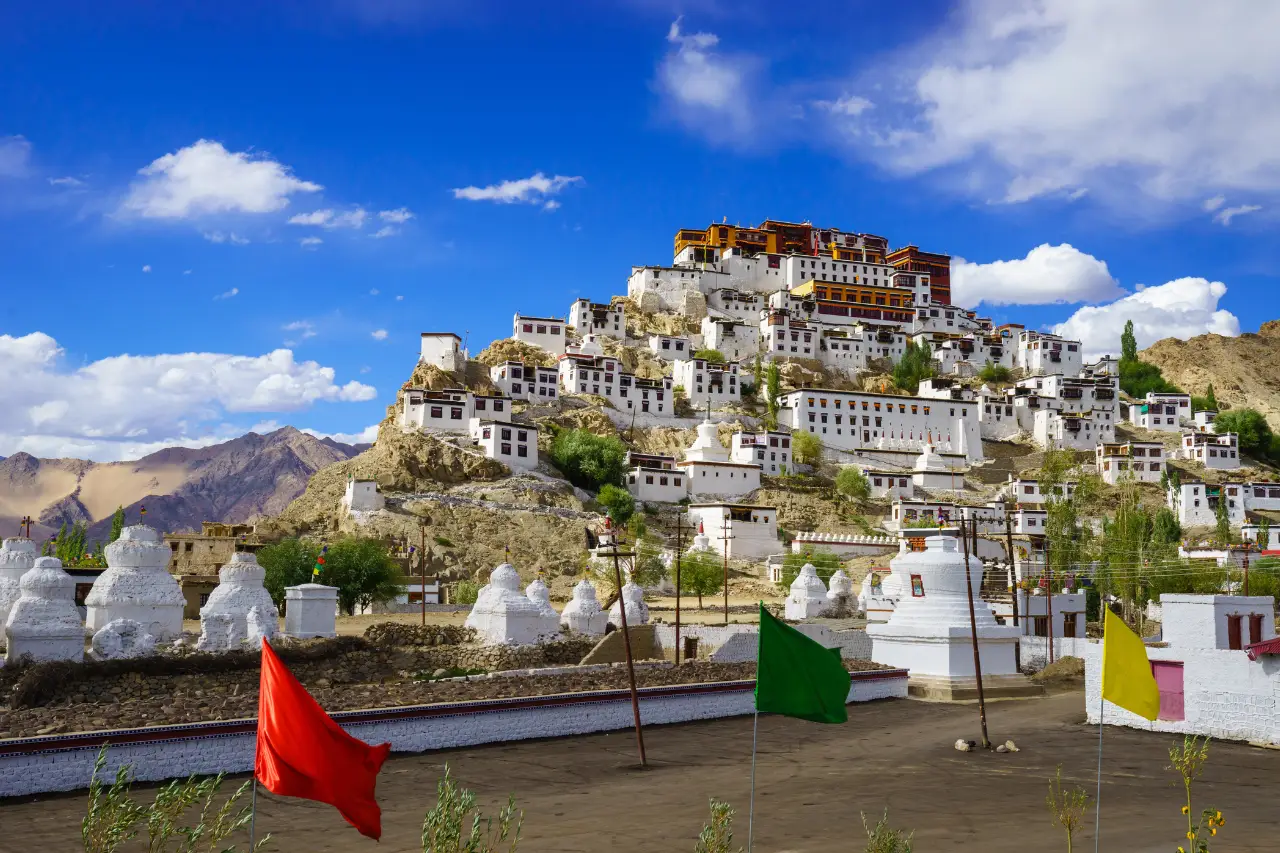
If you have ever seen the Potala Palace in old photographs, you will recognise Thiksey at first glance. This 12 storey complex spreads over an entire hilltop and is often called the “mini Potala”. The monastery belongs to the Gelugpa lineage, the same school as the Dalai Lama.
The crown jewel inside is a 15 metre statue of the future Buddha, Maitreya, that fills two full floors of the prayer hall. The dawn prayer ceremony, when monks blow long copper horns from the rooftop and the sun rises over the Indus Valley, is unforgettable. We include both Hemis and Thiksey in our Leh Ladakh Tour Packages for pilgrims who want a true Himalayan Buddhist experience.
Best time to visit: May to September
Nearest airport: Leh
5. Rumtek Monastery, Sikkim
Rumtek is the most important monastery of the Karma Kagyu lineage outside Tibet, and the seat of the Gyalwang Karmapa. Built in the 1960s as a near-replica of the original Tsurphu Monastery in Tibet, it houses some of the rarest Buddhist artefacts that were carried out of Tibet during the 1959 exodus.
The monastery sits on a hill above Gangtok, surrounded by thick forest and miles of fluttering prayer flags. The Golden Stupa inside the main shrine is said to contain relics of the 16th Karmapa, and the painted murals in the main prayer hall are among the finest in modern Tibetan Buddhist art.
Best time to visit: October to May
Nearest airport: Bagdogra
6. Namdroling Monastery, Bylakuppe, Karnataka
Few pilgrims expect to find a slice of Tibet in southern India, but in Bylakuppe, Karnataka, you will. Namdroling Monastery, popularly called the Golden Temple, is the largest teaching centre of the Nyingma lineage anywhere in the world. Inside the prayer hall, three giant gilded statues, the Buddha, Padmasambhava and Amitayus, rise more than 12 metres tall.
Over 5,000 monks and nuns study here, making it a living, breathing university of Buddhist philosophy. Walking through the painted corridors with the smell of butter lamps in the air, you feel that Tibet has truly travelled south. For pilgrims combining a temple tour of South India, Namdroling is an essential stop.
Best time to visit: October to March
Nearest airport: Mysore or Bangalore
7. Key Monastery, Spiti Valley, Himachal Pradesh
Perched at 13,500 feet on a conical hill, Key Monastery (also spelled Kee Gompa) is one of the oldest and most photographed Buddhist sites in India. It has stood for more than 1,000 years, surviving Mongol attacks, fires and earthquakes. Today it is the largest monastery in Spiti Valley and home to nearly 300 lamas.
The fortress-like architecture was built layer upon layer to defend against invasions. Inside, you will find ancient murals, rare manuscripts and a small collection of Buddhist wind instruments. The drive to Key, through the high desert of Spiti, is a pilgrimage in itself, easily one of the most spiritual road journeys you can take in India.
Best time to visit: May to October
Nearest airport: Bhuntar (Kullu)
What to Know Before You Visit These Buddhist Monasteries in India
A monastery tour is a special experience, but a little preparation goes a long way. Here is what we share with every group we host. For a deeper read on the full circuit, see our Buddhist Pilgrimage Guide for India and Nepal.
- Dress modestly: cover shoulders and knees, and remove shoes before entering shrines.
- Photography: ask permission inside prayer halls, and never photograph monks without consent.
- Walk clockwise: always move clockwise around stupas and prayer wheels, this is a basic rule of respect.
- Altitude: monasteries in Ladakh, Spiti and Tawang sit above 10,000 feet, plan a day to acclimatise.
- Best season: October to March for the plains and the south, May to September for the Himalayan monasteries.
- Donations: leave a small offering, this supports the monks and the daily upkeep of the monastery.
In our years of organising Buddhist tours, we have found that pilgrims who slow down and listen, rather than rush from site to site, take the deepest experience home with them. The good news is, we build every itinerary around that idea.
Plan Your Buddhist Pilgrimage with Prime Value Tours
| Design Your Sacred Journey We have been organising pilgrimage and cultural tours across India since 1999, with a special focus on Buddhist circuit tours for Thai and Southeast Asian groups. We are a Ministry of Tourism approved operator and a proud IATO member, and we speak English to assist Thai-speaking groups warmly. Phone : +91-542-2500113 WhatsApp : +91-9794122849 Email : info@primevaluetours.com Website : www.primevaluetours.com LINE : https://line.me/ti/p/6QtZRvYpeP Ready to plan? Visit Plan Your Trip and we will get back within 24 hours. |
Frequently Asked Questions
Which Buddhist monastery in India is the most important?
The Mahabodhi Temple in Bodh Gaya is the most important, as it is the place where the Buddha attained enlightenment. It is a UNESCO World Heritage Site and the spiritual heart of every Buddhist pilgrimage in India.
How many days do I need to visit the major Buddhist monasteries in India?
A complete tour of the main Buddhist circuit (Bodh Gaya, Sarnath, Kushinagar, Sravasti, Lumbini) takes 8 to 12 days. To include Himalayan monasteries like Tawang, Hemis or Key, plan a separate 6 to 10 day trip due to altitude and travel distance.
Are these monasteries open to non-Buddhists?
Yes. All major Buddhist monasteries in India warmly welcome visitors of every faith. We only ask that you respect the dress code, walk clockwise around shrines and stupas, and stay quiet during prayer ceremonies.
What is the best time of year for a Buddhist pilgrimage in India?
October to March is ideal for monasteries in the plains (Bodh Gaya, Sarnath) and the south (Bylakuppe). For Ladakh, Spiti and Arunachal Pradesh, plan between May and September when mountain passes are open and weather is pleasant.
Can Prime Value Tours arrange a customised Buddhist monastery tour?
Yes, this is exactly what we do. We design private and group tours to suit any budget, language or duration. We have been organising Buddhist pilgrimages for Thai and Southeast Asian groups since 1999, and we are happy to combine plains and Himalayan circuits in one journey.
A Final Thought
A Buddhist monastery in India is more than a building, it is a doorway. Step through it, and you walk into 2,500 years of wisdom, devotion and quiet courage. Whether you are a lifelong follower of the Dharma or simply a curious traveller, these 7 powerful monasteries will leave you changed in some small, lasting way. We would be honoured to walk that path with you.