
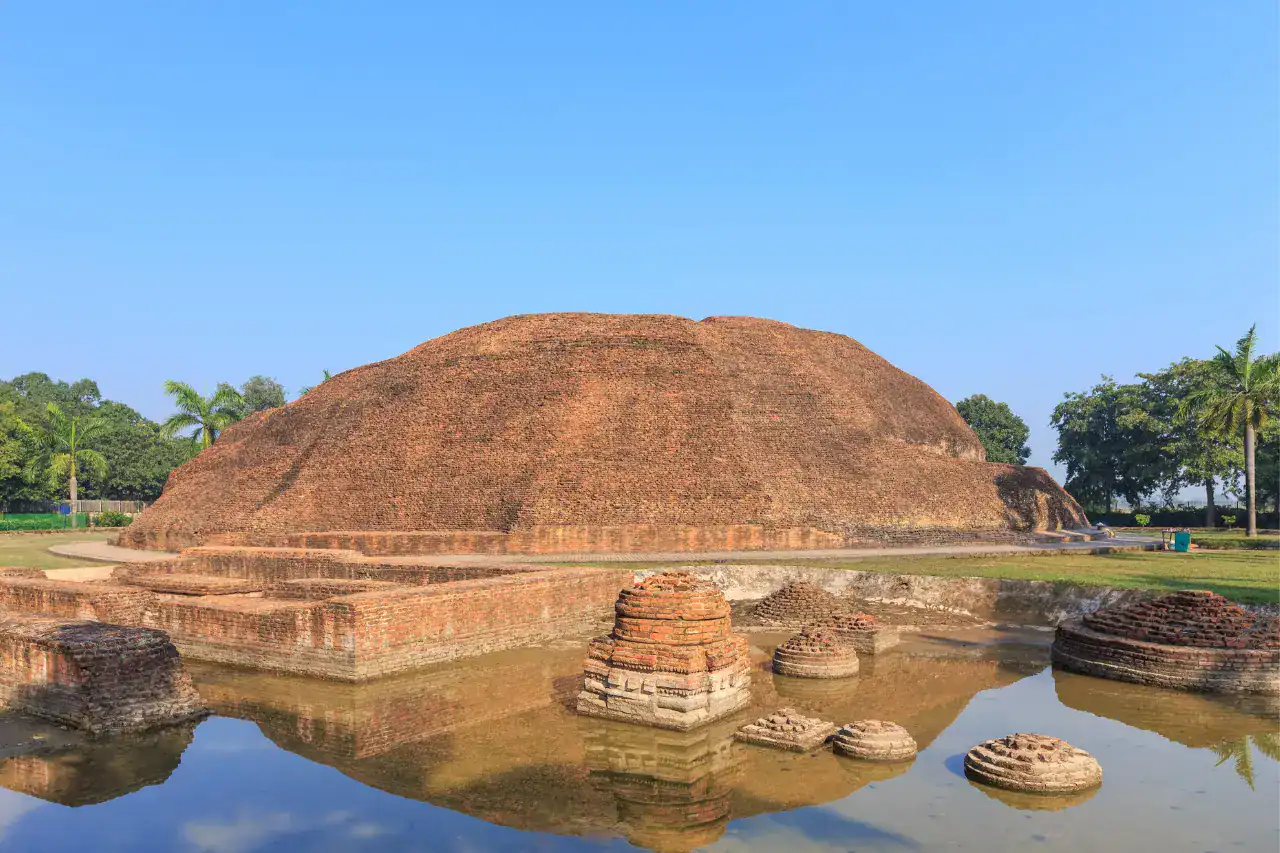
Ramabhar Stupa Kushinagar: Buddha’s Sacred Cremation Site
Imagine standing in a quiet meadow at dawn. The mist still clings to ancient red bricks. Birds call softly. A few saffron-robed monks walk slowly around a large mound, chanting in low voices. This is Ramabhar Stupa, Kushinagar, the very place where Lord Buddha’s body was cremated more than 2,500 years ago.
For Buddhists from Thailand, Sri Lanka, Myanmar, and across Southeast Asia, this site is sacred ground. It is where the Mahaparinirvana of the Buddha, his final passing into nirvana, came to its quiet end. At Prime Value Tours, a Ministry of Tourism, Government of India-verified tour operator, we have been guiding pilgrim groups to Ramabhar Stupa since 1999, and every visit feels new.
What is Ramabhar Stupa?
Ramabhar Stupa, also called Mukutbandhana Chaitya in ancient Buddhist texts, is a large dome-shaped monument located about 1.5 kilometers east of the main Mahaparinirvana Temple in Kushinagar, Uttar Pradesh.
The word “stupa” comes from Sanskrit and means a sacred mound built to hold relics or mark a holy site. Ramabhar is the local name. Mukutbandhana refers to the place where the Mallas, the local clan who ruled this area in Buddha’s time, used to crown their kings.
The current structure stands about 49 feet tall, though it was once even larger. Made of red bricks, the stupa rises from a circular base surrounded by green lawns. It looks simple. But the meaning is enormous.
Why Ramabhar Stupa, Kushinagar, Is Sacred to Buddhists Worldwide
For practicing Buddhists, four sites form the most important pilgrimage circuit, and Kushinagar is one of them:
- Lumbini in Nepal: where the Buddha was born
- Bodh Gaya in India: where he attained enlightenment
- Sarnath near Varanasi: where he gave his first sermon
- Kushinagar in India: where he attained Mahaparinirvana
Within Kushinagar, two sites matter most. The Mahaparinirvana Temple holds the famous reclining Buddha statue, marking the place where Buddha breathed his last. Ramabhar Stupa marks the place where his body was cremated.
In our years of leading Thai pilgrim groups along the Buddhist pilgrimage circuit of India and Nepal, we see how deeply this site moves visitors. Many sit silently for an hour. Some chant. Some simply weep. There is something about standing where the Buddha’s earthly journey truly ended that words cannot capture.
The Story Behind Buddha’s Cremation at Ramabhar Stupa
According to the Mahaparinirvana Sutta, one of the most important Buddhist texts, the Buddha passed away at the age of 80 between two sal trees in Kushinagar.
The local Malla clan took charge of the funeral rites. They wrapped the Buddha’s body in 500 layers of cloth and carried it to Mukutbandhana Chaitya, the place we now call Ramabhar Stupa. There, on a specially built funeral pyre, they cremated his body.
Here is something most travelers don’t know. When the Mallas tried to light the pyre, it would not catch fire. Buddhist texts say it remained unlit until the great disciple Maha Kashyapa arrived from a long journey to pay his final respects. Only after Kashyapa’s homage did the flames rise.
After the cremation, eight kingdoms claimed the relics. To prevent war, the relics were divided into eight equal parts and distributed across the Buddhist world. This division is the reason we see Buddhist stupas across India, Nepal, and beyond, each holding a portion of these sacred remains.
What to See at Ramabhar Stupa Today
The site today is peaceful and well-maintained by the Archaeological Survey of India. When you visit, here is what you will experience:
The Main Stupa
The large brick mound dominates the landscape. You can walk slowly around it in a clockwise direction, called pradakshina, which is a traditional act of devotion.
The Surrounding Lawns
Wide green spaces let you sit, meditate, or simply absorb the atmosphere. Many groups bring offerings of flowers and incense.
Excavated Foundations
Around the main stupa, you will see remains of smaller structures and prayer halls from the Gupta and post-Gupta periods, mostly between the 4th and 11th centuries.
Information Plaques
ASI has placed clear signs explaining the historical and religious significance in both English and Hindi.
The site is much quieter than the main Mahaparinirvana Temple, which makes it ideal for reflection. Plus, the natural setting under the open sky feels closer to how the original cremation ground might have looked in 483 BCE.
How to Reach Ramabhar Stupa, Kushinagar
Reaching Kushinagar has become much easier in recent years. Here are the main routes:
By Air
Kushinagar International Airport opened in 2021 and now receives direct flights from Bangkok and Yangon during the high pilgrimage season, October through March. Varanasi Airport (260 km away) and Gorakhpur Airport (50 km away) are also good options.
By Train
Gorakhpur Junction is the nearest major railway station, well connected to Delhi, Lucknow, and Varanasi. From Gorakhpur, Kushinagar is about a 90-minute drive.
By Road
From Varanasi, the drive takes about 5 to 6 hours. From Lumbini in Nepal, it is around 4 hours via the Sonauli border.
Once in Kushinagar, the Ramabhar Stupa is just 1.5 kilometers from the main town. A short auto-rickshaw or taxi ride brings you there. Most pilgrim groups visit it on the same day they visit the Mahaparinirvana Temple, often in the late afternoon when the light turns golden.
Best Time to Visit and Practical Tips
The ideal months to visit Ramabhar Stupa, Kushinagar, are October to March, when the weather is cool and pleasant. Summers (April to June) can touch 42 degrees Celsius, which is hard for most foreign pilgrims. The monsoon (July to September) is green and beautiful but can be muddy.
Practical tips from our experience:
- Carry a light scarf or shawl for sitting on the lawns
- Wear comfortable walking shoes; the area is large
- Carry water, especially in October and March when afternoons can still be warm
- Visit early in the morning (6 to 8 AM) or late in the afternoon (4 to 6 PM) for the most peaceful atmosphere
- Photography is allowed, but please be respectful of pilgrims in prayer
- Plan at least 1 to 1.5 hours at the site; do not rush
If you are part of a Thai pilgrim group, our guides will walk you through traditional offerings and chanting protocols at the stupa. We work with both monk-led groups and family pilgrim parties. You can plan your trip with our team for a smooth, fully managed pilgrimage experience.
Plan Your Buddhist Pilgrimage with Prime Value Tours
Visiting Ramabhar Stupa is most meaningful when included in a complete Buddhist circuit pilgrimage. We design tours that begin in Bodh Gaya, move through Rajgir, Nalanda, Patna, and Vaishali, then reach Kushinagar, before continuing to Lumbini and Sravasti and ending in Varanasi. We are an IATO member—Indian Association of Tour Operators—with more than 25 years of experience in Buddhist circuit pilgrimage tours for Thai and Southeast Asian groups.
| Plan Your Trip with Prime Value Tours We have been organizing pilgrimage and cultural tours across India since 1999, with a special focus on Buddhist circuit tours for Thai and Southeast Asian groups. We are a Ministry of Tourism-approved operator and proud IATO member. Contact us today to design your perfect itinerary: Phone: +91-542-2500113 WhatsApp: +91-9794122849 Email: info@primevaluetours.com Website: www.primevaluetours.com LINE: https://line.me/ti/p/6QtZRvYpeP We speak English and are happy to assist Thai-speaking groups. |
Final Thoughts
Ramabhar Stupa is more than an old brick mound. It is a quiet teacher. Standing there, you understand why the Buddha chose this small, simple place for his final rest. Greatness, his life seems to whisper, does not need golden palaces.
Whether you come as a devout pilgrim or as a curious traveler, the silence of the Ramabhar Stupa, Kushinagar, will stay with you long after you return home. We would be honored to walk this sacred ground with you. Visit our homepage to see all our Buddhist pilgrimage tour options.
Frequently Asked Questions
- What is the significance of Ramabhar Stupa in Kushinagar?
Ramabhar Stupa marks the exact location where Lord Buddha’s body was cremated after his Mahaparinirvana, around 483 BCE. It is one of the most sacred sites on the Buddhist pilgrimage circuit and is also known as Mukutbandhana Chaitya.
- How far is Ramabhar Stupa from the main Kushinagar temple?
Ramabhar Stupa is approximately 1.5 kilometers east of the main Mahaparinirvana Temple. It takes about 5 minutes by car or 20 minutes on foot through quiet roads.
- Is there an entry fee at Ramabhar Stupa, Kushinagar?
No, there is no entry fee. The site is open to all visitors free of charge throughout the year, from sunrise to sunset.
- What is the best month to visit Ramabhar Stupa?
The best months are October to March, when the weather is cool and ideal for outdoor pilgrimage. November to February is the most popular booking window for Thai and Southeast Asian groups.
- Can Thai pilgrim groups arrange chanting ceremonies at Ramabhar Stupa?
Yes, group chanting and meditation sessions are warmly allowed. At Prime Value Tours, we coordinate these sessions for our Thai pilgrim groups, including offering arrangements, timing, and Thai-speaking guide support.