
Buddhist Religions Explained | Prime Value Tours
“Discover the main branches of Buddhist religions,Theravada, Mahayana, Vajrayana before your India, pilgrimage. Expert travel guide since 1999”
Picture this. You arrive at the Mahabodhi Temple in Bodh Gaya at sunrise. A Thai monk in saffron robes walks past you, chanting in Pali. Behind him, a group of Tibetan pilgrims spin prayer wheels and whisper mantras. A Japanese Zen practitioner sits silently under the Bodhi tree. Three completely different ways of following the same Buddha, all in one courtyard.
This is the beauty of India’s Buddhist sites. But it can also feel confusing for first-time pilgrims. Which Buddhist religion do you belong to? Why do other groups look and pray so differently? And does it matter when you visit India?
In our 25+ years of organizing Buddhist pilgrimage tours at Prime Value Tours, we have guided thousands of pilgrims from Thailand, Sri Lanka, Vietnam, Japan, Korea, and beyond. Here is what every traveller should understand about the main branches of Buddhism before stepping onto sacred Indian soil.
Why Understanding Buddhist Religions Matters for Your India Trip
Before we explore each branch, let us answer one simple question: why should a pilgrim care about these differences?
The good news is, you do not need a university degree in Buddhism to enjoy your trip. But knowing a few basics helps you in practical ways.
- You will understand why temples look so different at each site
- You will know which chanting tradition matches your own practice
- You will choose the right meditation retreat or monastery stay
- You will respect local customs when visiting shrines from other traditions
- You will feel more connected to the history of each sacred place
Most Buddhist pilgrims visiting India today belong to one of three main traditions. Let us look at each one carefully.
The 3 Main Branches of Buddhist Religions
After the Buddha’s passing around 483 BCE, his teachings spread across Asia. Over 2,500 years, three major branches developed. Each kept the core teachings of the Buddha but developed its own style of practice, scripture, and temple design.
1. Theravada Buddhism: The Teaching of the Elders
Theravada means “the doctrine of the elders.” It is the oldest surviving branch of Buddhism and follows the earliest recorded teachings in the Pali Canon.
Where it is practised today: Thailand, Sri Lanka, Myanmar, Cambodia, Laos, and parts of Vietnam and Bangladesh.
Core focus: Personal liberation through meditation, monastic disc😎👍ine, and the Four Noble Truths. Theravada emphasizes the historical Buddha, Gautama, as the supreme teacher.
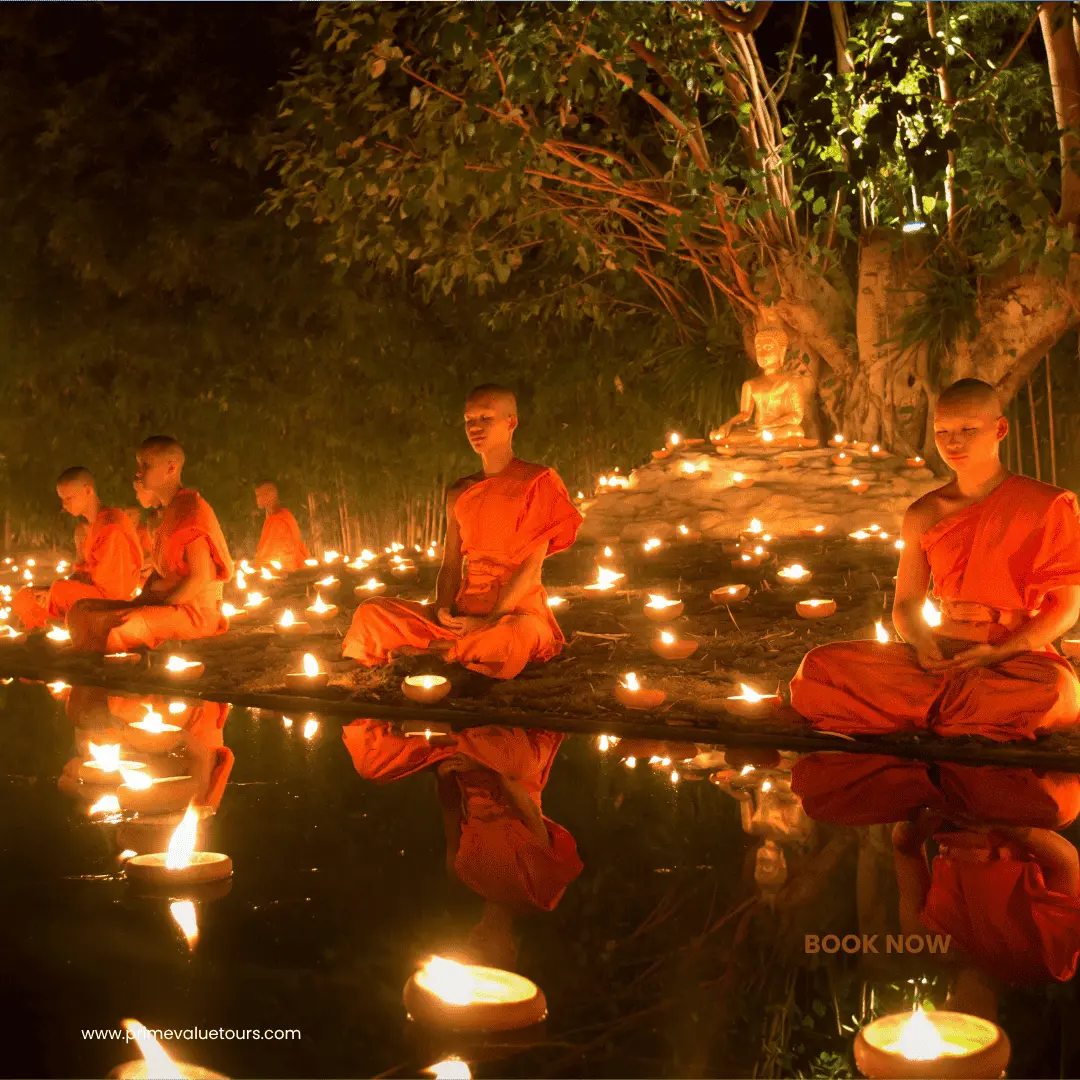
What you will notice in India: Thai, Sri Lankan, Burmese, and Cambodian monks wear orange or dark red robes. Their chanting is in Pali, the language closest to what the Buddha himself spoke. Temples are usually simple, with a single main Buddha statue and quiet meditation halls.
In our experience, Theravada pilgrims from Thailand feel most at home at Sarnath, Bodh Gaya, and Kushinagar, where the simple architecture and Pali chanting traditions are strongest.
2. Mahayana Buddhism: The Great Vehicle
Mahayana means “the great vehicle.” This branch developed about 500 years after the Buddha’s time and introduced new ideas about compassion and enlightenment for all beings.
Where it is practised today: China, Japan, Korea, Vietnam, Taiwan, and Singapore. Zen Buddhism and Pure Land Buddhism are both Mahayana schools.
Core focus: The Bodhisattva path. A Bodhisattva is someone who delays their own final liberation to help all beings reach enlightenment. Mahayana teaches compassion as the highest virtue.
What you will notice in India: Mahayana temples have many Buddha statues, plus Bodhisattvas like Avalokiteshvara (known as Kuan Yin in China). Chanting is often in Sanskrit, Chinese, Japanese, or Korean. Temples are more colourful and decorative.
Nalanda, once the greatest Buddhist university in history, was a Mahayana centre. Many Chinese and Japanese pilgrims feel a deep connection there. The ancient ruins still carry the energy of thousands of Mahayana scholars who studied on that very ground.
3. Vajrayana Buddhism: The Diamond Vehicle
Vajrayana means “the diamond vehicle” or “thunderbolt vehicle.” It is sometimes called Tantric Buddhism or Esoteric Buddhism. This is the newest of the three main branches, developed around 500 to 700 CE.
Where it is practised today: Tibet, Bhutan, Nepal, Mongolia, and the Indian Himalayan regions of Ladakh, Sikkim, and Arunachal Pradesh. Japanese Shingon Buddhism is also a form of Vajrayana.
Core focus: Rapid path to enlightenment through mantras, mudras (hand gestures), visualization, and guidance from a qualified teacher (lama or guru). Vajrayana uses elaborate rituals and symbolic imagery.
What you will notice in India: Tibetan Vajrayana monks wear maroon and yellow robes. You will see prayer wheels, colourful thangka paintings, sand mandalas, and many deity images. Chanting sounds deep and powerful, often accompanied by drums, bells, and long horns.
The Dalai Lama, leader of Tibetan Vajrayana, often teaches at Bodh Gaya in December and January. During this time, Bodh Gaya transforms into a sea of maroon robes and Tibetan prayer flags. It is one of the most moving experiences any pilgrim can witness.
Quick Comparison: How the 3 Branches Differ
Here is a simple side-by-side look at the main differences. This will help you spot each tradition when you visit sacred sites in India.
- Robe colour: Theravada uses orange or brown. Mahayana uses grey, black, or yellow. Vajrayana uses maroon and yellow.
- Sacred language: Theravada chants in Pali. Mahayana uses Sanskrit, Chinese, Japanese, or Korean. Vajrayana chants in Tibetan.
- Main goal: Theravada aims for personal liberation (Arhat). Mahayana and Vajrayana aim to become a Bodhisattva and help all beings.
- Temple style: Theravada is simple. Mahayana is colourful and decorative. Vajrayana is rich with symbols, prayer wheels, and deity images.
- Meditation style: Theravada uses Vipassana and Samatha. Mahayana includes Zen and Pure Land. Vajrayana uses visualization, mantra, and deity yoga.
Where Each Buddhist Religion Feels Most at Home in India
India is the birthplace of Buddhism. All three branches have strong connections here. But certain sites carry a stronger energy for specific traditions. Here is what most travellers do not know.
Best Sites for Theravada Pilgrims
Sarnath, where the Buddha gave his first sermon, is deeply sacred to Theravada Buddhists. The Thai temple here is one of the most active in India. Kushinagar, where the Buddha reached Parinirvana, also attracts large Thai and Sri Lankan groups every year. Bodh Gaya remains the ultimate destination for all Buddhists, but the Thai Monastery and Burmese Vihar give it a strong Theravada atmosphere.
Best Sites for Mahayana Pilgrims
Nalanda University ruins are a must-visit for Mahayana followers. This is where Hsuan Tsang, the famous Chinese monk, studied for years. The Nalanda Multimedia Museum shares the full story. Rajgir, with Vulture Peak (Griddhakuta Hill), is where the Buddha taught the Heart Sutra and the Lotus Sutra, both central to Mahayana. Japanese and Korean groups feel especially connected here.
Best Sites for Vajrayana Pilgrims
Bodh Gaya during the winter Kagyu Monlam and Dalai Lama teachings is the top Vajrayana destination in India. Beyond the Buddhist circuit, Ladakh (Hemis, Thiksey, Alchi monasteries), Sikkim (Rumtek, Pemayangtse), and Dharamshala (home of the Dalai Lama) are sacred Vajrayana regions. Many of our clients combine the main Buddhist circuit with a short Ladakh or Sikkim extension.
How to Respect All Buddhist Traditions When You Visit India
When you visit a sacred site like Bodh Gaya, you will see pilgrims from all three branches praying side by side. Here is the thing: even though the styles look different, the respect is universal. Follow these simple rules and you will feel welcome everywhere.
- Remove your shoes before entering any temple, no matter the tradition
- Dress modestly: shoulders and knees covered, no bright or flashy colours
- Walk clockwise around stupas and Bodhi trees, this is the practice across all branches
- Never point your feet toward a Buddha statue or a monk
- Speak softly, silence is valued in every Buddhist tradition
- Always ask before taking photos of monks or rituals
- Offer food or flowers with both hands, never with the left hand alone
Plus, remember that Thai monks follow very strict Vinaya rules. Women should not touch or hand items directly to them. In our tours, we always brief our groups before each site visit to make sure no one feels awkward or disrespectful.
What to Know Before You Go: Practical Tips for Buddhist Pilgrims
Here are a few insider tips we share with every group we organize.
- Best travel season: October to March. The weather is cool and comfortable, ideal for long temple visits and meditation sessions.
- Minimum trip length: 8 to 10 days for the main Buddhist circuit. Add 3 to 5 days for Ladakh or Sikkim if you want the Vajrayana experience.
- Visa: Thai, Singaporean, Korean, and Japanese citizens can apply for India e-Visa online. It is simple and usually approved within 72 hours.
- Language: Most guides at Buddhist sites speak English. At Prime Value Tours, we arrange Thai-speaking guides, Chinese-speaking guides, or Japanese-speaking escorts when required.
- Currency: Indian Rupee (INR). ATMs are available in all major towns. Carry some small cash for temple donations.
- Food: Vegetarian food is widely available. We recommend Buddhist-friendly hotels near each pilgrimage site.
Plan Your Buddhist Pilgrimage with Prime Value Tours
| Plan Your Buddhist Pilgrimage with Prime Value Tours We have been organizing pilgrimage and cultural tours across India since 1999, with a special focus on Buddhist circuit tours for Thai and Southeast Asian groups. Our team understands every branch of Buddhism and designs journeys that honour your faith, tradition, and comfort. Contact us today to design your perfect itinerary: Phone : +91-542-2500113 Mobile : +91-9721122849 WhatsApp: +91-9721122849 Email : info@primevaluetours.com Website : www.primevaluetours.com LINE : https://line.me/ti/p/6QtZRvYpeP We speak English and are happy to assist Thai-speaking groups. |
Final Thoughts: One Buddha, Many Paths
Here is what we hope you take away. Theravada, Mahayana, and Vajrayana are not competing religions. They are three paths up the same mountain, each with its own beauty. The Buddha himself taught that his teachings are like a raft, useful for crossing the river of suffering, not a burden to carry forever.
When you visit India, you will not just see ruins and temples. You will see living traditions, breathing and chanting and meditating exactly as they have for over 2,000 years. And you will understand, in a way no book can teach, that every branch of these Buddhist religions leads the same way: to peace, wisdom, and compassion.
We at Prime Value Tours would be honoured to guide you on that journey.
Frequently Asked Questions
Q1. What is the oldest form of Buddhism?
Theravada Buddhism is the oldest surviving branch. It preserves the earliest recorded teachings of the Buddha in the Pali Canon and is mainly practised in Thailand, Sri Lanka, Myanmar, Cambodia, and Laos.
Q2. Which Buddhist religion do Thai people follow?
Thai Buddhists follow Theravada Buddhism. Around 93% of Thailand’s population is Theravada Buddhist, making Thailand the largest Theravada country in the world.
Q3. Can pilgrims from different Buddhist branches visit the same sites in India?
Yes, absolutely. All three branches share the same sacred sites: Bodh Gaya, Sarnath, Kushinagar, Lumbini (Nepal), Nalanda, Rajgir, Vaishali, and Sravasti. These sites are connected to the life of the historical Buddha and are respected by every Buddhist tradition.
Q4. How many days do I need for a full Buddhist pilgrimage in India?
A complete Buddhist circuit covering the main 8 sacred sites takes 10 to 12 days. If you want to add Ladakh or Sikkim for the Vajrayana experience, plan for 14 to 16 days total. At Prime Value Tours, we customize the itinerary to match your group size, budget, and travel dates.
Q5. Which Buddhist branch is the most popular in the world today?
Mahayana Buddhism has the largest number of followers globally, mainly due to the large populations of China, Japan, Korea, and Vietnam. However, in terms of strict monastic tradition and direct connection to early Buddhist teachings, Theravada remains the most preserved form.