
Tibetan Buddhist Monasteries India: 7 Sacred Sites to Experience Vajrayana Buddhism
A pilgrim’s guide to the living heart of Vajrayana Buddhism in India
Imagine standing at 10,000 feet, prayer flags snapping in the cold mountain wind, the deep rumble of long copper horns echoing across the valley as crimson-robed monks chant a mantra that is over a thousand years old. This is the living heart of Vajrayana Buddhism, and the wonderful truth is, you do not need a visa to Tibet to experience it. India holds some of the most sacred and authentic Tibetan Buddhist monasteries in the world.
Why India Holds the Heart of Vajrayana Buddhism
For Buddhist travellers from Thailand, Vietnam, Sri Lanka, and across Southeast Asia, India is best known as the land of the Buddha, where Lord Shakyamuni was born, taught, and attained Mahaparinirvana. But there is another, lesser-known dimension of Indian Buddhism that draws thousands of pilgrims each year: the Tibetan Buddhist monasteries scattered across the Himalayas and as far south as Karnataka.
After His Holiness the 14th Dalai Lama and thousands of Tibetans took refuge in India in 1959, these monasteries became living centres of Vajrayana, the diamond vehicle tradition. Today, India is home to the world’s most active Vajrayana monasteries, preserving teachings, art, and rituals that are increasingly rare even inside Tibet itself.
In our 25 years of organising pilgrimage tours, we at Prime Value Tours have guided thousands of devotees to these sacred sites. Plus, as a Ministry of Tourism, Government of India – Verified Tour Operator and a proud IATO Member – Indian Association of Tour Operators, we know exactly how to make your journey smooth, respectful, and unforgettable. Here are 7 Tibetan Buddhist monasteries in India every serious Vajrayana practitioner should experience at least once.
What Is Vajrayana Buddhism, in Simple Words
Vajrayana, also called Tantric or Tibetan Buddhism, is the third major school of Buddhism after Theravada and Mahayana. It teaches that enlightenment can be reached swiftly in this very lifetime, through visualisation, mantra recitation, and the close guidance of a qualified lama or guru. The tradition flourished in Tibet for over 1,300 years before finding new soil here in India.
Today, all four main Tibetan lineages, Nyingma, Kagyu, Sakya, and Gelug, have major monasteries on Indian land. Each monastery you visit is not a museum piece. It is a living, breathing institution where monks study, debate, and practice exactly as their teachers have done for centuries.
The 7 Sacred Tibetan Buddhist Monasteries in India
1. Tawang Monastery, Arunachal Pradesh
Perched at 10,000 feet in the eastern Himalayas, Tawang Monastery is the largest in India and the second largest in the world after Lhasa’s Drepung. Founded in 1680 by Merak Lama Lodre Gyatso, it is the birthplace of the 6th Dalai Lama and a vital seat of the Gelug school.
The main shrine houses an 8-metre tall statue of Buddha Shakyamuni, surrounded by ancient thangka paintings, sacred manuscripts, and rare ritual objects. The chanting of over 400 monks at dawn is something you will never forget. Best time to visit: April to October.
2. Hemis Monastery, Ladakh
Hidden inside a quiet gorge 45 km from Leh, Hemis is the wealthiest and largest monastery in Ladakh. Built in 1672, it belongs to the Drukpa Kagyu lineage. The annual Hemis Festival in June or July, celebrating the birth of Guru Padmasambhava, is one of the most spectacular masked dance festivals in the entire Buddhist world.
Inside, you will find a giant 12-metre tall thangka of Padmasambhava that is unveiled only once every 12 years. Plus, the monastery museum displays ancient relics, copper-gilt statues, and priceless thangkas.
3. Thiksey Monastery, Ladakh
Often called the Mini Potala because it strikingly resembles the Dalai Lama’s former palace in Lhasa, Thiksey is a stunning 12-storey complex that climbs a hilltop 19 km from Leh. It is a major Gelug-school monastery with around 60 resident monks.
The Maitreya Temple, built in 1980 to commemorate a visit by the 14th Dalai Lama, holds a magnificent 15-metre statue of the future Buddha. Attending the morning prayers here, with Ladakh’s sunrise lighting up the Indus Valley below, is a spiritual experience that will stay with you forever.
4. Key Monastery, Spiti Valley, Himachal Pradesh
Few sights in India are as breathtaking as Key Monastery rising from a rocky hilltop in the lunar landscape of Spiti Valley. At 4,166 metres, it is one of the highest active monasteries in India, plus it is over 1,000 years old.
Belonging to the Gelug order, Key houses around 250 monks and a stunning collection of ancient murals, weapons, and rare manuscripts. The fortress-like architecture, with rooms stacked on top of rooms, was designed to protect the monastery from invaders, and it gives Key its unique honeycomb appearance. Best time to visit: June to September.
5. Namgyal Monastery, Dharamshala, Himachal Pradesh
Located inside the Tsuglagkhang Complex in McLeod Ganj, Namgyal Monastery is the personal monastery of His Holiness the 14th Dalai Lama. It is the spiritual epicentre of Tibetans in exile, originally founded in Lhasa in the 16th century and re-established in Dharamshala after 1959.
This is the place to visit if you wish to deepen your understanding of Vajrayana through teachings, debates, and rituals. His Holiness occasionally gives public teachings here, drawing thousands of devotees from across the world. Even when the Dalai Lama is travelling, the daily chanting and sand mandala creation by Namgyal monks is profoundly moving.
6. Rumtek Monastery, Sikkim
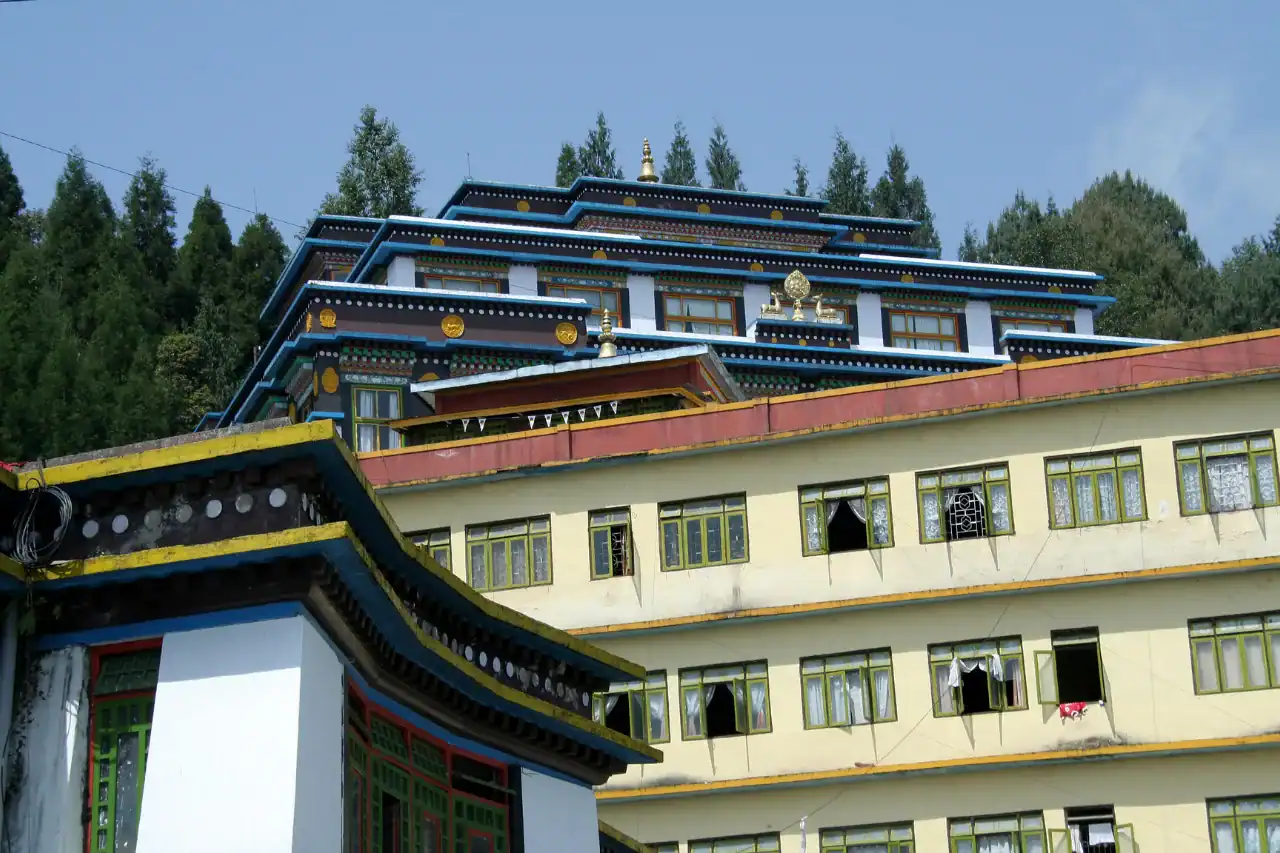
About 24 km from Gangtok, Rumtek is the largest monastery in Sikkim and the seat-in-exile of the Karmapa, head of the Karma Kagyu lineage. Built in the 1960s as an exact replica of the original Tsurphu Monastery in Tibet, it preserves some of the most sacred Kagyu relics, manuscripts, and ritual objects.
The Golden Stupa inside the main shrine contains the relics of the 16th Karmapa. Intricate murals, gold-painted statues, and richly decorated halls make Rumtek one of the most beautiful Tibetan monasteries you will ever step inside. The annual Tibetan New Year (Losar) celebrations here are unforgettable.
7. Namdroling Monastery (Golden Temple), Bylakuppe, Karnataka
Now here is something most travellers do not expect: one of the largest centres of Tibetan Buddhism in the world is in southern India. Founded in 1963 by Penor Rinpoche, Namdroling is the seat of the Nyingma lineage in India and home to over 5,000 monks and nuns.
The Golden Temple, with three massive 60-foot golden statues of Padmasambhava, Buddha Shakyamuni, and Buddha Amitayus, is breathtaking. Bylakuppe, the surrounding Tibetan settlement, gives you a chance to taste authentic Tibetan momos, butter tea, and culture. Plus, you can quietly watch monks debate philosophy in the traditional Tibetan way.
Best Time to Visit Tibetan Buddhist Monasteries in India
The honest answer depends on which monastery you choose. Tawang, Hemis, Thiksey, and Key are best between April and October when the high mountain passes are open. Rumtek in Sikkim is wonderful from March to May and again from October to December. Namgyal in Dharamshala is accessible all year, though winters get very cold. Namdroling in Karnataka is comfortable from October to March.
For first-time visitors from Thailand or Southeast Asia, we usually recommend combining 2 or 3 monasteries in one trip rather than trying to see all 7 in a single visit. Travel distances inside India are large, plus the high-altitude monasteries need 1 to 2 days of acclimatisation.
What to Know Before You Go
Here are 5 practical tips from our 25 years of guiding Buddhist groups across India:
- Dress respectfully: cover shoulders and knees. Remove shoes and hats before entering shrine halls.
- Photography rules: outside is usually fine, inside main shrines it is often restricted. Always ask first.
- Walk clockwise: always circumambulate stupas, chortens, and main shrines in a clockwise direction.
- Donations welcome: a small offering to the monastery is appreciated, never demanded.
- Acclimatise properly: spend 1 to 2 nights in Leh, Tawang, or Spiti before visiting high monasteries to avoid altitude sickness.
Before you travel, we strongly suggest reading our Buddhist Pilgrimage Guide for India and Nepal. Plus, our detailed Leh Ladakh Tour Packages page lists ready itineraries that include Hemis and Thiksey monasteries together with the Indus Valley highlights.
| Plan Your Trip with Prime Value Tours We have been organising pilgrimage and cultural tours across India since 1999, with a special focus on Buddhist circuit tours for Thai and Southeast Asian groups. We are a Ministry of Tourism approved operator and a proud IATO member. Contact us today to design your perfect itinerary: Phone : +91-542-2500113 WhatsApp : +91-9794122849 Email : info@primevaluetours.com Website : www.primevaluetours.com LINE : https://line.me/ti/p/6QtZRvYpeP We speak English and are happy to assist Thai-speaking groups. |
Ready to begin your Vajrayana journey? Visit our Plan Your Trip page to share your dates, group size, and interests. We will design an itinerary that fits you perfectly.
Frequently Asked Questions
Q1. What is the difference between Tibetan Buddhism and the Buddhism in Thailand?
Thai Buddhism follows the Theravada tradition, focused on the Pali canon and the historical Buddha’s teachings. Tibetan Buddhism follows Vajrayana, which uses tantric methods, mantras, visualisations, and the guidance of a qualified lama. Both share the same foundational teachings of the Buddha. Many devout Thai pilgrims visit Tibetan monasteries to deepen their understanding of Mahayana and Vajrayana practices.
Q2. Do I need a special permit to visit Tibetan Buddhist monasteries in India?
Most monasteries are freely accessible. However, Tawang in Arunachal Pradesh requires an Inner Line Permit for Indian citizens and a Protected Area Permit for foreigners. Bylakuppe also needs a special permit for foreign nationals. We arrange all permits as part of our tour packages, so you do not need to worry.
Q3. Can I attend prayers and teachings at these monasteries?
Yes, most monasteries warmly welcome respectful visitors during morning and evening prayers. Public teachings by senior lamas, and occasionally by His Holiness the Dalai Lama at Namgyal Monastery, are open to all. Check schedules in advance, plus dress modestly and switch off your phone during sessions.
Q4. How many days do I need to cover all 7 monasteries?
Realistically, covering all 7 needs about 18 to 21 days because the travel distances are very large. Most pilgrims pick 2 to 3 regions per trip. For example, Ladakh (Hemis and Thiksey) plus Dharamshala (Namgyal), or Sikkim (Rumtek) plus Tawang. We can plan multi-region tours across 2 visits if you want to cover all 7.
Q5. Is it safe for senior pilgrims to visit high-altitude monasteries?
Most monasteries are accessible, but high-altitude sites like Key (4,166 m), Hemis, and Thiksey require careful acclimatisation. We recommend a medical consultation before travel, plus a slow ascent itinerary for senior travellers. Lower-altitude monasteries like Rumtek (1,500 m) and Namdroling (820 m) are suitable for all ages.
Whichever monastery calls to you first, may your journey be safe, your heart be open, and your steps blessed by the wisdom of the lineage masters. Tashi Delek, and we look forward to walking part of this journey with you.