
Amaravati Buddhist Stupa: Complete Pilgrim Guide 2026
Picture this. You stand on the banks of the Krishna River in Andhra Pradesh, where 2,300 years ago one of the largest Buddhist stupas in Asia rose into the sky. Pilgrims walked thousands of kilometers to reach this sacred ground. Emperor Ashoka sent his envoys here. The Buddha himself, according to tradition, gave the Kalachakra teachings at this very spot.
This is Amaravati. And most travellers have never heard of it.
The Amaravati Buddhist Stupa is one of the most important Buddhist heritage sites in all of India, yet it remains beautifully uncrowded compared to Bodh Gaya or Sarnath. For Thai pilgrims, Sri Lankan monks, and serious students of Buddhism from across Southeast Asia, this site holds a very special place. The original Mahachaitya stood about 27 meters tall and stretched 50 meters across, decorated with some of the finest stone carvings the ancient world ever produced.
At Prime Value Tours Pvt. Ltd., we have been guiding Buddhist groups across India since 1999. We are a Ministry of Tourism, Government of India – Verified Tour Operator and a proud IATO Member – Indian Association of Tour Operators. In our years of organizing pilgrimage tours, we have seen Amaravati become a quiet favorite among returning Thai monks who want to walk where the Buddha walked, beyond the standard circuit.
Here is everything you need to know before you visit.
The Story of Amaravati Buddhist Stupa: A 2,300-Year Heritage
The Amaravati Buddhist Stupa was originally built around the 3rd century BCE during the reign of Emperor Ashoka. That alone places it among the oldest Buddhist monuments anywhere in the world. Located in the Guntur district of Andhra Pradesh, near the Krishna River, the site was once the heart of a thriving Buddhist civilization.
Over the next 1,500 years the stupa grew. Different ruling dynasties added to it, especially the Satavahana kings, who governed this region from roughly 230 BCE to 220 CE. Under their patronage, Amaravati flourished. Monks from across India and Sri Lanka came to study here. The site became a major center of Mahayana and later Vajrayana Buddhism.
By the 14th century, however, the great stupa had fallen into ruin. Local villagers used its bricks for construction. Sculptures lay buried under earth. The site might have been forgotten entirely if not for British surveyor Colin Mackenzie, who rediscovered it in 1797.
What stands today is a respectful reconstruction, but the spiritual presence remains untouched. Plus, the museum next to the site holds some of the finest pieces of ancient Buddhist art you will ever see in person.
Why Amaravati Buddhist Stupa Matters: The Kalachakra Connection
Here is what most travellers don’t know about Amaravati. It is the birthplace of one of the most important teachings in Vajrayana Buddhism: the Kalachakra Tantra.
According to tradition, the Buddha himself taught the Kalachakra at Dhanyakataka, the ancient name for this region, near the great stupa. King Suchandra of Shambhala received these teachings, and from there they spread throughout the Buddhist world. For Tibetan, Bhutanese, and many Thai practitioners, this makes Amaravati one of the holiest sites on Earth.
This connection is not just folklore. In January 2006, His Holiness the 14th Dalai Lama led a Kalachakra Initiation at Amaravati. Around 100,000 devotees from across the world attended. The event placed Amaravati firmly back on the global Buddhist map.
For pilgrims who already follow the classic Buddhist Pilgrimage Guide for India and Nepal, adding Amaravati transforms a standard tour into something truly complete. You walk both the path of the historical Buddha and the path of the esoteric teachings.
The Famous Amaravati School of Art and Sculpture
Beyond its spiritual importance, Amaravati gave birth to one of the three great schools of ancient Indian Buddhist art, alongside Gandhara and Mathura. The Amaravati School used pale green-white limestone, almost luminous when polished, to create some of the most graceful and detailed Buddhist carvings ever made.
You will see scenes from the Buddha’s life, jataka tales, lotus medallions, and intricate processional reliefs. Many panels show the Buddha symbolically, through footprints, an empty throne, or the Bodhi tree, rather than as a human figure. This style influenced Buddhist art across Sri Lanka, Myanmar, Thailand, and Indonesia.
Today, the major sculptures are spread across three places:
- The Government Museum in Chennai, which holds the largest collection.
- The British Museum in London, where the famous Amaravati Marbles are displayed.
- The Amaravati Archaeological Museum on-site, a manageable, focused collection.
The on-site museum is small but rich. In our experience, allowing one full hour here lets you appreciate the carvings without rushing. Photography is permitted in most sections, with a small camera fee.
What You Can See at Amaravati Buddhist Stupa Today
When you arrive at the Amaravati Buddhist Stupa site, you will find a peaceful, well-maintained complex. Here is what to expect:
- The Mahachaitya Foundation: the circular base of the original stupa, partly reconstructed. You can perform parikrama (circumambulation) here.
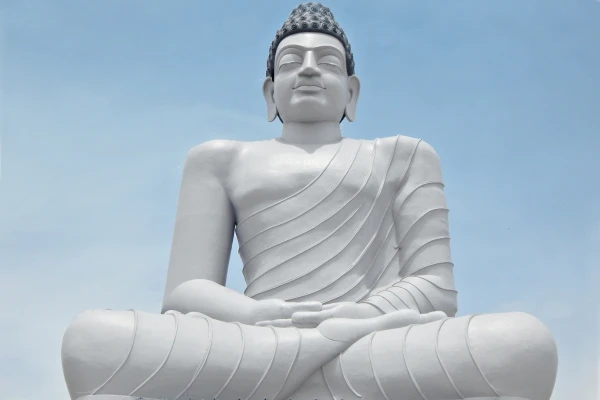
- The Dhyana Buddha Statue: a 125 ft tall meditation A Buddha statue installed in recent years, visible from far away. Wonderful for group photos and prayer.
- Amaravati Archaeological Museum: houses original carvings, pottery, and inscriptions from the Satavahana period.
- Amareswara Temple: an ancient Shiva temple next to the stupa. Many pilgrims visit both, reflecting the layered religious history of the region.
- Krishna River Ghat: a short walk away. Beautiful at sunrise and a peaceful place for quiet meditation.
The whole site can be covered in 3 to 4 hours at a relaxed pace. Most groups combine it with a visit to nearby Vijayawada or the Nagarjunakonda Buddhist site, which together make a wonderful 2- to 3-day South India Buddhist circuit.
How to Reach Amaravati Buddhist Stupa
Amaravati is in Andhra Pradesh, southern India. It is more remote than the famous North Indian Buddhist sites, but reaching it is straightforward with proper planning.
- Nearest Airport: Vijayawada Airport (VGA), about 35 km away. Daily flights connect from Hyderabad, Bangalore, Chennai, Delhi, and Mumbai.
- Nearest Railway Station: Vijayawada Junction, one of the busiest in South India. Well connected from Chennai, Hyderabad, and Bengaluru by overnight trains.
- By Road: From Vijayawada, you can reach Amaravati in about 1 hour by car. From Hyderabad it takes around 6 hours. Most of our groups travel by private AC coach, which we arrange end to end.
- Best Time to Visit: November to February is ideal. Daytime temperatures stay between 20 and 28 degrees Celsius, perfect for outdoor sightseeing. Avoid May to June when temperatures cross 40 degrees Celsius.
What to Know Before You Go: Practical Tips
A few things we always tell our Thai and Southeast Asian groups before they visit Amaravati:
- Dress modestly, as with any Buddhist heritage site. Cover shoulders and knees. Light cotton clothing works best in the South Indian climate.
- Carry water and snacks. Food options near the stupa are limited. Pack drinking water and light vegetarian snacks for the visit.
- Photography rules are simple. Free at the stupa, with a small fee at the museum. Drone photography requires advance permission from the Archaeological Survey of India.
- Plan a full day. Don’t rush. Pair Amaravati with Vijayawada’s Kanaka Durga Temple or the Undavalli Caves for a much richer experience.
- Hire a qualified local guide. The history is layered and complex. A good guide makes the difference between simply seeing stones and truly understanding a 2,300-year story.
For groups visiting from Thailand, Vietnam, or Sri Lanka, we often recommend including Amaravati on the way to or from a Bhutan tour package or as part of an extended South India Buddhist heritage circuit.
Plan Your Trip with Prime Value Tours
We have been organizing pilgrimage and cultural tours across India since 1999, with a special focus on Buddhist circuit tours for Thai and Southeast Asian groups. We are a Ministry of Tourism-approved operator and proud IATO member.
If you want to add Amaravati to your North Indian Buddhist circuit or design a full South Indian Buddhist heritage tour, our team will build a customized itinerary just for you. We handle visa support, transport, hotels, monk-friendly meals, and English-speaking guides. You can also start by visiting our Plan Your Trip page.
Contact us today to design your perfect itinerary:
Phone: +91-542-2500113
WhatsApp: +91-9794122849
Email: info@primevaluetours.com
Website: www.primevaluetours.com
LINE: https://line.me/ti/p/6QtZRvYpeP
We speak English and are happy to assist Thai-speaking groups.
Walk Where the Buddha Taught
The Amaravati Buddhist Stupa is more than a heritage monument. It is a quiet meeting point of faith, history, and art that has survived 2,300 years of change. To stand at its base is to feel that the Buddha’s teachings still travel through these stones. For pilgrims willing to step beyond the famous Northern circuit, Amaravati offers something rare: an unhurried, deeply spiritual encounter with one of the oldest Buddhist civilizations the world has ever known.
We would be honored to walk this sacred path with you.
Frequently Asked Questions
1. Where is the Amaravati Buddhist Stupa located?
The Amaravati Buddhist Stupa is in Amaravati village, Guntur district, Andhra Pradesh, southern India. It sits on the south bank of the Krishna River, about 35 km west of Vijayawada city.
2. How old is the Amaravati Buddhist Stupa?
It was originally built around the 3rd century BCE during Emperor Ashoka’s reign, making it more than 2,300 years old. It was expanded and decorated over the next 1,500 years by various dynasties, especially the Satavahanas.
3. Why is Amaravati important for Buddhists?
Amaravati is believed to be where the Buddha gave the Kalachakra teachings, making it one of the holiest sites for Vajrayana Buddhism. It is also the birthplace of the famous Amaravati School of Buddhist art that influenced Sri Lanka, Myanmar, and Southeast Asia.
4. How long do I need to visit the Amaravati Buddhist Stupa?
A relaxed visit, including the museum, takes about 3 to 4 hours. Pilgrims who want to combine prayer, parikrama, and the museum should plan a full half-day. If you also visit Vijayawada and Undavalli Caves, plan 2 full days.
5. Can I visit Amaravati as part of a Buddhist circuit tour from Thailand?
Yes, absolutely. Prime Value Tours regularly designs custom itineraries that combine Amaravati with the North India Buddhist circuit (Bodh Gaya, Sarnath, Lumbini, Kushinagar) or with Bhutan tours for a complete pilgrimage experience. Contact us with your group size and travel dates, and we will build a tailored plan.