- Govt. of India Approved
- IATO Member
- Trusted Since 1999
Pilgrimage Guide › Sacred Sites 1–9 › Sarnath Archaeological Museum
The Sarnath Archaeological Museum is the place to see the famous Lion Capital of Sarnath, the four-lion sculpture that is now India’s national emblem. The capital once stood on top of the Sarnath Ashoka Pillar, whose base you can still see near the Dhamek Stupa. Opened in 1910, it is the oldest site museum of the Archaeological Survey of India.
Part of our guide to Buddhist heritage sites in India. To visit with a guide, see our Sarnath tour from Varanasi.
Sarnath, about 10 km from Varanasi, beside the ruins
The Lion Capital, India's national emblem
1910, the oldest site museum of the ASI
Archaeological Survey of India
Not allowed inside the museum
About one hour
The Sarnath Archaeological Museum keeps the most important objects found at Sarnath, the place where the Buddha gave his first sermon. Its galleries hold the Lion Capital, the seated Preaching Buddha and many Buddha and Bodhisattva images. The museum was set up by the Archaeological Survey of India so that the finds could stay close to the site where they were discovered.
Emperor Ashoka placed the Lion Capital on a tall stone pillar in the 3rd century BCE to mark the place of the Buddha’s first sermon. Four lions sit back to back above a round base carved with a wheel, an elephant, a horse, a bull and a lion. The wheel stands for the Dhamma Chakra, the Wheel of the Teaching.
India uses the Lion Capital of Sarnath as its national emblem, and the wheel appears in the centre of the national flag. For many visitors, seeing the original sculpture is the highlight of the Sarnath Archaeological Museum.

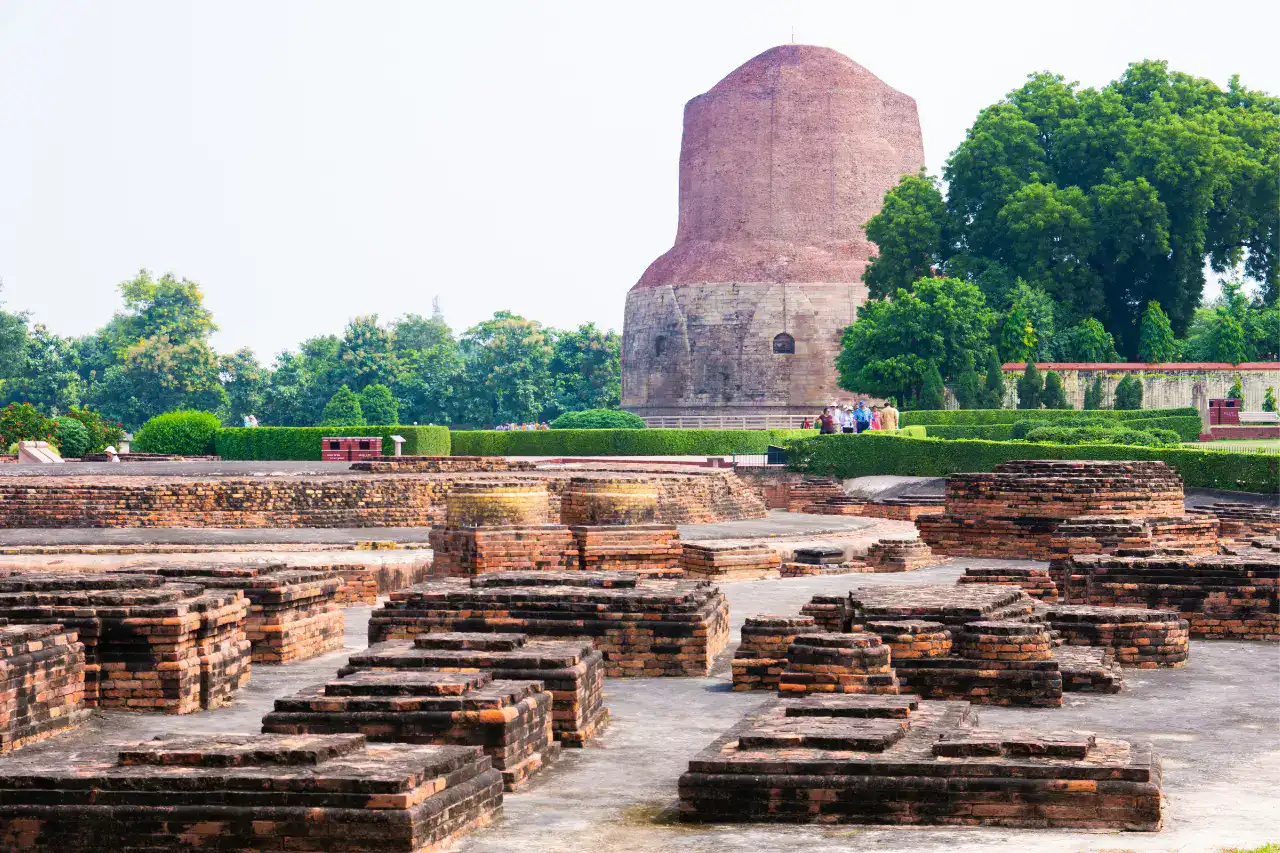
The broken lower part of the Sarnath Ashoka Pillar still stands at the site, protected by a fence, a short walk from the Dhamek Stupa. It carries an inscription of Ashoka that warns monks and nuns against splitting the Sangha. The Lion Capital from its top is kept safely inside the museum.
The museum also keeps the famous seated Preaching Buddha of the Gupta period, showing the Buddha turning the Wheel of the Dhamma. Many art lovers see it as one of the most beautiful Buddha images in India. Other rooms show Bodhisattva figures, carved railings and pieces of the old monasteries of Sarnath.
Sarnath was a great centre of Buddhism for more than a thousand years. Kings and monks built stupas, monasteries and shrines around the Deer Park. Later the site was abandoned, and its buildings fell into ruin and were slowly covered by earth.
In the 19th and early 20th centuries, archaeologists began to dig at Sarnath. During the excavations of 1904–05, the Lion Capital was found near the base of the Ashoka Pillar. To keep these treasures safe and close to the place where they were found, the Sarnath Archaeological Museum was built beside the ruins and opened in 1910. It was the first site museum of the Archaeological Survey of India, and it is still one of the most important Buddhist museums in the world.
When India became a republic on 26 January 1950, the government chose the Lion Capital of Sarnath as the national emblem. The official emblem shows three of the four lions (the fourth is hidden at the back), the wheel in the centre of the base, a bull and a horse, and the words “Satyameva Jayate”, meaning “Truth alone triumphs”.
You will see this emblem on Indian banknotes, coins, passports and government papers. Many visitors are surprised to learn that the original sculpture, more than 2,200 years old, is right here in the Sarnath Archaeological Museum.
For Buddhist pilgrims, the Lion Capital is more than a national symbol. The lions are often understood as the “lion’s roar” of the Buddha, his fearless teaching that spread in all four directions. The wheel stands for the Dhamma Chakra, the Wheel of the Teaching that the Buddha set in motion at Sarnath with his first sermon.
Standing in front of the Lion Capital, many Thai pilgrims pause for a short prayer. It reminds them that the words the Buddha spoke at Sarnath were honoured by Emperor Ashoka and have reached us across more than two thousand years.
The Sarnath Archaeological Museum stands opposite the main archaeological park, so it is easy to combine with the other holy places of Sarnath:
Most of our Thai groups visit the Sarnath Archaeological Museum in the morning, after chanting at the Dhamek Stupa. Our guide explains the Lion Capital, the Preaching Buddha and the other main pieces in simple words, and Thai-speaking guides are available on request.
Sarnath is about 10 km from Varanasi, so the Sarnath Archaeological Museum fits easily into any Buddhist Circuit tour that includes Varanasi. You can visit it on these tours:
Tell us your travel dates and group size on WhatsApp or LINE, and we will plan your visit to Sarnath around your prayer time.

Sarnath is about 10 km from Varanasi, so it is easy to visit in half a day. Start at the Dhamek Stupa and the Deer Park, see the Ashoka Pillar, then walk across to the museum. Finish at the Mulagandha Kuti Vihara and the Thai temple. See our Sarnath temple guide and our Dhamek Stupa guide.
It is a stone sculpture of four lions made for Emperor Ashoka in the 3rd century BCE. It is India’s national emblem and is kept in the Sarnath Archaeological Museum.
The lower part of the pillar stands at the Sarnath site near the Dhamek Stupa. The Lion Capital from its top is inside the museum.
No. Photography is not allowed inside the museum.
About one hour is enough for most visitors.
Sarnath is about 10 km from Varanasi.
It was found during the excavations at Sarnath in 1904–05, near the base of the Ashoka Pillar.
India adopted the Lion Capital of Sarnath as its national emblem on 26 January 1950.
Yes. The museum stands opposite the archaeological park where the Dhamek Stupa is, so you can walk between them.
Government-approved tour operator from Varanasi since 1999. Private Buddhist pilgrimage tours for Thai and Southeast Asian groups, with English or Thai-speaking guides.