- Govt. of India Approved
- IATO Member
- Trusted Since 1999
Pilgrimage Guide › Sacred Sites 1–9 › Dhamek Stupa, Sarnath
The Dhamek Stupa in Sarnath, near Varanasi, marks the Deer Park where the Buddha gave his first sermon to five disciples and set the Wheel of Dhamma in motion. It is the most famous Sarnath stupa and one of the most sacred places in Buddhism. Dhamek Stupa Sarnath Varanasi is only 10–13 km from the city, so pilgrims can visit it easily in half a day.
Part of our guide to Buddhist heritage sites in India.
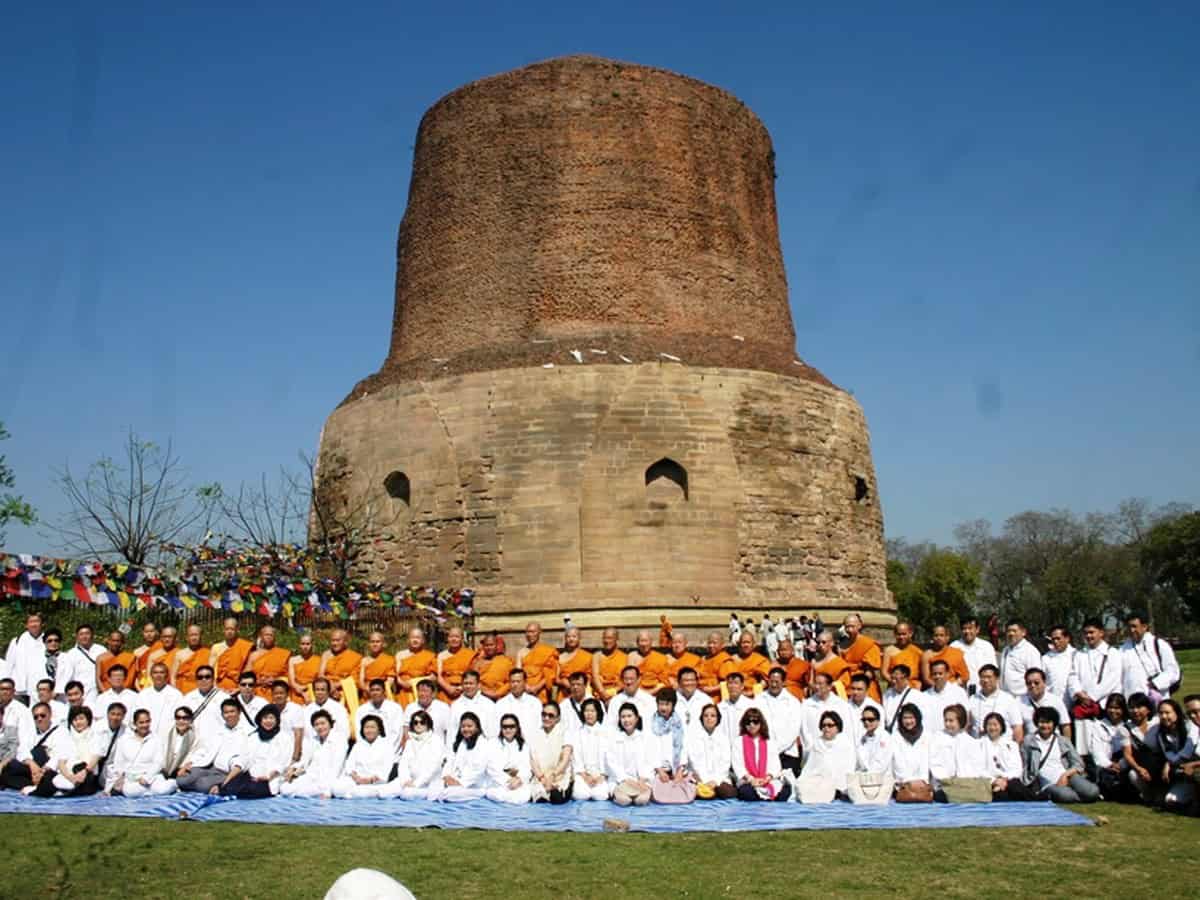
Sarnath, about 10–13 km from Varanasi. UNESCO World Heritage Site (2026)
About 43.6 m high, 28 m wide
Archaeological Museum – closed on Fridays
Varanasi (VNS), about 30 km
October to March
Half a day
After his Enlightenment at Bodh Gaya, the Buddha walked to the Deer Park at Isipatana, now Sarnath. Here he gave his first sermon, the Dhammacakkappavattana Sutta, to his five former companions. They became his first disciples, and the Sangha was born. Buddhists call this event the first turning of the Wheel of Dhamma.
Emperor Ashoka later built stupas and raised a stone pillar here. Its famous Lion Capital is now India’s national emblem and can be seen in the Sarnath Museum. The great Dhamek Stupa, in its present form from around the 6th century CE, rises about 43.6 metres and has fine carved floral patterns on its stone base. Nearby, the Mulagandha Kuti Vihara, built in 1931, keeps the memory of the Buddha’s first rainy-season retreat.
On 25 July 2026, UNESCO inscribed the Ancient Buddhist Site of Sarnath on the World Heritage List, during the 48th session of the World Heritage Committee in Busan, South Korea. Sarnath became India’s 45th World Heritage Site.
The listed site has two parts: the Archaeological Remains of Sarnath, which include the Dhamek Stupa, and the Chaukhandi Stupa nearby. With this listing, three of the four great Buddhist pilgrimage places are now World Heritage Sites: Lumbini in Nepal, the Mahabodhi Temple in Bodh Gaya, and Sarnath.
Many people believe Emperor Ashoka built the Dhamek Stupa. Archaeologists now date the present stupa to the Gupta period, in the 5th–6th century CE. It stands over older foundations, and Ashoka did build other stupas and his famous pillar at Sarnath in the 3rd century BCE.
The Dhamek Stupa is the largest monument in Sarnath. It is a solid cylinder of stone and brick, about 43.6 metres high and 28 metres wide at the base. The lower part is covered with stone carved with fine floral and geometric patterns, and small niches around it may once have held Buddha images. The upper part, of brick, was never finished.
British archaeologists began digging at Sarnath in the early 19th century. In the 1830s, Alexander Cunningham excavated the Dhamek Stupa and found an inscribed stone slab inside it. Today the Archaeological Survey of India (ASI) protects the stupa.
Sarnath is where the Dhamma was first shared with the world. Every chant of the Dhammacakkappavattana Sutta looks back to this Deer Park. Reciting it beside the Dhamek Stupa is one of the most moving moments of a pilgrimage for Thai groups.
Sarnath is also the birthplace of the Sangha, the community of monks, which makes it especially meaningful for monks and temple groups.
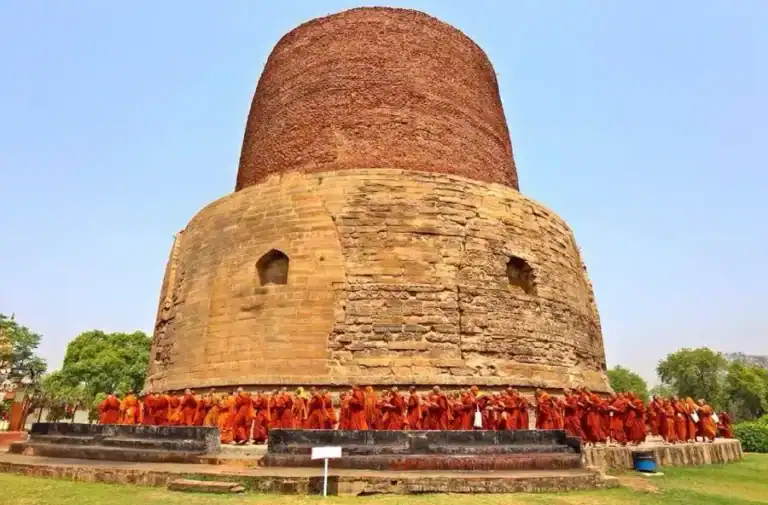
Sarnath is about 10–13 km from the centre of Varanasi. Varanasi’s Lal Bahadur Shastri Airport (VNS) is about 30 km away, and Varanasi Junction is a major railway station. Taxis and auto-rickshaws run between Varanasi and Sarnath all day. Prime Value Tours is based in Varanasi and guides Sarnath visits for pilgrim groups every season.
October to March is the best time. The Sarnath Museum is closed on Fridays, while the stupa park stays open, so plan your day around this. Visit early morning for quiet chanting at the Dhamek Stupa, and attend the evening prayers at Mulagandha Kuti Vihara. Buddha Purnima and the Mulagandha Kuti anniversary in November draw large gatherings of monks and pilgrims.
Prime Value Tours can include this sacred place in a private tour for your group, with an English or Thai-speaking guide, comfortable air-conditioned transport, vegetarian meals and unhurried time for chanting and meditation at every stop. Tell us your group size and travel dates, and we will plan the best route and send your quotation within 24 hours.
This is how a peaceful half-day at Sarnath often looks for our pilgrim groups:
Sarnath is only about 30 minutes from our office in Varanasi, so we can easily add it before or after the Ganga boat ride.
ธัมเมกขสถูป สารนาถ คือสถานที่ที่พระพุทธเจ้าทรงแสดงปฐมเทศนา (ธัมมจักกัปปวัตตนสูตร) แก่ปัญจวัคคีย์ ณ ป่าอิสิปตนมิคทายวัน และเป็นหนึ่งในสังเวชนียสถาน 4 ตำบล ในปี 2026 สารนาถได้รับการขึ้นทะเบียนเป็นมรดกโลกของยูเนสโก สารนาถอยู่ห่างจากเมืองพาราณสีประมาณ 10–13 กม. พิพิธภัณฑ์ปิดทุกวันศุกร์
Prime Value Tours มีสำนักงานที่พาราณสี จัดทัวร์สารนาถและทัวร์ตามรอยพระพุทธเจ้า อินเดีย–เนปาล แบบส่วนตัว พร้อมไกด์พูดภาษาไทย ติดต่อเราทาง LINE หรือ WhatsApp +91-9794122849
(Summary for Thai pilgrims: Dhamek Stupa, Sarnath – the place of the Buddha’s first sermon, now a UNESCO World Heritage Site, and our private Sarnath tours with a Thai-speaking guide.)
The Dhamek Stupa is a large stupa in Sarnath that marks the Deer Park where the Buddha gave his first sermon. It is about 43.6 metres high.
The present Dhamek Stupa dates from the Gupta period, in the 5th–6th century CE. It stands over older foundations. Emperor Ashoka built other stupas and a stone pillar at Sarnath in the 3rd century BCE.
The Dhamek Stupa is about 43.6 metres high and about 28 metres wide at the base. It is the largest monument in Sarnath.
Yes. UNESCO inscribed the Ancient Buddhist Site of Sarnath on the World Heritage List on 25 July 2026. It is India’s 45th World Heritage Site.
The Dhamek Stupa and the Sarnath ruins are open every day from sunrise to sunset. The Sarnath Archaeological Museum is closed on Fridays.
No. The Sarnath Archaeological Museum is closed on Fridays. The Dhamek Stupa and the ruins remain open.
At Sarnath the Buddha gave his first sermon, the Dhammacakkappavattana Sutta, teaching the Four Noble Truths and the Noble Eightfold Path to his first five disciples.
Sarnath is about 10–13 km from central Varanasi, around 30 minutes by road.
Yes. The original Ashoka Lion Capital, now India’s national emblem, is displayed in the Sarnath Archaeological Museum.
Government-approved tour operator from Varanasi since 1999. Private Buddhist pilgrimage tours for Thai and Southeast Asian groups, with English or Thai-speaking guides.