- Govt. of India Approved
- IATO Member
- Trusted Since 1999
Pilgrimage Guide › Sacred Sites 19–27 › Dhauli Shanti Stupa
Dhauli Hill, about 8 km from Bhubaneswar in Odisha, overlooks the battlefield of the Kalinga War (around 261 BCE). After this war, Emperor Ashoka turned to Buddhism and spread the Dharma across Asia. Today a white Peace Pagoda (Shanti Stupa) crowns the hill.
Part of our guide to Buddhist heritage sites in India.
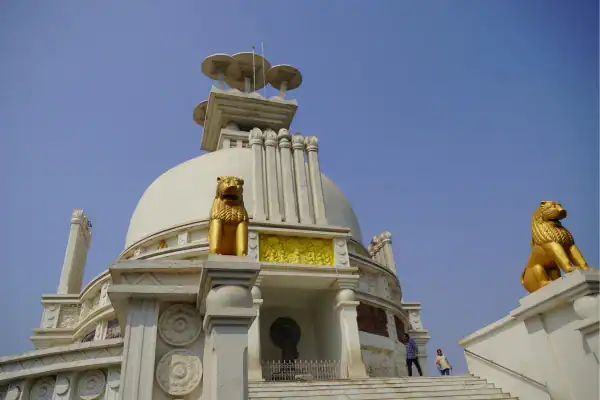
Dhauli Hill, about 8 km from Bhubaneswar, Odisha
Kalinga War, around 261 BCE
Ashoka's Rock Edicts
Bhubaneswar (BBI)
October to February
1–2 hours
The Kalinga War fought near Dhauli caused terrible loss of life. Moved by the suffering, Emperor Ashoka embraced Buddhism and became its greatest royal patron, helping it grow from an Indian teaching into a world religion.
At the foot of the hill, Ashoka’s edicts are carved in Brahmi script on a large rock, declaring his rule by Dharma, non-violence and care for all people. Above them, a carved elephant is one of the earliest Buddhist sculptures in Odisha. The white Shanti Stupa (Peace Pagoda) on the hilltop was built in 1972 with Japanese Buddhist support, with four Buddha images facing the four directions.
Dhauli is where the story of Ashoka’s change of heart is remembered. After Kalinga, Ashoka sent Buddhist teachers to many lands. According to Thai and Southeast Asian tradition, the monks Sona and Uttara brought the Dharma to Suvarnabhumi in his time — so this hill holds special meaning for pilgrims from the region.
Standing before the edicts and the Peace Pagoda, pilgrims reflect on non-violence and compassion, the core of the Buddha’s teaching. It is also the natural starting point for visiting the Buddhist Diamond Triangle of Odisha.
Dhauli stands on the bank of the Daya river. A well-known story says the river turned red with the blood of the fallen in the Kalinga war. It is a legend, but it is told at Dhauli to this day, and it is the story that led Ashoka to give up war. Many people believe the carved elephant above the edicts marks the place of his change of heart.
Sources do not agree on how many people died or on the exact year of the war, so we do not give those numbers here.
Eleven of Ashoka’s 14 major rock edicts are carved at Dhauli. There are also two special “Kalinga edicts”, in which Ashoka speaks of the welfare of all people. The Peace Pagoda on the hill was built in 1972 by the Japan Buddha Sangha and the Kalinga Nippon Buddha Sangha. The work is linked with the Japanese monk Nichidatsu Fuji Guruji. Stone panels on the stupa show the Buddha’s footprints, the Bodhi tree and Ashoka laying down his sword.
Dhauli is about 8 km from Bhubaneswar. Bhubaneswar Airport (BBI) has flights from Delhi, Kolkata, Mumbai and Chennai. Autos, taxis and city buses run from Bhubaneswar. Dhauli is often combined with the Lingaraj Temple and the Udayagiri–Khandagiri caves of Bhubaneswar on the same day.
October to February is the best time (about 15–28°C). The Peace Pagoda looks beautiful when lit in the evening. Avoid May–June (heat) and July–September (heavy monsoon). From Bhubaneswar, continue to the Diamond Triangle of Ratnagiri, Udayagiri and Lalitgiri.
Prime Value Tours can include this sacred place in a private tour for your group, with an English or Thai-speaking guide, comfortable air-conditioned transport, vegetarian meals and unhurried time for chanting and meditation at every stop. Tell us your group size and travel dates, and we will plan the best route and send your quotation within 24 hours.
Dhauli Shanti Stupa is on Dhauli Hill, about 8 km from Bhubaneswar in Odisha, India.
Dhauli overlooks the Kalinga War battlefield. After this war, Emperor Ashoka turned to Buddhism and spread it across Asia.
The Shanti Stupa was built in 1972 with the support of Japanese Buddhists, together with the Odisha government.
They are inscriptions of Emperor Ashoka carved on a rock at the foot of the hill, describing his rule by Dharma and non-violence.
Dhauli is about 8 km from Bhubaneswar. Take an auto, taxi or city bus.
Government-approved tour operator from Varanasi since 1999. Private Buddhist pilgrimage tours for Thai and Southeast Asian groups, with English or Thai-speaking guides.