- Govt. of India Approved
- IATO Member
- Trusted Since 1999
Pilgrimage Guide › Sacred Sites 10–18 › Sanchi Stupa
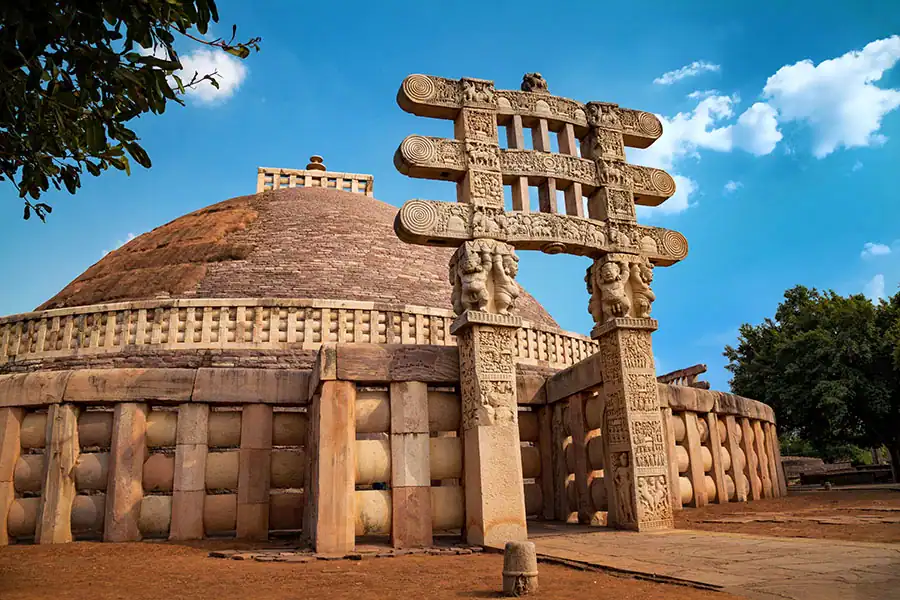
Sanchi Stupa in Madhya Pradesh is the Great Stupa first built by Emperor Ashoka in the 3rd century BCE, famous for its four richly carved gateways. The Buddhist monuments at Sanchi are a UNESCO World Heritage Site.
Part of our guide to Buddhist heritage sites in India.
Sanchi, Raisen district, Madhya Pradesh
UNESCO World Heritage Site (1989)
3rd century BCE, by Emperor Ashoka
About 46 km (1 hour)
ASI Museum – closed on Fridays
October to March
The Great Stupa at Sanchi was first built in brick by Emperor Ashoka in the 3rd century BCE. In the following centuries it was enlarged with a stone covering, railings and four magnificent toranas (gateways). The gateways are carved with scenes from the Buddha’s life and the Jataka tales, in which the Buddha is shown through symbols such as the Bodhi tree, the wheel and footprints.
Stupa No. 3 once held relics of the Buddha’s two chief disciples, Sariputta and Moggallana. They were taken to England in the 19th century and returned to India in the mid-20th century. Since 1952 they have been enshrined in the Chetiyagiri Vihara at Sanchi and are shown to pilgrims every year in late November. The Buddhist monuments at Sanchi became a UNESCO World Heritage Site in 1989.
Sanchi holds a rare blessing: the relics of Venerable Sariputta and Venerable Moggallana, the Buddha’s two chief disciples. Paying respect to them is deeply moving for Theravada pilgrims from Thailand and Southeast Asia.
The carved gateways also tell the Buddha’s life and the Jataka stories in stone, so pilgrims can “read” the teaching while walking around the stupa.
Sanchi was a centre of Buddhist teaching until the 12th century. It was then left empty for about 600 years, until it was found again in 1818. UNESCO calls it the oldest surviving Buddhist sanctuary. The site has more than the Great Stupa. Four statues of the Buddha, seated under canopies, were later placed at the four entrances of the Great Stupa. Sanchi did well again between the 7th and 12th centuries CE.
Stupa 1 is the Great Stupa. Stupa 3 lies to its north-east. It is smaller and has one gateway. Stupa 4, behind it, is worn down and only the base remains. Small Stupa 5, between Stupas 1 and 3, once held a Buddha statue, which is now in the museum. The four gateways of the Great Stupa were put up around 35 BCE. Incredible India says they stand for courage, peace, love and trust.
Sanchi is about 46 km from Bhopal, around 1 hour by road. Bhopal’s Raja Bhoj Airport has flights from Delhi, Mumbai and other cities. Sanchi also has a small railway station, and Vidisha, about 10 km away, has more train stops. Sanchi and Vidisha can be visited together on the same day.
October to March is the best time to walk around the hilltop monuments. The ASI Museum is closed on Fridays. The relics of Sariputta and Moggallana are displayed during the Chetiyagiri Vihara festival in late November, a very special time for pilgrims. Start early to enjoy the gateways in soft morning light.
Prime Value Tours can include this sacred place in a private tour for your group, with an English or Thai-speaking guide, comfortable air-conditioned transport, vegetarian meals and unhurried time for chanting and meditation at every stop. Tell us your group size and travel dates, and we will plan the best route and send your quotation within 24 hours.
The Great Stupa at Sanchi was first built by Emperor Ashoka in the 3rd century BCE and later enlarged with stone and carved gateways.
Yes. The Buddhist monuments at Sanchi were declared a UNESCO World Heritage Site in 1989.
The relics of the Buddha’s two chief disciples are enshrined in the Chetiyagiri Vihara at Sanchi and shown to pilgrims each year in late November.
Sanchi is about 46 km from Bhopal, around 1 hour by road.
No. The ASI Museum at Sanchi is closed on Fridays. The stupa complex is open daily.
Government-approved tour operator from Varanasi since 1999. Private Buddhist pilgrimage tours for Thai and Southeast Asian groups, with English or Thai-speaking guides.