
What Are the Four Holy Sites of Buddhism? A Pilgrim’s Guide to the Buddha’s Sacred Journey
Snippet answer (place this in a highlighted box at the top of the post):
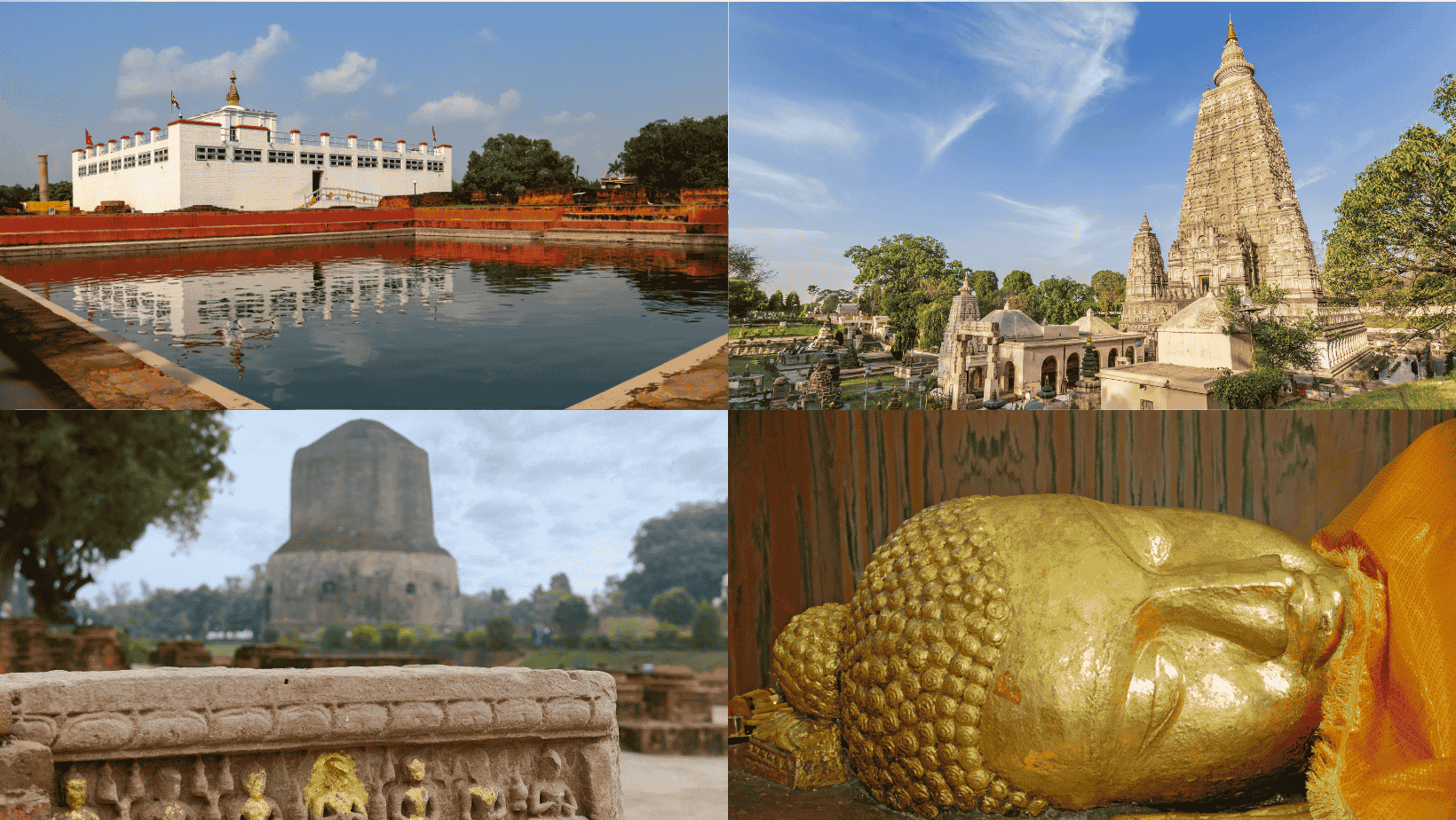
The four holy sites of Buddhism are Lumbini in Nepal, where the Buddha was born; Bodh Gaya in India, where he attained enlightenment; Sarnath, where he gave his first sermon; and Kushinagar, where he attained Mahaparinirvana. The Buddha himself named these 4 places of pilgrimage in the Mahaparinibbana Sutta.
Every year, thousands of pilgrims from Thailand and across the world walk in the footsteps of the Buddha. For many, it is the journey of a lifetime — a dream saved for over many years, carried in the heart long before it is carried in the feet. The four holy sites of Buddhism are the heart of this journey. These are not simply tourist destinations. They are the 4 places the Buddha himself asked his followers to visit with devotion. In this guide, we walk through each sacred site — Lumbini, Bodh Gaya, Sarnath, and Kushinagar — what happened there, what a pilgrim experiences today, and how to visit all 4 in one blessed circuit across India and Nepal.
Why These Four Places? The Buddha’s Own Words
Shortly before his passing, the Buddha spoke to his beloved attendant, Venerable Ananda. He named 4 places that a faithful follower should visit and regard with reverence: the place of his birth, his enlightenment, his first teaching, and his final Nibbana. This teaching is recorded in the Mahaparinibbana Sutta of the Pali Canon — the same scripture chanted in temples across Thailand today.
This is why the four holy sites are called, in Pali, the Samvejaniya Thanani — or, in the Thai tradition, the Sangwechaniyasathan (สังเวชนียสถาน). Visiting them is not sightseeing. It is an act of merit, reflection, and gratitude. Pilgrims often describe a feeling that words cannot hold — tears under the Bodhi Tree, silence at Kushinagar, joy at Lumbini. The sites awaken samvega: the spiritual urgency that turns the heart toward the Dhamma.
Suggested Image: Pilgrims chanting beneath the Bodhi Tree at dawn
Caption: “Thai pilgrims offer morning chanting at the Mahabodhi Temple, Bodh Gaya”
1. Lumbini, Nepal — Where the Buddha Was Born
In the gardens of Lumbini, over 2,600 years ago, Queen Maya Devi gave birth to Prince Siddhartha. Today, the sacred garden holds the Maya Devi Temple, the Ashokan Pillar that marks the exact spot, and the peaceful Puskarini pond. Around it stands a remarkable monastic zone, where Thailand, Myanmar, Sri Lanka, and many other nations have built beautiful monasteries. Many Thai pilgrims feel especially at home at the Royal Thai Monastery, gleaming white in the morning sun. Read more on our Lumbini page [link: /lumbini-the-sacred-birthplace-of-buddha/].
Practical tip: Lumbini lies just across the India–Nepal border. Most nationalities receive a Nepal visa on arrival at the Sunauli crossing; carry passport photos and USD for the fee. October to March offers the gentlest weather.
2. Bodh Gaya, India — Where Enlightenment Dawned
Bodh Gaya in Bihar is the holiest place in the Buddhist world. Here, seated beneath the Bodhi Tree, Prince Siddhartha became the Buddha — the Awakened One. The magnificent Mahabodhi Temple, a UNESCO World Heritage Site, rises beside a living descendant of that very tree. Pilgrims circumambulate the temple, meditate under the tree’s shade, and offer lotus flowers where the greatest awakening in history took place. Our Bodh Gaya tour package [link: /bodh-gaya-tour-package/] includes quiet early-morning time at the temple, before the crowds arrive.
Practical tip: Dress modestly and remove shoes before entering the temple precinct. Dawn and dusk are the most peaceful hours, when chanting from many nations mingles in the evening air.
Suggested Image: Mahabodhi Temple reflected in the Muchalinda pond
Caption: “The Mahabodhi Temple at Bodh Gaya, the site of the Buddha’s enlightenment”
3. Sarnath, India — Where the Dhamma Was First Taught
Just 10 km from Varanasi lies Sarnath, the deer park where the Buddha gave his first sermon to 5 ascetic companions — setting the Wheel of Dhamma in motion. The mighty Dhamek Stupa marks the spot. Nearby stand the ruins of ancient monasteries, the Ashokan lion capital (now India’s national emblem), and the serene Mulagandha Kuti Vihara with its famous frescoes. Combine it with the sacred city on the Ganges through our Sarnath–Varanasi tour [link: /sarnath-varanasi/].
Practical tip: Allow half a day for Sarnath, including the excellent archaeological museum. Many pilgrim groups chant the Dhammacakkappavattana Sutta together before the Dhamek Stupa — a moment few ever forget.
4. Kushinagar, India — Where the Buddha Attained Mahaparinirvana
In a quiet grove of sal trees at Kushinagar, the Buddha lay down between two trees and passed into Mahaparinirvana at the age of 80. The Mahaparinirvana Temple shelters a deeply moving 6-metre reclining Buddha statue, draped in golden robes offered by devotees. The Ramabhar Stupa nearby marks his cremation site. Many pilgrims say Kushinagar touches them most deeply of all — a place of stillness, gratitude, and gentle tears. See our Kushinagar tour [link: /kushinagar/].
Practical tip: Sit quietly for some minutes before the reclining Buddha rather than only photographing it. Kushinagar now has its own international airport, making arrival easier than ever.
Suggested Image: The reclining Buddha at Mahaparinirvana Temple, Kushinagar
Caption: “The reclining Buddha of Kushinagar, draped in robes offered by pilgrims”
How to Visit All Four Holy Sites in One Journey
The 4 sites form a natural circuit across northern India and southern Nepal, and 7–8 days is the ideal duration. A typical route begins at Bodh Gaya, continues to Sarnath and Varanasi, then Kushinagar, crosses into Nepal for Lumbini, and can include Sravasti and Rajgir for a complete pilgrimage. Our most-loved itinerary is the 8-Day Buddhist Pilgrimage Tour [link: /8-day-buddhist-pilgrimage-tour/], designed over 25+ years of guiding Thai and international pilgrim groups. Explore all options on our Buddhist tour packages page [link: /buddhist-tour-packages-india/], or begin with the full 48-site pilgrimage guide [link: /buddhist-pilgrimage-guide-india-nepal/].
Travelling with a dhamma-literate guide changes everything. Distances between sites are long, border formalities need care, and each site’s meaning deepens immeasurably when explained by a guide who knows both the history and the heart of the teaching — in your own language.
Frequently Asked Questions
Q: How many days do I need to visit the four holy sites of Buddhism?
A: Plan 7–8 days for a comfortable, prayerful pace covering all 4 sites plus Varanasi. Shorter trips are possible but feel rushed at the sacred places.
Q: What is the best time of year for this pilgrimage?
A: October to March, when the weather across the Buddhist circuit is cool and pleasant. Buddha Purnima (the April–May full moon) is deeply auspicious but hot.
Q: Is Thai food and a Thai-speaking guide available?
A: Yes. We provide Thai-speaking, dhamma-literate guides and arrange pure vegetarian, Thai-friendly meals throughout the journey — a comfort our guests from Thailand treasure.
Q: Do Thai citizens need a visa for Lumbini in Nepal?
A: A Nepal visa is available on arrival at the border for most nationalities, including Thai passport holders. We manage all border formalities for our groups.
Q: Can elderly parents join this pilgrimage comfortably?
A: Yes. Our itineraries use a patient pace, comfortable vehicles, and carefully chosen hotels. Many guests bring parents; see why pilgrims choose us [link: /why-choose-prime-value-tours/].
Begin Your Sacred Journey
If this guide has stirred something in your heart, perhaps the time is right. At Prime Value Tours, we have walked alongside Buddhist pilgrims for over 25 years — from the Bodhi Tree in Bodh Gaya to the peaceful gardens of Lumbini. We would be honoured to plan your pilgrimage to the four holy sites. Reach out to us [link: /plan-your-trip/] — there is no obligation, only a conversation about what your journey could look like.