
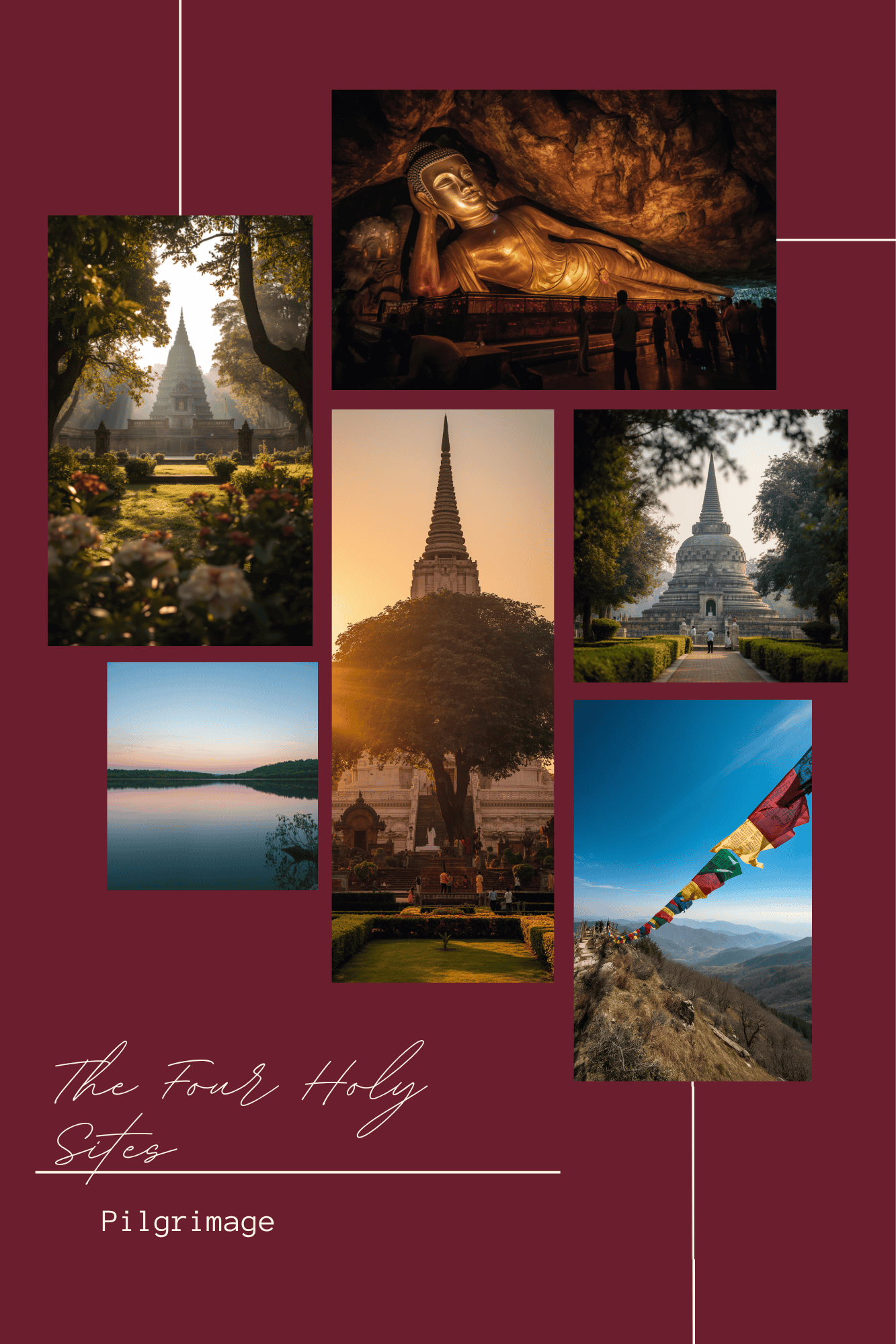
Somewhere in every Buddhist heart there is a quiet wish to stand where the Buddha stood. Not to read about it. To stand there. To touch the same earth, breathe the same river air, and sit beneath the descendant of the same tree.
That wish has a map. The 8 great holy places of Buddhism — known in Pali as the Attha Maha Thana — are the eight sites where the most significant events of the Buddha’s life took place. They stretch across northern India and southern Nepal, and together they form the oldest continuous pilgrimage route in the world.
This guide walks you through all eight sites, explains why four of them carry special weight, and sets out a practical route from India to Nepal — with honest advice on seasons, distances, and how long you really need.
What Are the 8 Great Holy Places (Attha Maha Thana)?
The tradition of the eight great places comes from the Buddha’s own words. In the Mahaparinibbana Sutta, in his final days at Kushinagar, the Buddha was asked what devoted followers should do after he was gone. He named four places that a person of faith should visit and regard with reverence.
Later tradition — recorded in the Pali commentaries and in the accounts of the Chinese pilgrims Faxian and Xuanzang — added four more sites, each marking a great miracle or a turning point in the Buddha’s teaching life. Together these became the Attha Maha Thana, the eight great holy places.
The 4 Primary Sites Named by the Buddha
These four mark the birth, the awakening, the first teaching, and the passing. They are the heart of the pilgrimage, and no serious itinerary omits any of them.
- Lumbini — where the Buddha was born
- Bodh Gaya — where he attained enlightenment
- Sarnath — where he gave his first sermon
- Kushinagar — where he entered Mahaparinirvana
The 4 Additional Sacred Sites
These four were added by tradition. Each commemorates a great miracle or a moment of profound compassion.
- Shravasti — the Twin Miracle
- Sankasya — the descent from Tavatimsa heaven
- Rajgir — the taming of the elephant Nalagiri
- Vaishali — the announcement of his coming Parinirvana
Most pilgrims who have three or four days visit only the primary four. Pilgrims with 10 days or more can complete all eight. Knowing this distinction early makes planning much easier — and it is a distinction many tour listings quietly skip over.
Suggested Image: A wide view of the Mahabodhi Temple at dawn with pilgrims circumambulating Caption: The Mahabodhi Temple in Bodh Gaya, the second of the 8 great holy places and the spiritual centre of the Buddhist world.
The Four Primary Sites: Where the Buddha’s Life Turned
Lumbini, Nepal — The Birthplace
In a garden in the Terai plains of southern Nepal, Queen Maya Devi gave birth beneath a sal tree. Today the Maya Devi Temple shelters the marker stone believed to indicate the exact spot, alongside ancient brick foundations.
Just outside stands the Ashokan pillar, erected around 249 BCE. Its inscription records that Emperor Ashoka came here in person and exempted the village from tax. It is the single strongest piece of archaeological evidence for the Buddha’s birthplace anywhere.
Beside the temple lies the Puskarini, the sacred pond where Maya Devi is said to have bathed. The wider monastic zone holds temples built by Buddhist nations from across Asia — including a graceful Thai monastery in white marble that Thai pilgrims often find deeply moving.
Practical tip: Lumbini is at its most peaceful in the early morning, before tour groups arrive. Allow one full day, and dress modestly — shoulders and knees covered — as at all eight sites.
Bodh Gaya, Bihar — The Enlightenment
This is the still point of the entire Buddhist world. Beneath the Bodhi Tree, after years of searching, Siddhartha Gautama became the Buddha.
The Mahabodhi Temple, a UNESCO World Heritage Site, rises 55 metres beside the tree. At its base sits the Vajrasana, the diamond throne — a polished sandstone slab placed by Ashoka to mark the spot of the awakening. Pilgrims meditate here through the night, and in the winter months the air fills with chanting in a dozen languages at once.
Bodh Gaya also holds Wat Thai Buddhagaya, established in 1957 — the first foreign monastery built in the town, and a natural gathering point for Thai pilgrims.
Practical tip: Give Bodh Gaya two nights, not one. Most pilgrims say the second morning is when the place truly opens for them.
Suggested Image: Monks in saffron robes seated in meditation beneath the Bodhi Tree Caption: Pilgrims meditate beneath the Bodhi Tree at Bodh Gaya, where the Buddha attained enlightenment.
Sarnath, Uttar Pradesh — The First Sermon
Ten kilometres from Varanasi, in a deer park once called Isipatana, the Buddha found his five former companions and taught them the Four Noble Truths. This was the Dhammacakkappavattana Sutta — the turning of the wheel of dhamma — and the moment the Sangha was born.
The great Dhamek Stupa still stands, 43 metres of brick and carved stone. Nearby are the ruins of the Mulagandhakuti Vihara and another Ashokan pillar. The Sarnath Museum holds the famous lion capital that became India’s national emblem.
Practical tip: Sarnath pairs naturally with Varanasi. A sunrise boat ride on the Ganges followed by a morning at Sarnath is one of the finest days on the whole circuit.
Kushinagar, Uttar Pradesh — The Parinirvana
Here, between two sal trees, the Buddha lay down on his right side and passed into final nirvana. The Mahaparinirvana Temple houses a 6-metre reclining Buddha carved from a single block of sandstone in the 5th century. Pilgrims drape it in golden robes.
A short walk away is the Ramabhar Stupa, raised over the site of his cremation. It is quieter than the temple, and many pilgrims find it the more affecting of the two.
Kushinagar now has its own international airport, and a Thai monastery that welcomes visitors warmly.
Practical tip: Kushinagar is small and can be covered in half a day, but an unhurried evening at Ramabhar Stupa is worth the extra night.
Suggested Image: The reclining Buddha statue at the Mahaparinirvana Temple draped in golden cloth Caption: The 5th-century reclining Buddha at Kushinagar marks the place of the Mahaparinirvana.
The Four Additional Sites: Miracles, Compassion, and Teaching
Shravasti — The Twin Miracle
The Buddha spent 24 rainy seasons here, more than anywhere else. It was at Shravasti that he performed the Yamaka Patihariya, the Twin Miracle of fire and water, before a doubting crowd.
The great site here is Jetavana, the monastery gifted by the merchant Anathapindika, who famously paid for the land by covering it in gold coins. You can still walk the foundations of the Buddha’s own dwelling, the Gandhakuti, and sit beneath the Anandabodhi tree, grown from a cutting of the original Bodhi Tree.
Practical tip: Jetavana is a garden site, green and shaded. It rewards slow walking rather than a quick photograph stop.
Sankasya — The Descent from Heaven
After teaching the Abhidhamma to his mother in the Tavatimsa heaven, the Buddha descended to earth at Sankasya on a triple stairway, accompanied by Brahma and Indra. An Ashokan elephant capital still stands on the mound, weathered but unmistakable.
An honest note: Sankasya (also written Sankissa) sits in Farrukhabad district and is the hardest of the eight to reach. There is no railway station of consequence nearby and few facilities. Many commercial itineraries leave it out entirely.
We include it when a pilgrim asks for the complete Attha Maha Thana — but it adds a long driving day, and it is fair to weigh that against your time and energy.
Rajgir — Compassion and Teaching
Ringed by five hills, Rajgir was the capital of King Bimbisara, the Buddha’s great royal patron. Here Devadatta released the maddened elephant Nalagiri to kill the Buddha — and the elephant, meeting only loving-kindness, knelt at his feet.
Climb Gridhakuta, the Vulture’s Peak, where the Buddha taught the Lotus Sutra and the Heart Sutra. The path is gentle and a chairlift serves the nearby Vishwa Shanti Stupa. Below lie Venuvana, the bamboo grove, and the Saptaparni caves, where the First Buddhist Council met after the Parinirvana.
Practical tip: Climb Gridhakuta before 8 a.m. The light is soft and the heat has not yet arrived.
Vaishali — The Last Journey
Vaishali is where the Buddha announced that he would enter Parinirvana in three months’ time. It is also where a monkey is said to have offered him a bowl of honey — an act of simple devotion remembered across the Buddhist world.
The Ashokan pillar at Kolhua is topped by a single lion facing north, towards Kushinagar. Nearby is the Relic Stupa, one of the original eight stupas built over the Buddha’s ashes. Vaishali also hosted the Second Buddhist Council, and it was here that women were first admitted to the Sangha.
Suggested Image: The Ashokan pillar at Kolhua, Vaishali, with its lion capital against an open sky Caption: The Ashokan lion pillar at Vaishali faces north towards Kushinagar, the Buddha’s final destination.
A Practical Route: 12 Days from India to Nepal
The eight sites do not sit in a neat circle. Planned badly, you will double back for hours. This sequence flows west in a single line and wastes almost nothing.
- Day 1 — Arrive Varanasi (VNS). Evening aarti on the Ganges.
- Day 2 — Sunrise boat ride, then Sarnath.
- Day 3 — Drive to Bodh Gaya (about 250 km, 6 hours).
- Day 4 — Bodh Gaya: Mahabodhi Temple, Bodhi Tree, Wat Thai.
- Day 5 — Rajgir and Nalanda; overnight Patna.
- Day 6 — Vaishali, then drive to Kushinagar.
- Day 7 — Kushinagar: Mahaparinirvana Temple, Ramabhar Stupa.
- Day 8 — Cross the Sonauli border into Nepal; arrive Lumbini.
- Day 9 — Lumbini: Maya Devi Temple, Ashokan pillar, monastic zone.
- Day 10 — Return to India; Shravasti.
- Day 11 — Sankasya, then on to Agra.
- Day 12 — Depart from Delhi.
Shorter on time? A 7-day version covering only the four primary sites — Varanasi/Sarnath, Bodh Gaya, Kushinagar, Lumbini — works beautifully and is the most popular choice among Thai groups.
Practical Information for Pilgrims
Best season: October to March. Days are clear and mild; December and January mornings can be genuinely cold in Bihar, so bring a warm layer. Avoid May and June, when temperatures pass 42°C, and July to September, when monsoon rain slows road travel.
Airports: Varanasi (VNS), Gaya (GAY), Patna (PAT), Lucknow (LKO), Kushinagar (KBK), and Gautam Buddha International at Bhairahawa (BWA) for Lumbini.
The India–Nepal border: Most groups cross at Sonauli, near Gorakhpur. Nepal offers visa on arrival for most nationalities, including Thai citizens. Indian visas must be arranged before travel — and if you leave India for Nepal and return, your Indian visa must permit multiple entries. This single detail causes more trouble than any other on the circuit.
Duration: 10 to 14 days for all eight sites. 7 to 8 days for the primary four.
Roads: Distances look short on a map and take longer on the ground. Bihar and eastern Uttar Pradesh roads are improving but remain slow. Plan for 5 to 7 hours on driving days, not 3.
Optional addition: Nalanda, the ancient Buddhist university, is not one of the eight but sits beside Rajgir and costs you nothing extra in time. Almost every pilgrim who visits is glad they did.
Suggested Image: A map illustration of northern India and southern Nepal with the eight sites marked Caption: The 8 great holy places stretch across Bihar, Uttar Pradesh, and southern Nepal.
Why Travel the Circuit with a Guide
This is not a route you improvise. The sites are scattered across two countries, three states, and hundreds of kilometres of rural road. Signage is limited, English is not always spoken, and vegetarian food is not guaranteed at every stop.
At Prime Value Tours, we have been walking this circuit with pilgrims for over 25 years from our base in Varanasi. We are recognised by the Ministry of Tourism, Government of India and are a member of IATO, the Indian Association of Tour Operators.
What that means in practice:
- Thai-speaking, dhamma-literate guides who can explain a site in your own language and chant with your group
- Vegetarian and Buddhist-friendly meals arranged in advance at every stop
- Monastery access and chanting sessions arranged where possible
- Border formalities at Sonauli handled for you
- Realistic scheduling that leaves room for meditation, not just photographs
You can read more about our approach on our Why Choose Prime Value Tours page, or browse our Buddhist tour packages for India.
Frequently Asked Questions
Q: Do I need to visit all 8 great holy places, or are four enough? A: Four are enough. The Buddha himself named only Lumbini, Bodh Gaya, Sarnath, and Kushinagar. The other four were added by later tradition and are wonderful if you have the time, but a pilgrimage to the primary four is complete and traditional in every sense.
Q: How many days do I need for the full Attha Maha Thana circuit? A: Plan 10 to 14 days for all eight sites, allowing for real driving times. The four primary sites can be covered comfortably in 7 to 8 days. Our pilgrimage guide for India and Nepal sets out both options in detail.
Q: Are Thai-speaking guides available throughout the circuit? A: Yes. This is our particular strength. Our Thai-speaking guides are trained in dhamma as well as history, so they can lead chanting, explain the significance of each site, and answer questions about practice — not simply recite dates.
Q: Is vegetarian food available at every site? A: Yes, but it needs to be arranged. Bodh Gaya, Sarnath, and Lumbini have good vegetarian options. Smaller sites such as Shravasti, Vaishali, and Sankasya have very little, so we arrange meals in advance for every stop.
Q: What should I wear at the sacred sites? A: Modest clothing with shoulders and knees covered. White is traditional for lay pilgrims and is widely worn. You will remove your shoes at every temple, so slip-on footwear and a pair of socks will make your days much easier. More answers are on our FAQ page.
Begin Your Sacred Journey
If reading this has stirred something quiet in you, perhaps the time is right.
For more than 25 years we have walked these roads alongside pilgrims — from the Bodhi Tree at Bodh Gaya to the still garden at Lumbini where it all began. We know which mornings are best, which stretches are long, and where to stand when the chanting starts.
We would be honoured to help you plan your pilgrimage.
Reach out to us — there is no obligation, only a conversation about what your journey could look like.